

This week in Taxtech
Looks like holiday mode has been activated across the industry so news is realtively thin and i’ve been heads down working on a major upgrade for the newsletter that I know you’re going to love!
I’ve also been scouring the space trying to find some additional upcoming events over the summer without a great deal of luck, hwowver I did find 2 interesting webinars from Fonoa and Fintua. In lieu of much scheduled activity here, I’m wondering if you all would value an increased online learning program for august, let me know by clicking below:
Outside of this i’ve been seeing a lot of promotion around the new California SaaS taxability legislation SB122, like this one from Anrok . This would have been just the thing that got my sales and marketing teams excited previously and it got me thinking about how it actually impacts the wider market and how I can help put buyers and sellers together, which is after all the mission of the nexus.
So below is the main article, if anyone wants help directly connecting to buyers or sellers, message me here…
⭐ California’s SaaS Tax: SB 122, Nexus Creation, and the Next Tax Tech Demand Wave
Executive summary
California just turned one of the largest software markets in the world into a new SaaS tax event. That is the signal. The noise is everything else.
SB 122 matters because it does two things at once. It expands California sales and use tax to digital prewritten software and SaaS from 1 January 2027, and it makes SaaS revenue count toward California’s existing $500,000 economic nexus threshold for remote sellers. The first point changes taxability. The second creates the market opportunity.
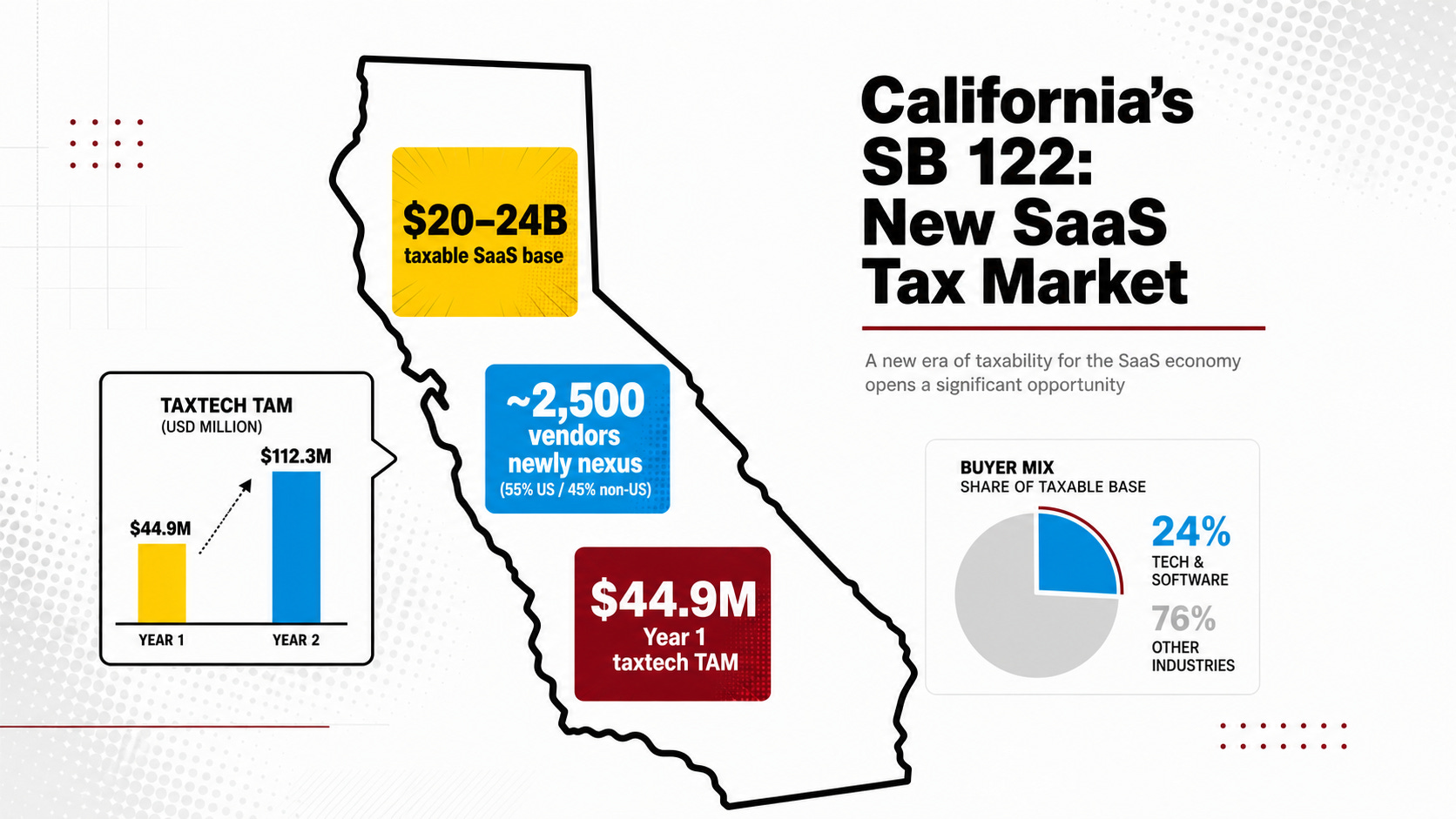
Using the state’s own revenue assumptions, California appears to be targeting roughly $20 billion to $24 billion of annual taxable software and SaaS spend. A base-case model suggests roughly 2,520 newly nexus-triggered SaaS vendors globally, with 1,386 in the U.S. and 1,134 outside it . That in turn creates a California-only Year 1 tax technology TAM of roughly $44.9 million, where Year 1 includes registrations, filing setup, and engine or configuration projects, followed by a much smaller Year 2 TAM of roughly $4.5 million that is mostly onward filing and recurring compliance work.
The vendors best placed to benefit are not necessarily the vendors with the deepest enterprise tax stacks. Major suites such as Vertex, Thomson Reuters, Sovos, and Avalara have the scale and product depth to capture complex downstream work, but the challenger cohort - including Kintsugi, Anrok, Sphere, Numeral, and Taxwire — is structurally closer to the newly triggered, digital-native SaaS vendor base that SB 122 is most likely to activate first.
The bigger punchline sits one layer out. California is not another Wayfair, but it could be the most important SaaS tax precedent since Wayfair created the current nexus framework. If additional non-taxing states adopt California-style SaaS treatment, the California-only TAM model scales into a much larger multi-state opportunity.
Overview of SB 122
Starting on 1 January 2027, California will apply sales and use tax to digital prewritten software, including software accessed remotely as SaaS. The old distinction between software delivered on physical media and software delivered remotely is effectively gone.
The statewide base rate remains 7.25%, with local district taxes increasing the effective rate depending on customer location. Custom software remains exempt, which means some services-heavy and modification-heavy statements of work still sit outside the taxable base, but most standard subscription software sold into California becomes taxable.
For operators, this is not just a rate change. It is a product-taxability, billing, contracting, data, and filing problem arriving on a fixed deadline.
Place in the context of Wayfair
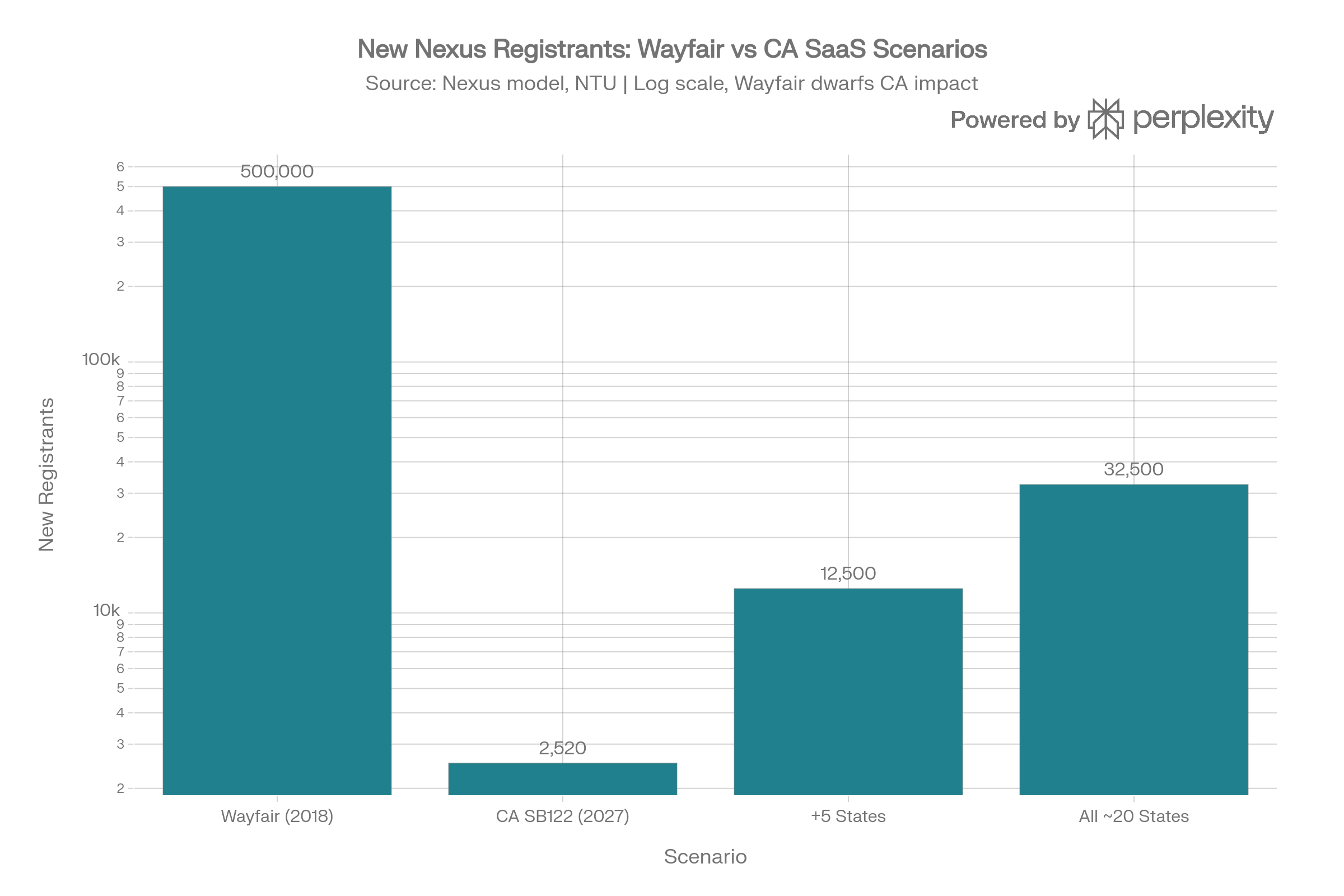
Wayfair was the structural reset. It changed who states could tax by allowing economic nexus without physical presence, and it touched remote commerce across the U.S. economy. Revenue estimates tied to Wayfair commonly referenced $8.5 billion to $13.4 billion of previously uncollected tax and a registration wave measured in the hundreds of thousands.
SB 122 is smaller, but sharper. It does not create a new nexus doctrine. It changes what counts inside California’s existing nexus framework by making SaaS revenue taxable and countable. That is why the effect is measured in thousands of vendors, not hundreds of thousands.
It is still strategically important because California is not a marginal state in software. It is one of the biggest software buying markets anywhere. When California flips from exempt to taxable, the market notices.
Tax revenue estimates and implied SaaS spend
California’s own numbers provide the clearest anchor. The state projects roughly $900 million of annual General Fund revenue and $1.1 billion of local sales tax revenue once SB 122 is fully in effect, or about $2.0 billion annually in total.
Back into that using a blended effective rate of roughly 8.5% to 10%, and the implied taxable software and SaaS base lands at about $20 billion to $24 billion per year. That is the spend pool the state appears to believe it can reach.
For tax technology vendors, that number matters less as a forecasting endpoint than as a confidence signal. California has effectively told the market that the taxable base is large enough to justify major policy change and meaningful enforcement attention.
Modelled new SaaS vendor nexus estimates
The key commercial mechanic is the nexus threshold. California already has a $500,000 economic nexus rule for remote sellers, but SaaS revenue historically did not count because SaaS was not taxable. SB 122 changes that.
Using a global SaaS company base of roughly 42,000 and applying filters for meaningful California exposure, likely absence of existing California nexus, and the probability of crossing the threshold once SaaS is included, the base-case model produces about 2,520 newly nexus-triggered SaaS vendors globally. The low-high range runs from roughly 1,260 to 4,410.
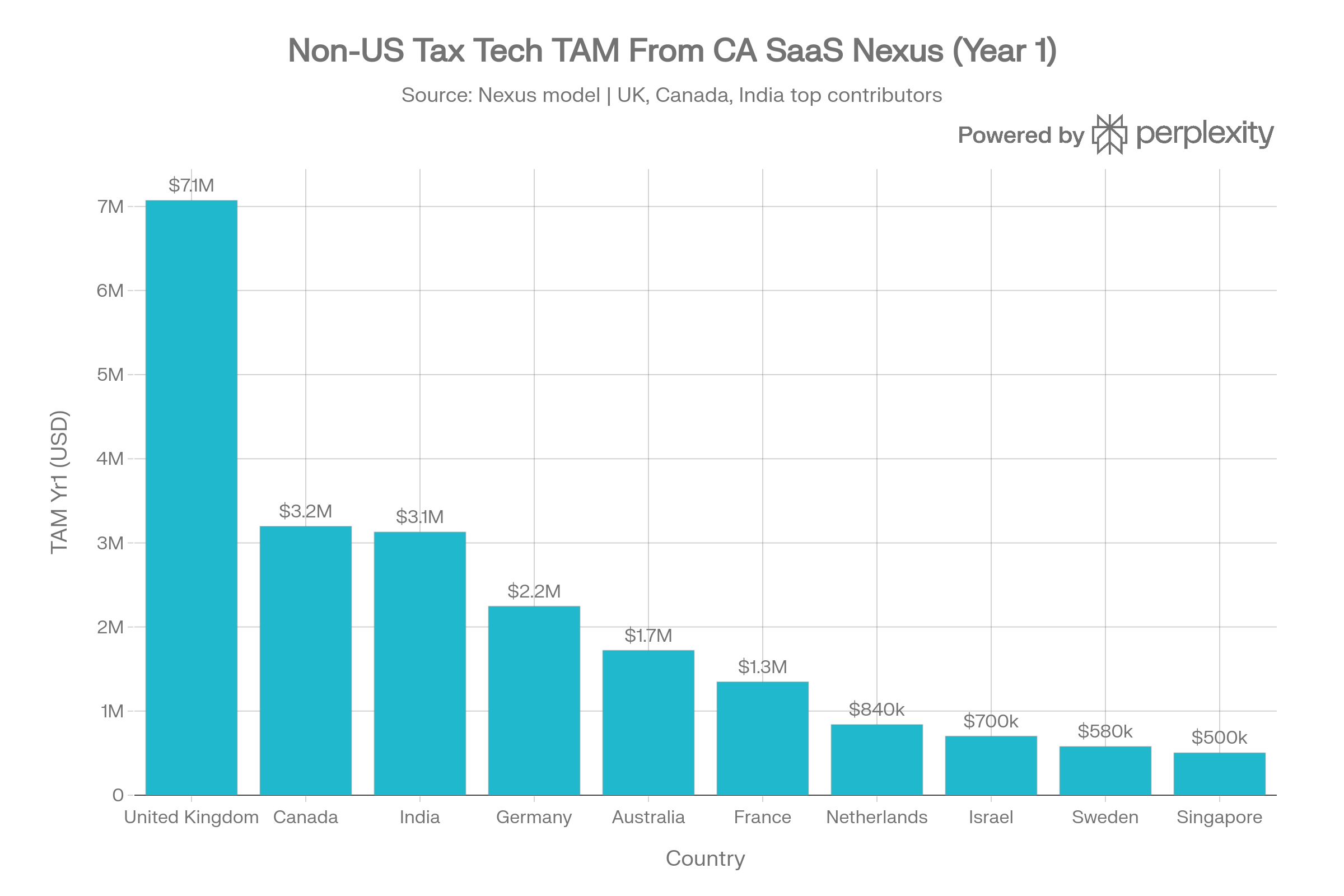
That wave is not just domestic. In the base case, roughly 1,386 vendors are U.S.-based and 1,134 are non-U.S. vendors . The largest non-U.S. contributors are the United Kingdom, Canada, India, and Germany.

Tax technology TAM methodology and estimates
The California-only TAM model is intentionally simple and operator-friendly. Year 1 includes the first-wave spending categories that are most likely to activate once a vendor becomes taxable in California: registration, filing setup, tax engine configuration, taxability mapping, billing and ERP changes, and adjacent quote-to-cash or contracting work. Year 2 strips the model back to onward filing and recurring compliance activity, which is why it is much smaller.
The calculation logic works in three steps. First, estimate the newly nexus-triggered vendor count by filtering the global SaaS company base for meaningful California exposure, then removing vendors likely to already have California nexus from other taxable activity, then applying a threshold-crossing assumption once SaaS revenue becomes countable. Second, apply an average Year 1 activation spend per newly triggered vendor covering registration, setup, engine configuration, and adjacent workflow changes, plus a smaller recurring Year 2 filing and compliance spend. Third, aggregate those vendor-level assumptions across the low, base, and high scenarios to produce total TAM.
In formula form, the simplified model is: new nexus vendors × average Year 1 activation spend = Year 1 TAM, and new nexus vendors × average recurring compliance spend = Year 2 TAM . This is important because SB 122 is less about selling entirely new tax engines into greenfield accounts than about expanding existing tax operations into a newly taxable category. The real prize is the implementation wave, not the annuity.
A practical way to read the base case is this: California creates roughly $44.9 million of Year 1 TAM and roughly $4.5 million of Year 2 TAM, with the gap between those numbers representing the one-time surge in activation work . That is why timing matters. The market is likely to be most intense in the run-up to 1 January 2027 and the first filing cycles after go-live.
For buyers, the practical implication is straightforward: the first-year cost of getting California right is likely to be lumpy rather than linear . A newly nexus-triggered SaaS vendor should expect a Year 1 spend envelope that combines registration, initial returns setup, tax engine or billing configuration, and some level of advisory or implementation support, with the base-case model implying an average cost in the high four figures to low five figures per affected vendor before settling into a much smaller ongoing annual filing and compliance cost in Year 2. In plain terms, this is more likely to feel like a short activation project than a simple filing fee.
Breakdown by vendor geography
The geography split is part of the signal. This is not just a California-to-U.S. compliance story. It is also a cross-border software revenue story.

The UK leads the non-U.S. group because it combines one of the largest SaaS vendor bases outside the U.S. with strong export orientation into California and the wider U.S. enterprise market. Canada, India, and Germany follow for different reasons: Canada for U.S. commercial adjacency, India for sheer SaaS scale, and Germany for enterprise software density.
Breakdown by main buyer verticals and main vendor categories
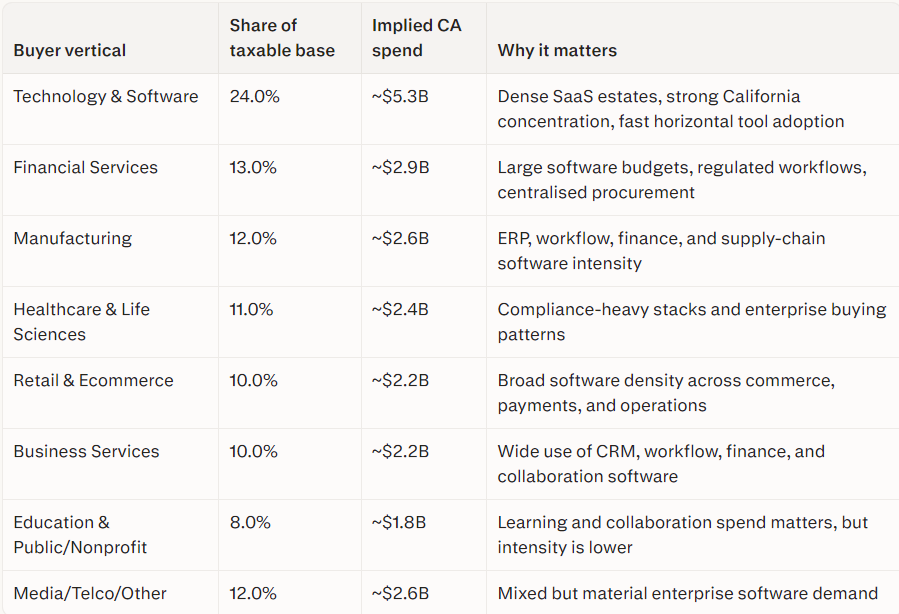
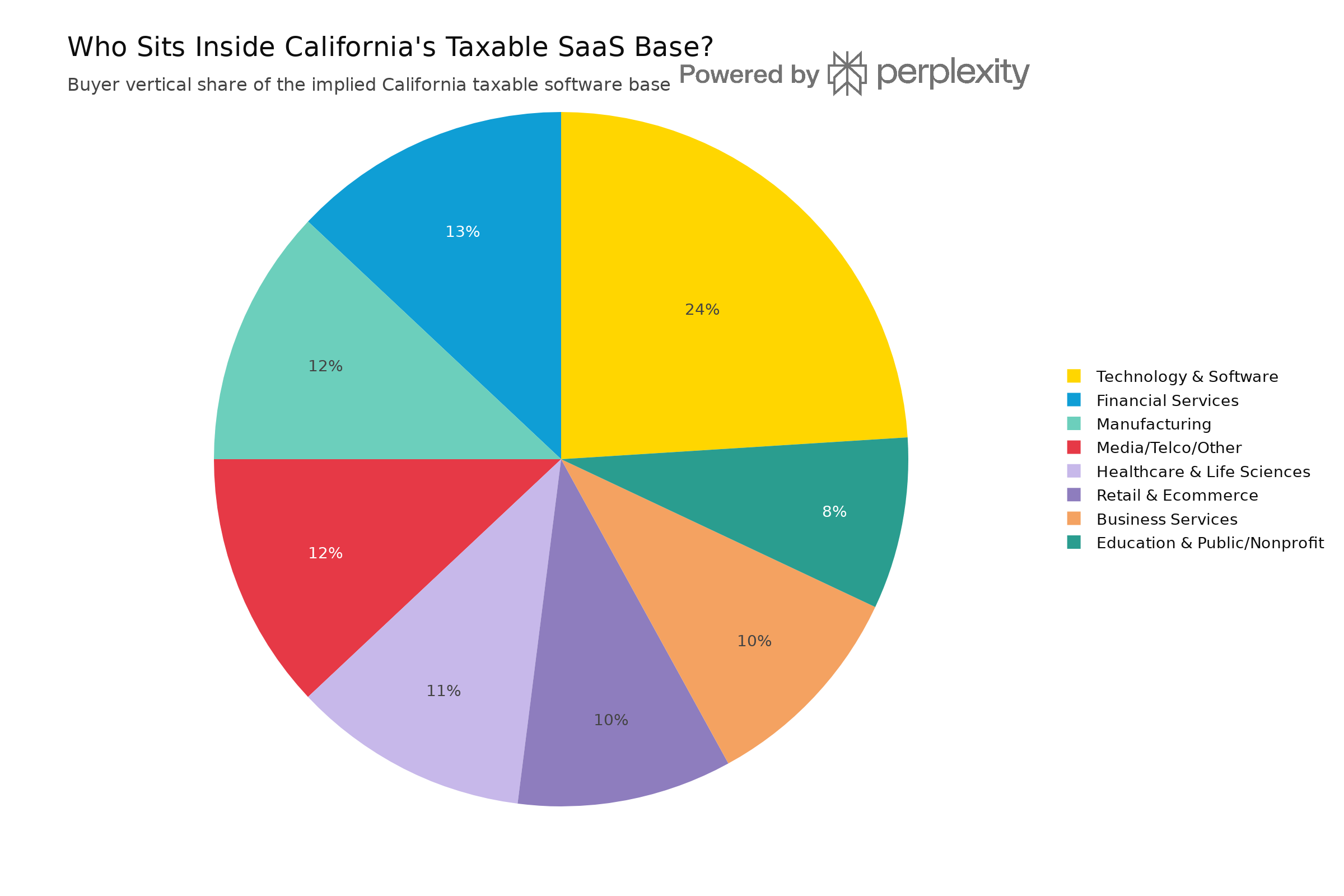
The buyer-side story is not evenly distributed. Some sectors sit at the centre of the California software tax event because they buy more enterprise SaaS, centralise procurement more aggressively, and rely more heavily on software categories that will now become taxable.
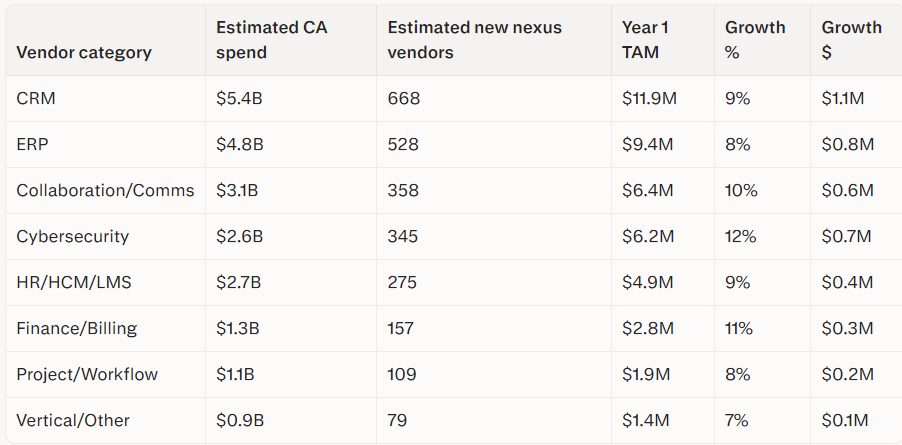
On the vendor category side, CRM and ERP dominate by spend, while cybersecurity has one of the strongest dispositions toward nexus triggering because many security vendors sell internationally into U.S. enterprises at relatively high contract values. HR/HCM/LMS matters more than it might look at first glance because learning, onboarding, compliance training, and workforce development are increasingly part of a wider employee-software estate rather than a standalone niche. The added growth lens sharpens the commercial picture: cybersecurity and finance/billing screen as the fastest-growing slices of the SB122-created opportunity, while CRM and ERP remain the biggest in absolute dollars.
Positioning of tax technology vendors to capture the market
The SB 122 opportunity is unevenly distributed by vendor positioning. That is where the market gets interesting.
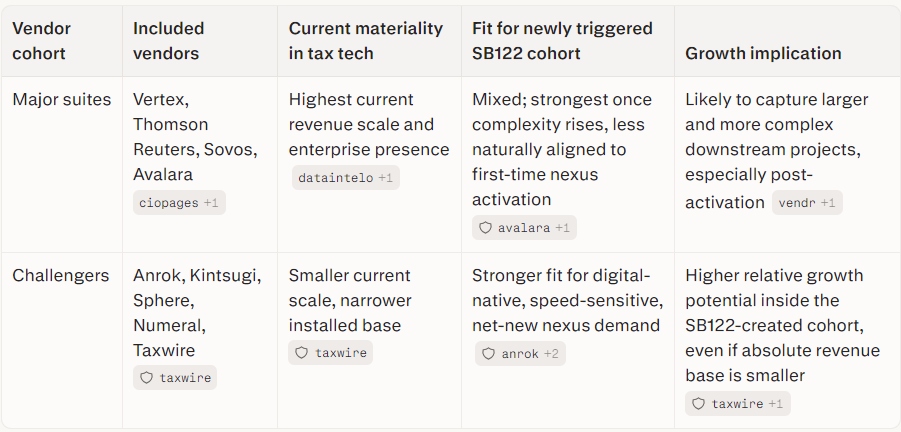
The major suites — Vertex, Thomson Reuters, Sovos, and Avalara — bring brand recognition, product breadth, and stronger fit for complex indirect tax environments. But that does not mean they are equally well placed to capture the first wave of newly nexus-triggered SaaS vendors. Vertex, Thomson Reuters, and Sovos are stronger where the use case is already complex, cross-border, ERP-heavy, or embedded in a broader tax operating model. Avalara is better positioned than the other large suites for the earlier activation layer because it has more natural reach across SMB, mid-market, registrations, returns, and quicker deployment patterns.
The challenger cohort should be treated as one strategic group here: Anrok, Kintsugi, Sphere, Numeral, and Taxwire. These vendors are structurally closer to the digital-native SaaS cohort likely to be created by SB 122 because they are more aligned to lighter implementations, faster onboarding, registration-led motions, and software-native workflows.
The commercial implication is not that challengers are bigger today, the implication is that they may have higher growth potential inside the specific slice of demand SB 122 creates, because that slice is more likely to resemble a newly activated SaaS compliance workflow than a full enterprise tax transformation programme. Major suites are still likely to capture the higher-complexity and larger-account work, especially after the first wave, but challengers appear better placed to win speed-sensitive, digitally native, net-new nexus demand in the first phase.
States with and without SaaS taxability — and why that changes the TAM story
California matters more because it is not arriving into a blank map. As of 2025-2026, around 24 to 25 U.S. jurisdictions tax SaaS in some form, while a meaningful group of states still generally does not, and five states have no statewide sales tax at all. California flipping from non-taxable to taxable is therefore not just a local revenue event. It is one of the largest green-to-blue moves left on the map.
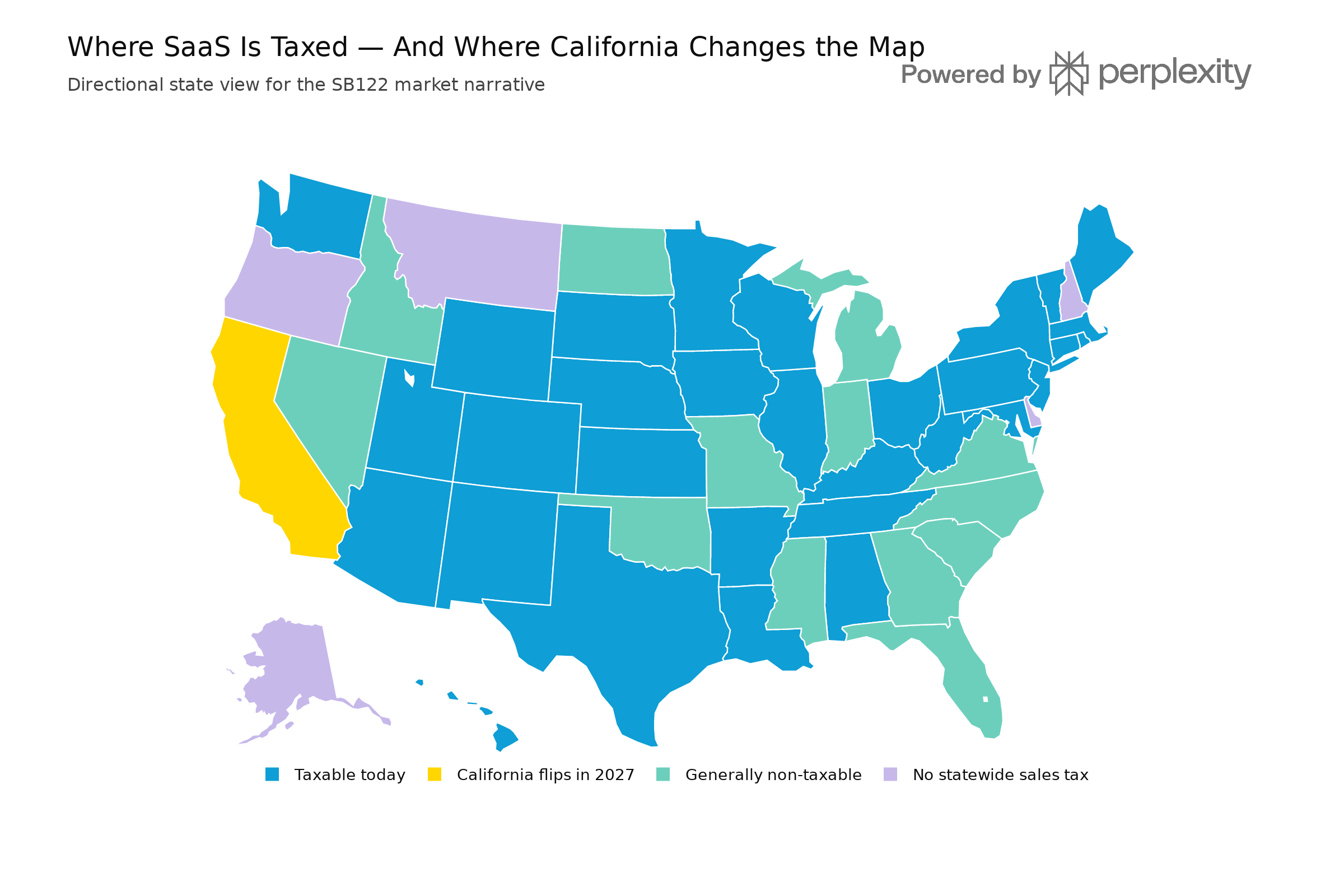
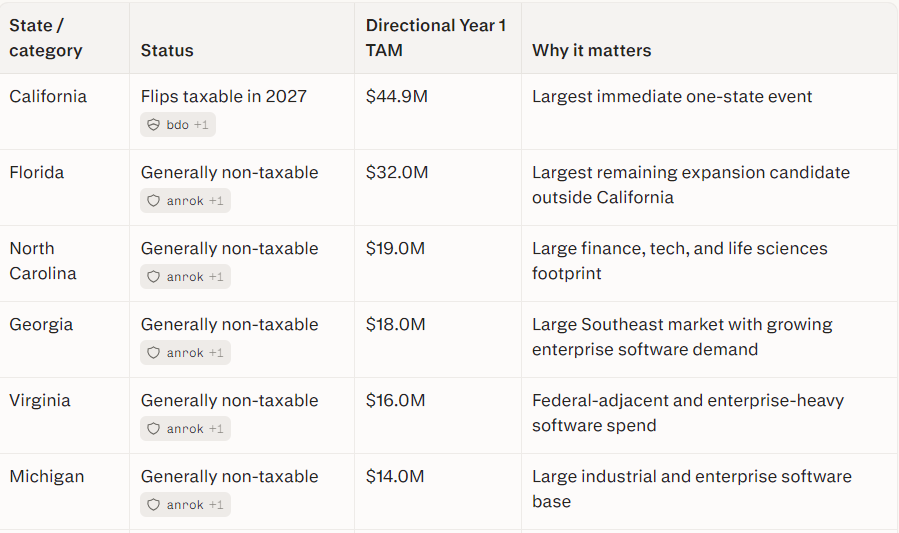
That matters for TAM because the California model scales. If one of the biggest software markets in the country moves into the taxable column, it sharpens the case for further moves elsewhere and gives tax technology vendors a working playbook for registration, configuration, and filing activation. Earlier modelling suggested that if five additional large states adopted California-style SaaS treatment, the Year 1 TAM could rise into the $180 million to $270 million range, and if the remaining non-taxing states followed over time, the Year 1 TAM could reach roughly $450 million to $720 million.
The state map therefore is not just descriptive. It is a forward-looking TAM lens. Every grey state is a potential future California, and California has just become the most visible proof point in the market.
Larger states still left to implement matter most. Florida, North Carolina, Georgia, Virginia, and Michigan stand out because they combine economic scale, meaningful enterprise software spend, and enough seller volume to create a noticeable second-wave TAM if they follow California’s lead.
Conclusions
SB 122 is not another Wayfair. It does not need to be. It is the clearest state-level SaaS tax expansion with real commercial force in one of the largest software markets anywhere.
The base-case signal is clear: roughly 2,520 newly nexus-triggered SaaS vendors globally, a California-only Year 1 TAM of roughly $44.9 million, a much smaller Year 2 TAM once the implementation wave passes, and a split of demand that is material both inside and outside the United States .
The strategic split is just as clear. CRM, ERP, cybersecurity, collaboration, and HR/HCM/LMS sit at the heart of the category opportunity; technology, financial services, manufacturing, healthcare, and retail sit at the heart of the buyer-side opportunity; and challengers may be better positioned than some major suites to capture the first wave of newly activated demand.
California has moved one of the biggest software markets in the country from exempt to taxable. The vendors that treat that as a filing update will miss the point. The vendors that treat it as an activation moment will not.
Implications and recommendations for buyers
For buyers — meaning SaaS vendors that will newly incur California nexus or enterprises that will feel the impact through vendor invoices and procurement workflows — the practical implications are immediate.
Treat this as a revenue-operations issue, not just a tax issue. Product taxability, billing logic, customer address quality, and contract language all sit upstream of the filing process.
Model exposure now, not in Q4 2026. The key question is whether California SaaS revenue pushes the business over the $500,000 threshold and which product lines or bundled charges are affected.
Segment the product catalogue. Prewritten subscription software, custom work, implementation services, training, and modifications should not be treated as one bucket if the goal is defensible tax treatment and better audit posture.
Stress-test billing and quoting workflows. Businesses need to know whether tax is added cleanly at the right point in the quote-to-cash flow and whether invoices can distinguish taxable and non-taxable lines where needed.
Expect vendor conversations to change. Buyers using tax engines or tax advisors should ask explicitly how California SaaS treatment will be configured, who owns registration timing, and whether current workflows are built for a state-by-state SaaS taxability map rather than a single rule.
Use California as the template state. Even if the immediate exposure is only California, the smart move is to design the operating model for repeatability in case more states follow.
The operator-grade recommendation is simple: build for the second state while solving the first one. That is how California stops being a one-off headache and becomes a reusable compliance capability.
Recommendations for sellers (taxtech GTM)
Build target lists around SaaS vendors most likely to cross California’s $500k nexus threshold, prioritising companies with meaningful California revenue concentration and limited legacy sales‑tax infrastructure.
Focus demand generation on the highest-signal categories:
CRM and ERP for absolute dollar opportunity,
Cybersecurity and finance/billing for the fastest‑growing SB 122‑driven demand and sharpest urgency.
Think about the impacted horizontal and vertical SaaS castegories and vendors that sell into California’s taxable base, led by Tech, FS, Manufacturing, Life Sciences, Retail.
Treat non‑U.S. SaaS vendors as a primary segment, not a side case, given the large cross‑border cohort (particularly UK, Canada, India, Germany) that is likely to newly trigger California nexus.
Build messaging that explicitly speaks to tax, finance, RevOps, and billing stakeholders together, because implementation risk and effort will sit across systems rather than inside the tax team alone.
Use California as the entry point to a broader multi‑state narrative, especially in larger non‑taxing states such as Florida, North Carolina, Georgia, Georgia, Virginia, and Michigan, where future imitation of SB 122 would materially expand TAM.
Want help engaging vendors or potential customers?

A selection of of opportunities to connect in person and interact online over the next few weeks
JULY 2026
E-Invoicing Is Coming Fast: Are Your Tax Processes Actually Ready? (Webinar)
Vertex, Inc. | 9 July 2026, 15:00–16:00 CEST | Online
A live webcast examining why SAP Document and Reporting Compliance alone isn’t enough for e-invoicing readiness, covering the process and data gaps organisations commonly overlook before mandates go live.
NAEA Tax Summit 2026 (Conference)
National Association of Enrolled Agents | 27–29 July 2026 | New Orleans Marriott, New Orleans, LA
NAEA’s flagship in-person event for tax practitioners, including a dedicated Practice Management Bootcamp track covering the tools, workflows, and automation strategies powering efficient firms today.
Prompt Engineering for Tax Teams: Hands-On AI Lab (Virtual Workshop)
TEI — Tax Executives Institute | 29 July 2026 | Virtual
A hands-on session for in-house tax professionals on applying prompt engineering techniques directly to tax workflows — practical AI skills rather than theory.
France 2026 eInvoicing: From Compliance to Operational Readiness (Webinar)
Fintua | 30 July 2026, 10:00 GMT+1 | Online
A practical session on moving from France’s e-invoicing compliance requirements to genuine operational readiness, ahead of the phased mandate taking effect from 1 September 2026 for large and mid-sized companies.
AUGUST 2026
FTA Technology Conference and Expo 2026 (Conference)
Federation of Tax Administrators | 2–5 August 2026 | St. Louis Union Station, St. Louis, MO
The premier gathering for state tax administrators, software vendors, and compliance teams — a key venue for indirect tax automation vendors engaging directly with government decision-makers on emerging requirements.
US International Tax Course 2026 (Course)
TEI — Tax Executives Institute | 3–7 August 2026 | Seattle, WA
TEI’s intensive week-long course for in-house tax professionals covering the full spectrum of US international tax — from Subpart F and GILTI through FDII, BEAT, and transfer pricing — with substantial CPE credit available.
The New Indirect Tax Technologist: A Skillset and Team Structure for the AI Era (Webinar)
Fonoa | 11 August 2026, 4:00pm CEST / 10:00am ET | Online
Tax leaders from NVIDIA, KPMG, and Fonoa discuss how to structure, hire, and upskill an indirect tax team that gets real value from AI — covering the emerging skillset and team design questions facing tax functions in the AI era.
*any organisers or events I’ve missed? please let me know.

A curated selection of blogs, white-papers and on demand content published by multiple organisartions across the landscape, organised into a themed learning path.
MONTH TWO · JULY 2026
E-Invoicing, CTC & the Live Mandate Landscape
Belgium is in full enforcement. France’s September 2026 deadline is six weeks away. Poland’s KSeF soft-landing period is closing. Norway has just accelerated its mandatory timeline. Brazil’s dual-VAT transition is live. Comarch, Basware, Marosa, Innovate Tax, and Sovos are the specialist lenses for this month — alongside Fonoa and Vertex for the platform and maturity dimensions.
Week 1 · 6–10 July
The Global CTC Landscape: What 80+ Live Mandates Actually Look Like
📖Continuous Transaction Controls: The Future of Compliance Sovos 12–15 min
📖Streamline the Future #6: Reporting Built for Global E-Invoicing Operations Comarch 8–10 min
📖2025 in Review: 5 Trends That Defined the Indirect Tax Industry Innovate Tax 8–10 min
Week total: 3 articles · ~28–35 min
Week 2 · 13–17 July
ViDA, Belgium & the European Mandate Wave
Basware’s recently confirmed accreditation as a certified French PDP (Plateforme de Dématérialisation Partenaire) makes it one of the most credible voices on France’s September 2026 mandate. The Comarch / Forrester webinar from January 2026 remains the most authoritative external analysis of the global e-invoicing technology landscape — covering GenAI, agentic AI, Peppol, and the 2026–2027 mandate timeline in 60 minutes.
📖 What is ViDA? VAT in the Digital Age Initiative Q&A Pagero (Thomson Reuters) 12–15 min
📖5 Things We Can Learn from Belgium’s 2026 E-Invoicing Mandate Innovate Tax 8–10 min
🎥E-Invoicing Trends and Obligations: 2026 and Beyond (feat. Forrester) Comarch / Forrester 60 min
Week total: 2 articles + 1 webinar · ~80–85 min
Week 3 · 20–24 July
Emerging Markets & Platform Architecture: Brazil, Norway & Building for Scale
Brazil’s 2026 CBS/IBS tax reform is the most structurally significant emerging market e-invoicing development of the year — Fonoa’s guide is the most accessible and detailed available for non-specialists. Marosa’s country monitoring brings a European VAT compliance partner’s practical lens on the mandates moving fastest right now (Norway’s just-announced acceleration, Spain’s reactivated B2B requirement). Vertex’s platform consolidation argument provides the architectural counterpoint.
📖Brazil 2026 Tax Reform: Key E-Invoicing Changes Fonoa 10–12 min
📖E-Invoicing in Norway and Latest European VAT Updates Marosa VAT 8–10 min
📖Leading the Charge: E-Invoicing as the Cornerstone of Future Compliance Vertex Inc. 10–12 min
Week total: 3 articles · ~28–34 min
Week 4 · 27–31 July
The Buyer’s Market: Evaluating VAT & E-Invoicing Tools Across the Vendor Spectrum
This week deliberately introduces the buyer’s perspective — how do you navigate a market that now runs from $49/month Quaderno for SaaS B2C through to Comarch, EDICOM, and Basware serving Fortune 500 multinationals? Kintsugi’s cross-border VAT guide maps the mid-market options clearly. The Sovos webinar provides the live regulatory update that anchors the month. Avalara’s AI webinar closes the loop on how automation is being embedded into compliance workflows in 2026.
📖8 Best Cross-Border VAT Compliance Software: 2026 Guide Kintsugi 12–15 min
🎥VAT Snapshot: From Poland to the UAE — Preparing for 2026 Mandates Sovos 45–60 min
🎥Embracing the Future of Tax Compliance with AI Avalara 45–60 min
Week total: 1 article + 2 webinars · ~102–135 min
Month Two total: 9 articles + 3 webinars · ~238–289 min
*any cool content I’ve missed? please let me know.

A selection of open roles across tax tech vendors and tax advisory/consulting businesses who are involved in tax technology.
Use the column headers to sort, or the search function and don’t forget to navigate all pages!
*I do this using an AI agent and due to the volume, I don’t check every link, so please let me know if any of these don’t work or have disappeared when you follow them.
✌ Last thoughts
Thanks again for reading! If you have any feedback, suggestions, want to contribute, share gossip or would like to work together in any way, email me here or hit the button below! And if you haven’t already, please subscribe to get The Nexus each and every Friday!