

THIS ISSUE IS PROUDLY SPONSORED BY:

Sponsors keep The Nexus independent and free: the insights, the career content, and the connections. Here’s who’s paying for this one.
Fintua is a global indirect tax technology company. Its connected platform brings VAT compliance, e-invoicing, global payments and VAT recovery together in one place, backed by nearly 30 years of VAT expertise and a fully managed service.
Want to know more, read the Fintua Special and Fintua Spotlight editions
The Week in Taxtech
Mandates: two reprieves, two deadlines
France. The SME e-invoicing moratorium didn’t survive. The Assemblée rejected the whole revenue part of PLF 2027 by 458 to 0, so amendment I-3426 lapsed with it. The Senate takes up the government’s text from 20 Nov and votes on 9 Dec. Until then, SMEs still have to issue e-invoices from 1 Sep 2027. Légifiscal
Poland. The Sejm voted 437 to 1 to push KSeF penalties back to 1 Jan 2028. They can reach 100% of the VAT on invoices issued outside KSeF. Firms still have to use KSeF; they just won’t be fined in 2027. Expect enterprise urgency to drop. Rzeczpospolita
UAE. Large taxpayers had to appoint a service provider by 30 Oct, and go-live is 1 Jan 2027. The country now has about 35,000 Peppol IDs. EnterpriseAM Indian SMB software vendor Tally says it has already onboarded 4,600+ businesses as a provider. Local players are taking the small-business end of the market before the global vendors arrive. Zawya
Saudi Arabia. ZATCA’s Wave 25 reaches businesses with more than about $50k of VAT-taxable revenue, with an integration deadline of 1 Feb 2027. That’s a long tail of small firms, and it suits local providers more than the global vendors. Arabian Business
Vendors
Vertex published the 2026 CompOps™ Index, a survey of 750 large enterprises. Only 16% treat indirect tax as a standing board item, and 73% of firms holding tax reserves say a quarter or more rests on positions they can’t substantiate. “CompOps” is Vertex trying to create a category that sells Sōl to CFOs and boards. GlobeNewswire
Avalara put out its second Aviator beta customer story in three weeks. The Lab Depot went from filing in 3 states to 31 with no new staff. Like Fran’s Chocolates, it’s a small US sales-tax customer; there’s still no enterprise reference for the agentic pitch. Avalara
Sovos is focused on the IRS switch from FIRE to IRIS, which happens on 19 Nov, and says thousands of filers already use it for the move. Its November messaging is about 1099 reporting and US sales tax, not e-invoicing. Sovos
CereTax launched SmartResearch, an AI research tool that answers only from primary law, cites its sources, and declines when the sources don’t support an answer. Answers you can check are becoming the way in. CereTax
Kintsugi’s monthly update adds a usage-based billing connector (OpenMeter), self-serve back filings, and a customer story about switching from Avalara. Kintsugi
VAT IT is partnering with Conferma, Sabre’s virtual-payments business, to pipe hotel invoice data into VAT reclaim. Conferma already has a similar deal with Fintua. In reclaim, whoever controls the travel and expenses data wins. FF News
Esker says it’s a Leader in four IDC MarketScapes, including compliant e-invoicing. Thomson Reuters, Tradeshift and Comarch make the same claim, so the badge doesn’t set anyone apart any more. Yahoo Finance
Release notes worth a line:
Deals and markets
Grant Thornton closed its $5bn all-cash purchase of CBIZ. The combined firm reports more than $7bn in revenue and 34,500+ people, which makes it a new mid-market buyer of tax tech. Accounting Today
Tallia, a London AI platform for tax research and drafting, raised a €4M seed round led by Outward VC and ICAEW. It’s the ICAEW’s first direct AI investment, and it puts Tallia up against Blue J in the UK. Dealroom
Thomson Reuters announced a new $500M buyback, smaller than last year’s $1.6B authorisation. Rivals are buying companies (Sovos, Fonoa, Alphatax) while TR buys back its own stock. PR Newswire
H&R Block’s Q1 FY27 revenue rose 10.2% to $224.3m, its usual off-season loss, and it kept full-year guidance. The real test is the 3 Dec Investor Day. SEC filing
Now for this week’s feature, one I’ve been looking forward to sharing for a few weeks now. My recent discussion with aleksandra Bal, where we covered why good tax lawyers make bad tax sofware, the proliferation of AI slop in tax and haow to trade off between risk and compliance.
🌍 Good Tax Lawyers Make Bad Tax Software: An interview with Stripe’s Aleksandra Bal
Paul Guyer in conversation with Aleksandra Bal, Tax Technology Lead, Stripe
Aleksandra Bal trained as a tax lawyer. Now she builds indirect tax solutions at Stripe, across more than 100 jurisdictions. She is studying for a master’s in applied AI, writes the Tax Engineer Substack (which you should absolutely subscribe to) , and we worked together at Vertex a few years ago.
She has distilled what she has learned into seven lessons that apply whether you are building, buying or implementing tax technology. We went through them one by one. What follows is our conversation, lightly edited for length and clarity.
One caveat up front, in my words on the call: “This isn’t a Stripe promotion. The views are our own.”
Lesson 1: Clarity never arrives
In short: You can’t research 100 countries before day one, so build for being wrong and make it cheap when you are.
Paul: Your first lesson was that clarity never really arrives. You can’t research everything up front. You have to make educated guesses, move fast and make it cheap to be wrong. What does that look like in the real world?
Aleksandra: When you build a technology solution, for example a tax engine or an e-invoicing platform, you know that your solution in the end needs to cover, let’s say, a hundred countries, but not at launch. You can’t research a hundred countries before day one. You know that the assumptions you make on day one might be wrong in the future. So you need to design for being wrong. I know it may sound counterintuitive, but you need to make it cheap to be wrong.
Make decisions reversible, make rules configurable. When you need to change a threshold, a rate or a product mapping later on, that should be a simple data change and not a rebuild, not something you need to hard code from scratch.
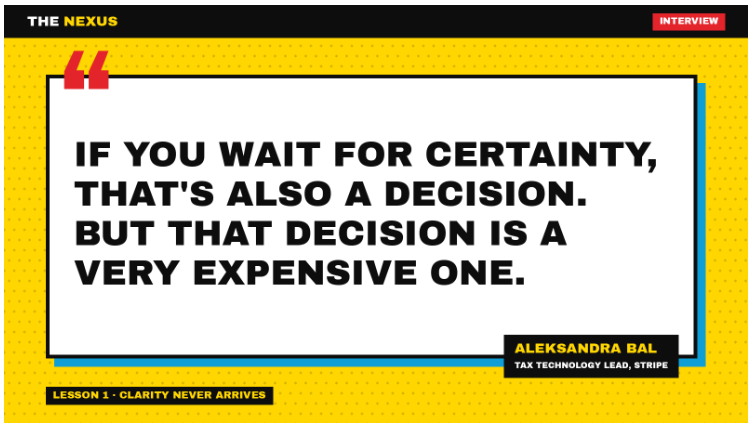
And as you mentioned, some things will never become clear, because the regulations will still be vague. So if you wait for certainty, that’s also a decision. But that decision is a very expensive one.
Paul: In tax software you’d always have the product, the features and the buttons, and then the content: legislation. Is that what you’re saying? That content is part of the architecture you design at the start?
Aleksandra: Yes, you need to think about both layers. You need to think about content, that the content may change because of changing laws and regulations. But you also need to think about your product architecture, the system architecture, so that it doesn’t hold you back, doesn’t get in the way of implementing new legislative changes.
Lesson 2: Good tax lawyers make bad tax software
In short: The adviser’s instinct to cover every exception becomes a failure to prioritise when you build software. Compliance has a cost too.
Paul: Your next lesson contains, I think, the best quote of the session: good tax lawyers make bad tax software. Tell me where that came from.
Aleksandra: I started my career as a lawyer. When you are a tax consultant, a tax lawyer, and you write a legal opinion, you want to list every exception. Because if you don’t do it, it feels like malpractice.
But when you build tax software and you want to include every exception, that is actually malpractice. That’s a failure to prioritise.
Let’s use the example of a tax engine. If it has to work across hundreds of countries, it cannot capture every country-specific nuance. So the goal is not just to eliminate risk, to be 100% accurate, but to understand which risks you can live with. And it may sound very counterintuitive, what I would say now, but compliance has a cost too. And that’s something that’s not often visible on a balance sheet.

Paul: We have this paradigm in tax where if you’re not 100% right, you’re wrong. You’re saying design for an acceptable level of risk. What does that do in practice?
Aleksandra: It means all of the things that you’ve just mentioned. It makes you faster, it makes you build faster, launch products faster.
But there is this problem that many people are of the opinion everything needs to be 100% accurate. So if you say, let’s not aim for zero risk, they are surprised. And you also need to sell it to a CFO. So the question is how to sell it.
I sell it as a trade. What it costs to prevent versus what it costs if it goes wrong. Lawyers usually optimise one variable: we want to minimise non-compliance. But when you build something, you need to look at the whole ledger. The cost of being wrong, the cost of being right, the cost of the delay and the cost of getting there. And that’s also how CFOs think. They think in terms of ledgers.
So when the last mile of compliance costs more than the exposure it removes, that’s just a bad trade.
The Nexus take: “100% accuracy, every jurisdiction” is a lawyer’s pitch. The buyers who sign next will be the ones who have done Aleksandra’s ledger. They know which exposures matter and will pay for coverage where the risk sits, not for a long tail of edge cases they’ll never hit. Vendors that help customers build that ledger will outsell vendors that only promise to make risk disappear.
Lesson 3: Think slow, act fast
In short: Planning is the cheapest phase of any project. Spend your thinking there, including a pre-mortem, before the money starts moving.
Paul: Lesson three: think slow, act fast.
Aleksandra: It’s core advice from the book How Big Things Get Done. The key message is: take your time planning things. Planning is cheap. It costs almost nothing. You start spending money once you start building. So if you make a mistake during planning, it’s cheap. If you make a mistake during the execution, it’s expensive.
You don’t want to discover missing features halfway through the execution, because then the project may get delayed, may become more expensive, and ultimately it may be cancelled. Planning is the cheapest part of the project, so don’t save money there.
Paul: Is there a methodology behind it?
Aleksandra: Think about the problem holistically: tax content, system impact, product architecture, the edge cases. Discuss it with stakeholders, because while you are building something new, you are also learning about your current system. It’s also good to do a kind of pre-mortem. Think about all possible things that can go wrong during the project. And when you are thinking about them now, they will not surprise you later on.
Lesson 4: The data model decides everything
In short: Get the foundation wrong and you live on workarounds. Test it against the hardest cases, not the easy ones.
Paul: Lesson four: the data model decides everything. If you get it wrong, you’ve got workarounds on workarounds. That sounds like a lesson born of experience.
Aleksandra: If you don’t get your data model right, you need to work around it. You need to build workarounds. Then you build workarounds on workarounds until no one really understands what’s going on. No one can see through the code.
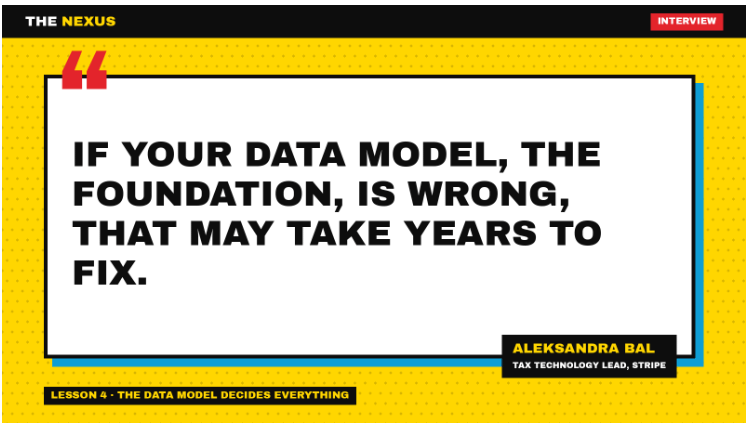
So when you scale, when you expand your product to a new jurisdiction or a new scenario, that should be just a configuration change, not a special case that you need to put in the code. Even if you have to make changes in the code, usually those changes take days. But if your data model, the foundation, is wrong, that may take years to fix.
Paul: When we sold to large enterprises, we’d always ask for their hardest scenarios, not domestic UK VAT. Is that what you mean?
Aleksandra: Yes. You need to be sure that your data model can capture all those edge scenarios. If it can’t, that’s a risk you are taking and you need to document it. That’s why it’s always good to test with the hardest scenario.
We were talking about tax engines, so test some US scenarios, because there you have plenty of taxes at each level. One transaction can carry state, county, city and district taxes at once. We also know that in the US, ZIP codes are not enough to identify the taxing jurisdiction. You need the street address.
If you are more EU-focused, we also have some special territories: the Canary Islands, Réunion, the Isle of Man, Monaco. Just check how those configurations work.
The Nexus take: For buyers, this is the least-tested part of most selection processes. Demos run on the happy path. Ask for the Canary Islands. Ask what happens when a ship-to address resolves to two jurisdictions. Then ask how many customer-specific workarounds the implementation team built last year. That answer tells you more about the data model than any architecture slide.
Lesson 5: AI is a tool, not a destination
In short: Don’t always use AI. Use it for the work you don’t want to do, and watch who ends up paying for the slop.
Paul: Lesson five is about using AI as a tool and not as a destination. Everyone’s AI native, AI first. But does that actually help the customer?
Aleksandra: I use AI a lot. I see great potential, great value in AI. But there is also rule number one of machine learning, which we can now call rule number one of AI: don’t always use AI.
There are use cases where AI is not a good fit. For example, if you want the same input to produce the same output every time. For those scenarios, where repetition and explainability are important, a traditional workflow might be a better solution. Something that is transparent, reliable and that you can audit.
Paul: Where do you see it helping in tax, and where not?
Aleksandra: AI is making tax people more productive. One of my favourite use cases is: let AI do the things that you don’t want to do. I like tax research, I like tax writing. I don’t want to outsource that to AI. What I don’t like doing is cleaning up my hard drive. Let AI do it. Don’t outsource the things you like.
But we also have the other side of AI, and that’s also got a lot of attention in the media: AI slop.
Paul: We had an interesting chat about this a while ago. You get AI to help you write a report, but it takes over. You end up with a much longer, more detailed report that you may not fully understand, because the AI designed and wrote it. Then you send it out to 20 people and give them the job of working out whether it’s useful. Is that a good definition?
Aleksandra: That’s a very good definition of AI slop. AI makes producing work cheap, but checking work very expensive. And in tax, that’s a dangerous combination, because volume is mistaken for value.
Everyone can produce anything, but that doesn’t mean that anything should be produced. Lengthy memos that could be answered with one question are being distributed. Memos refer to legislation as a decoration, because the legislation says the opposite of what the memo says. Errors are sitting inside texts that read perfectly.
And as you mentioned, the cost moves from the writer to the reviewer. Usually reviewers are your most senior, most expensive people. So companies that allow AI slop just promote what we call artificial mediocrity at the expense of expertise.

Paul: It’s the reverse of cost arbitrage. The work moves from the cheaper assets to the most expensive ones.
The Nexus take: Every vendor deck claims AI makes tax teams more productive. Few measure where the review burden lands. If a product generates more output than a senior reviewer can check, it hasn’t saved time. It has moved the cost to the most expensive line on the payroll. Ask every AI vendor three questions: who checks this, how long does it take, and what happens when it’s confidently wrong?
Lesson 6: Measure outcomes, not activity
In short: Much of the best tax work leaves no trace, and AI is making activity metrics meaningless.
Paul: Lesson six: measure the outcomes, not the activity. Is this an AI thing?
Aleksandra: It’s a little bit of an AI thing, but it’s also something else. A lot of work that tax teams do leaves no visible trace. For example, we are monitoring legislative developments which get delayed, or are not enacted at all. So you do something, you write something, but it shows up nowhere.
Often we want to measure what’s easy to measure, and these are activity metrics: AI tool usage, memos written, support tickets closed. You can see it on the monthly dashboard. The things that matter are not things you can put on a monthly dashboard: audit outcomes, post-filing corrections, or even time to deliver tax guidance to internal stakeholders.
The AI component is that artificial mediocrity makes measuring the right things much worse. When output is free, counting output measures nothing at all, because the volume of memos, of tax opinions, can triple overnight.
And AI gave rise to pseudo-experts: people with little subject matter expertise who are very confident providing guidance. They don’t read the law. They just read the AI output. It sounds right, it must be right.

Paul: In go-to-market we measure human conversations in close rates and win rates, and those become the KPIs. In tax, much of the real work is never seen: educating people, stopping problems before they happen. How do you deal with that?
Aleksandra: That’s difficult, because you cannot just say: we prevented a penalty, we prevented late payment interest, we did everything on time. So you focus on things that you can easily track, for example returns filed on time. But what if there is an audit and it turns out that the return was incorrect?
Lesson 7: Work changes faster than job descriptions
In short: Build range, bring decisions not problems, say yes to work that isn’t yours yet, and get comfortable with good enough.
Paul: The last lesson: work changes faster than job descriptions. A lot of our readers are early in their tax tech careers. What does it mean to you?
Aleksandra: At the beginning of my career I was focused on VAT, European VAT. But then my scope expanded to cover APAC, Canadian indirect taxes, and now it also covers the US. So I’m dealing with over a hundred different jurisdictions.
When the company grows and enters new business, you need to grow with it, and learn things that weren’t familiar to you at the beginning.
So if I could give some advice: build range, not just depth. Learn how systems work. Understand data models, APIs, technology concepts. Bring decisions, not problems. When you are asked to provide tax input, provide a number, a risk exposure. Don’t just say it’s not compliant, because that’s not something actionable for a product manager.
Say yes to jobs that are not yours. They will become yours in the future. And what we’ve already discussed: get comfortable with good enough. Decide what risks to accept, write them down and move on.
Paul: The easy thing is to push a problem up the chain, the same as pushing the slop. The people I’ve rated most in my teams said: we’ve got a problem, but here’s how we get through it.
Aleksandra: Yes. When you need to make a decision, always bring the options. Bring the numbers. Bring something quantifiable.
The one that matters most
In short: Problems and tools keep changing. Judgement about which risks to take does not.
Paul: If you were going to pick one of the seven, which would it be, and why?
Aleksandra: Probably the thing we just mentioned: that the tax professional’s job is to solve problems. Problems will keep changing. The tools will keep changing. So your job will keep changing too, but the essence of your job stays the same. It is to solve problems.
And maybe that’s why humans are so valuable in the age of AI. Because no model and no amount of technology will tell you what risks to accept, which problems are worth solving and what not to do.

Paul: That’s a wonderful place to finish. Where can people read more from you?
Aleksandra: I have a Substack blog called Tax Engineer, where I write about building tax technology solutions and about AI. I’m also on LinkedIn, and I’m always happy to connect.
Before you go
Seven lessons, one through-line: tax software fails when it’s built the way tax advice is written. Certainty was never on the roadmap. Judgement is the product.
Watch the full conversation. The complete 30-minute interview is linked at the top of the article
Read Aleksandra. Subscribe to Tax Engineer on Substack and connect with her on LinkedIn.
Answer Lesson 6 for us. If your tax function has cracked outcome measurement, reply to this email. The best answers will feature in a future edition.
Subscribe and share. If this was useful, forward it to someone building, buying or implementing tax tech.
Evaluating Taxtech Vendors? See Below ⬇️


A selection of of opportunities to connect in person and interact online over the next few weeks.
NOVEMBER 2026
SYNERGY 2026 (Conference)
Thomson Reuters | 16–19 November 2026 | Fontainebleau Las Vegas, Las Vegas, NV
Thomson Reuters’ comprehensive annual conference for tax, accounting, audit, legal, and corporate professionals — the largest event in the Thomson Reuters calendar. Extensive product training, CPE/CLE credit opportunities, and insights from leading industry experts. In-person only in 2026.
SAPinsider Copenhagen 2026 (Conference)
SAPinsider (Basware attending) | 16–19 November 2026 | Copenhagen, Denmark
SAP decision-makers’ conference covering finance, data, AI and the partner ecosystem.
Tax Compliance Summit Paris 2026 (Conference)
Sovos | 17 November 2026, 08:00–18:00 | Le Cercle d’Aumale, 22 Rue d’Aumale, Paris, France
Third annual summit on what comes after e-invoicing and digital reporting mandates: real-time data exchange, ViDA, AI in compliance, with 25+ speakers. Free for qualified professionals; French/English interpretation.
Trade and Tariff Tuesdays: Navigate Shifting Trade Policy with Confidence (Webinar)
Avalara | 17 November 2026, 16:00 GMT (11am ET) | Online
Avalara experts on recent US and global tariff changes, a possible Supreme Court IEEPA ruling and de minimis changes, and how automation helps importers and ecommerce sellers adapt.
SSON Berlin (Conference)
SSON (Basware attending) | 17–19 November 2026 | Berlin, Germany
Shared services organisations on how they scale with AI-powered automation.
Tax Evolution Summit 2026 — From Evolution to Revolution: Accelerating the Tax Function (Conference)
Tax Evolution Summit / PwC | 18–19 November 2026 | FEMA Madrid, Av. del Partenón, 5, Madrid, Spain
Co-hosted with PwC and designed for senior audiences including CFOs, Tax Directors, and Tax Transformation/IT leads across EMEA, this year’s edition combines with a second PwC event in Madrid on 18 November for cross-event networking, exploring how tax functions move from incremental evolution to real technology-driven transformation.
14th Tax Strategies & Experiences (Forum)
Thought Leader Global | 18–19 November 2026 | Radisson Blu Centre, Amsterdam, Netherlands
A senior peer-to-peer forum for tax leaders to share strategies and experiences on tax technology, transformation, and evolving compliance demands — running in parallel with other major November tax events.
3rd Tax Technology & Compliance Summit 2026 (Conference)
Tax Technology Summit | 18 November 2026 | Grand Millennium Hotel, Dubai, UAE
The region’s premier gathering for tax technology and compliance leaders, focusing on VAT and e-invoicing readiness, AI-driven compliance, and the accelerated digital transformation of tax administration across the GCC. Expert panels, industry talks, and peer-level networking.
Basware World Tour — Sydney (Customer Event)
Basware | 19 November 2026, 10:00–16:30 AEST | Sydney, Australia
VIP customer event with product insights, innovation and networking.
Southern Europe Tax Summit (Conference)
Uniglobal | 24–25 November 2026 | Milan, Italy
Uniglobal’s Southern Europe gathering for indirect tax and tax technology professionals, covering regional VAT, e-invoicing, and compliance developments across Italy, Spain, and neighbouring markets.
VNSG — AI & Analytics (Conference)
VNSG / Basware | 26 November 2026 | Bunnik, Netherlands
Session on how Basware’s AI helps SAP customers turn procure-to-pay data into faster decisions.
SAP NOW AI (Conference)
SAP (Basware attending) | 26 November 2026, 08:00–22:00 CET | Wilhelm Studios, Berlin, Germany
AI-powered finance automation for SAP S/4HANA and turning AI investment into ROI.
Basware World Tour — Norway (Customer Event)
Basware | 26 November 2026, 11:00–16:30 CEST | Oslo, Norway
Half-day event for customers and AP and finance professionals.
UKISUG Connect 2026 (Conference)
UK & Ireland SAP User Group | 29 November – 1 December 2026 | Birmingham, UK
SAP user group conference covering e-invoicing, digital transformation and compliance.
DECEMBER 2026
SAPience — Annual Conference (Conference)
SAPience / Basware | 1 December 2026, 08:30–19:00 CET | Dilbeek (Waerboom), Belgium
Year-end SAP conference on AI-ready ERP and 2027 finance transformation.
Corptax CONNECT 2026 (Conference)
Corptax | 7–10 December 2026 | Resorts World, Las Vegas, NV
The ultimate event for corporate tax professionals using Corptax technology, featuring deep-dive product sessions, peer networking, expert-led workshops, and a look at the roadmap for one of the leading corporate tax compliance platforms. CPE credit available.
Inside the UK Mandate: Are You Ready for What’s Coming? (Webinar)
Basware / SharedServicesLink | 9 December 2026, 14:00–15:00 GMT | Online
What is confirmed and what is still uncertain in the UK e-invoicing mandate, and how finance teams should prepare ahead of 2029.
*Any cool content I’ve missed? Want yours included?? please let me know.

Sponsors keep The Nexus independant and free, and each one is a true specialist in their field. For introductions, contact me, or go direct, it’s your choice.


VAT Compliance Partner: Fintua
Einvoicing Partner: VAT IT

A curated selection of blogs, white-papers and on demand content published by multiple organisartions across the landscape, organised into a themed learning path.
Tax Technology Learning Program
November & December 2026
8 Weeks · 48 Resources · ~17–20 Hours
📖 = Article or guide
📄 = Whitepaper or report (free, registration required)
🎥 = On-demand webinar (free, most require simple registration)
NOVEMBER 2026
Direct Tax Technology, Agentic AI & the Post-Filing Landscape
November focuses on direct tax. The Pillar Two first filing cycle has closed, GIR amendments are being processed, and the provision platform market is consolidating around a smaller number of purpose-built enterprise systems. The agentic AI race between Thomson Reuters and Avalara is the competitive storyline of the month, with Wolters Kluwer’s more conservative, workflow-embedded model as a useful third position. The month closes with the first strand of a reconciliation thread that runs into December: as tax authorities gain transaction-level data, reconciling ERP, eInvoice and VAT return data becomes an audit-readiness control, not a period-end chore. By month end you will know what the first real Pillar Two cycle revealed operationally, how the three dominant platforms differ on AI, and why audit readiness is now a standing discipline.
Week 1 · 3–7 November
The Corporate Tax Reality Check: What 2026 Actually Delivered
📖 2026 Corporate Tax Trends: Predictions vs. Reality
insightsoftware / Longview · 12–15 min
📖 Orbitax Powers 1,700+ Pillar Two Filings Across 34 Jurisdictions
Orbitax · 10–12 min
📖 The Pillar Two Filing Landscape: Understanding Form Types and How to Stay on Top of Them
Orbitax · 10–12 min
🎥 Pillar Two Compliance: Grant Thornton & Orbitax Strategies
Orbitax / Grant Thornton · 60 min · CPE credit available
Week 2 · 10–14 November
The Agentic AI Race: Thomson Reuters vs. Avalara, and Wolters Kluwer’s Third Way
📖 Thomson Reuters Advances AI Market Leadership with New Agentic AI Solutions
Thomson Reuters · 8–10 min
📖 CoCounsel Reaches One Million Users: What This Means for the Tax Function
Thomson Reuters / independent analysis · 8–10 min
📖 Avalara vs. Thomson Reuters: Agentic AI Compared
Avalara · 8–10 min
📖 What’s New with CCH Axcess Tax: AI Integration and 2026 Enhancements
Wolters Kluwer / CCH · 8–10 min
📖 Why Defensible, Workflow-Embedded AI is the New Standard for Tax Firms
Wolters Kluwer / CCH · 8–10 min
🎥 Seamless Tax Data Integration: From Any System to Pillar Two Compliance
Orbitax / Deloitte · 45–60 min
Week 3 · 17–21 November
Pillar Two Post-Filing Deep Dive: SbS Package, GIR Amendments & the Operating Model
📖 OECD Side-by-Side Package: Relief for US Multinationals
RSM US · 12–15 min
📖 The New Pillar Two Framework: Unboxing the Side-by-Side Package
Alvarez & Marsal · 15–18 min
📖 Orbitax Introduces GIR Amendments for Pillar Two GloBE Returns
Orbitax · 8–10 min
📖 Understanding the GloBE Information Return: XML, XSD Schemas and Validation Rules
Orbitax · 12–15 min
🎥 Taking Corporate Tax Management Beyond Provision with Longview
insightsoftware / International Tax Review · 60 min
Week 4 · 24–28 November
AI Governance, Audit Readiness & Reconciliation as a Control
📖 Top 4 Tax Technology Trends for 2026 and Beyond
Thomson Reuters · 8–10 min
📖 The 2026 AI TaxTech Map: Every Major Partnership YTD
Independent analysis · 10–12 min
📖 Why eInvoicing Reconciliation Is Becoming Critical to VAT Compliance
Fintua · 8–11 min
📄 Reconciliation in the Era of eInvoicing: 2026 Benchmark Report
Fintua · 15–20 min
📖 Ready Before the Notice: A Sales Tax & VAT Audit Playbook
Anrok / KPMG · 20–25 min
🎥 Beyond the Return: How AI and Automation Are Reshaping Tax Preparation
Wolters Kluwer / CCH · 50–60 min
🎥 From VAT Reporting to Real-Time Control: The New Era of VAT Compliance
Sovos · 45–60 min
November: 16 articles · 1 report · 5 webinars · ~7.5–9 hours
DECEMBER 2026
Year-End Review, January 2027 Mandates & 2027 Planning
December runs two tracks: reviewing what 2026 delivered against what was forecast, and building the intelligence base for 2027 investment decisions. Several mandates go live on 1 January (Germany, Norway, UAE, Slovakia), which makes the middle weeks operationally time-critical for anyone exposed to those markets. The reconciliation thread from November resumes in the planning weeks, where the business case for connecting eInvoice, ERP and VAT return data meets the 2027 budget conversation. The payments piece in the final week asks the follow-on question of what happens after the return is filed. The month closes with a lighter capstone, built for reflection rather than consumption.
Week 5 · 1–5 December
2026’s Defining Market Events: Consolidation, Live Mandates & the AI Platform Race
📖 Fonoa Raises $110M and Acquires PwC’s Indirect Tax Edge
Fonoa · 10–12 min
📖 AI for Serious People: The Fonoa/PwC Edge Acquisition
Dawn Capital · 8–10 min
📖 Sovos Launches Compliance Network: Addressing the Global E-Invoicing Wave
Sovos · 10–12 min
📖 Several Indirect Tax and Digital Trade Trends Will Shape 2026 and 2027
Bloomberg Tax · 10–12 min
🎥 Sovos TaxScapes Q3/Q4 2026: What’s Changing in Indirect Tax
Sovos · 45–60 min
🎥 France 2026 eInvoicing: From Compliance to Operational Readiness
Fintua · 45–60 min
Week 6 · 8–12 December
What’s Mandatory from January 2027: Germany, Norway, UAE & Slovakia
⚠️ UAE: the ASP appointment deadline was 30 October. If not yet appointed, act immediately. AED 5,000/month penalties apply from day one of the January 2027 enforcement date.
📖 Sovos Brings Global 2000 Clients Live in France
Sovos · 8–10 min
📖 Global E-Invoicing Mandates Are Becoming an ERP Architecture Test
ERP.today · 8–10 min
📖 E-Invoicing Transformation: How to Get It Right
Pagero (Thomson Reuters) · 10–12 min
🎥 Countdown to Slovakia 2027: Preparing for Mandatory E-Invoicing
Sovos · 45–60 min
🎥 E-Invoicing in Eastern Europe: KSeF, ViDA, Romania, Hungary & Beyond
Pagero (Thomson Reuters) · 45 min
🎥 The Global eInvoicing Landscape: Models, Mandates and How to Prepare
Fintua · 45–60 min
Week 7 · 15–19 December
2027 Technology Investment Planning: Making the Case, Choosing the Platform
📖 6 Insights from the 2026 Corporate Tax Technology Report
Thomson Reuters / TEI · 10–12 min
📖 Top Trends for Tax Technology in 2026 and Beyond
RSM US · 8–10 min
📖 Projected 2027 Federal Tax Brackets and Inflation-Adjusted Amounts
Wolters Kluwer / CCH · 8–10 min
📖 The Majority of CFOs Require Human Oversight of Agentic AI: 4 Governance Frameworks
Anrok · 12–15 min
📖 8 Best Indirect Tax Software 2026
Kintsugi · 12–15 min
📄 Turning VAT & eInvoicing Reconciliation into Strategic Advantage
Fintua · 15–20 min
🎥 Taking Corporate Tax Management Beyond Provision with Longview
insightsoftware / International Tax Review · 60 min
🎥 The New Control Layer in VAT Compliance: Why Reconciliation Matters
Fintua · 45–60 min
Week 8 · 22–31 December
Capstone: What 2026 Changed and What It Means for 2027
📖 AI-Enabled Tax Transformation
Deloitte Global · 20–25 min
📖 How to Build a Winning Indirect Tax Maturity Roadmap
Fonoa · 12–15 min
📖 The Future of Indirect Tax: 3 Traits Every Modern Tax Team Needs
Fonoa · 8–10 min
📖 Why Global Businesses Need a Better Way to Pay VAT Liabilities
Fintua · 10–15 min
📄 The Business Case for eInvoicing
Fintua · 15–20 min
🎥 Closing the Loop: Reconciling VAT Returns with eInvoicing Data
Fintua · 45–60 min
December: 16 articles · 2 reports · 8 webinars · ~9.5–12 hours
Full program: 32 articles · 3 reports · 13 webinars · 48 resources · ~17–20 hours
*Any cool content I’ve missed? Want yours included?? please let me know.

A selection of open roles across tax tech vendors and tax advisory/consulting businesses who are involved in tax technology.
In house roles are provided courtesy of the smart people at https://taxjobs.ai
Use the column headers to sort, or the search function and don’t forget to navigate all pages! And feel free to share the love on socials.
*I do this using an AI agent and due to the volume, I don’t check every link, so please let me know if any of these don’t work or have disappeared when you follow them.

Want to go deeper? Let’s chat
For Buyers - bespoke vendor analysis, comparisons, tailored market research and vendor selection
For Vendors - Go To Market analysis, strategy and execution support, interim leadership
Click on the image below