

Decision to Defense: where Vertex Sōl stands after earnings
What’s available today, what’s coming next, and what Wednesday’s call added.
Vertex launched Sōl on 26 October alongside a refreshed brand and a clear message about governed AI. The question I wanted to answer is simple: what can a customer actually use today, and what is the Decision-to-Defense tagline promising beyond that? With Wednesday’s earnings call now behind us, we also have a first read on what Vertex is prepared to say publicly.
The short answer
Decision-to-Defense is a substantive product thesis. It commits Vertex to one transaction-level record running from tax determination through e-invoicing, filing and audit.
The audit and defense capabilities are the next phase. Vertex lists them as “coming next”.
Outside the AI layer, the jobs are mostly familiar. Sōl connects work Vertex already does. The step change is in governance, not in new workflow coverage.
Where each capability stands
Vertex’s AI Workflow Agents page groups capability into three buckets: available now, limited availability and coming next. It’s the clearest guide to what’s live.
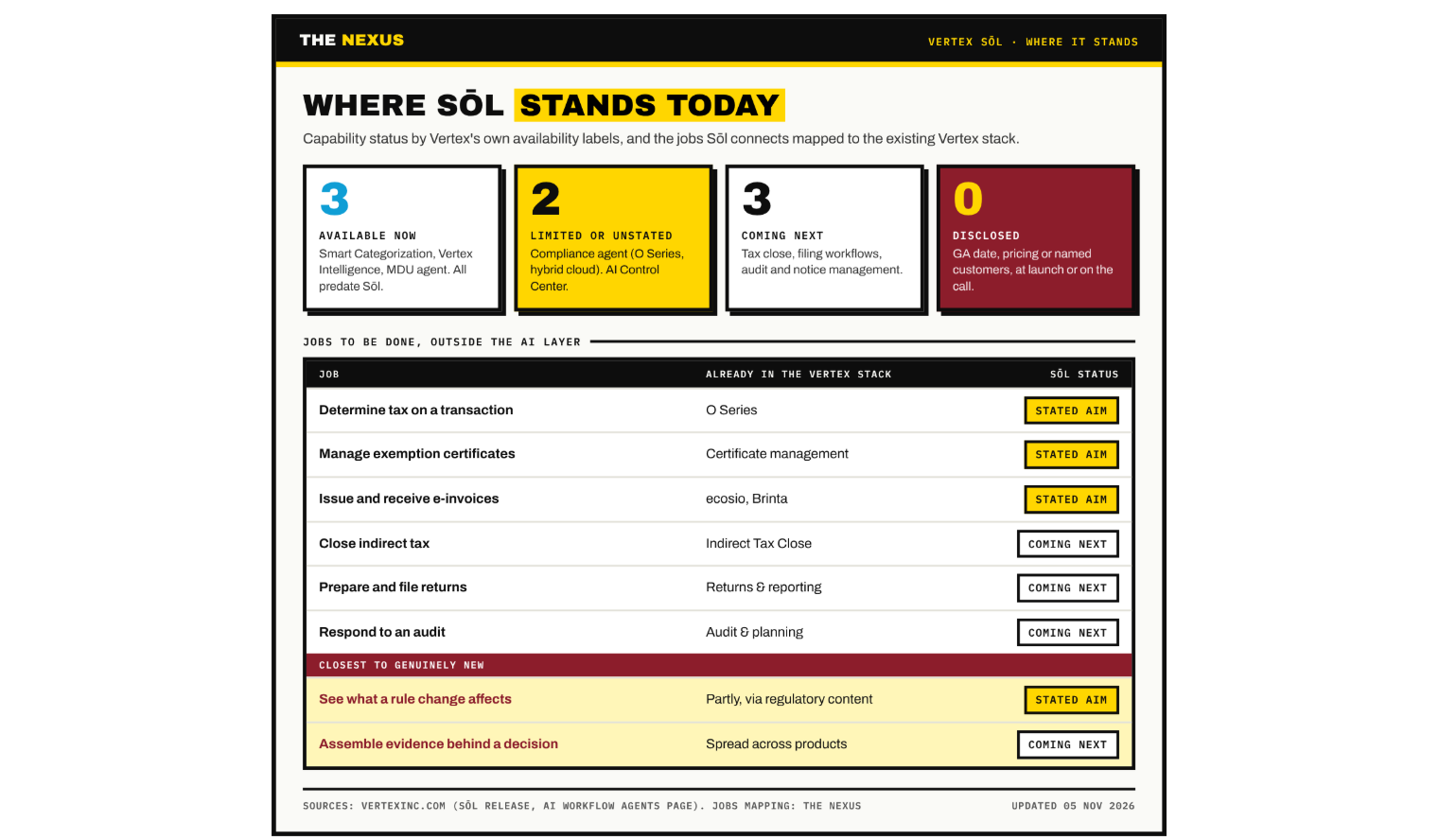
The three capabilities available now (Smart Categorization, Vertex Intelligence and an MDU Analysis Agent) all predate Sōl. The one capability explicitly delivered through Sōl is a continuous compliance agent, in limited release for eligible O Series or hybrid-cloud customers (so would seem quite limited and most compliance activity is taking place outside of O-series). AI Control Center is described in detail but carries no availability statement. Tax close, filing and audit and notice management are all “coming next”. Vertex’s own product page notes that the direction shown is illustrative.
What Decision-to-Defense means for the product
Vertex frames the journey in four pillars: Determine, Prove, Defend and Improve. The first two build on long-established strengths in O Series and the ecosio and Brinta e-invoicing businesses. The second two are where Sōl’s new capability is being added.
Three things stand out. First, is Vertex moving its unit of value from the tax calculation to the transaction record? With CTC mandates and ViDA pulling audit closer to real time, that’s the right direction. Second, Sōl is a governance and experience layer over existing products rather than a new engine. Third, the agent model conforms to the norm in this market right now. Trust levels per agent, human-approved actions and session logs are a credible answer to buyers who won’t adopt compliance AI without the ability to override and reverse it.
New jobs, or the same jobs connected?
Set the AI to one side and look at the jobs Sōl is built around. Vertex names six: tax determination, certificate management, e-invoicing, indirect tax close, reporting and filing, and audit and notice management. Four of these map to something Vertex already sells.
For a customer already running O Series and Vertex e-invoicing, Sōl changes how the work is governed more than what work gets done. Only two jobs look genuinely new: seeing what a rule change affects across your own configuration and transactions (across multiple products?), and assembling the evidence behind a decision when an auditor asks. Both depend on the connected record, and both are still a stated aim or coming next.
Outside the AI layer, Sōl reorganises jobs Vertex already serves. That’s useful, and incremental. Any claim to being game-changing rests on the connected record, which is still being built.
That isn’t a criticism of the strategy. Incumbents rarely win by inventing new jobs. They win by making the jobs customers already pay for work together better than a stack of point tools can.
After the earnings call
Before Wednesday’s call I set five questions on Sōl. Here’s how they scored.
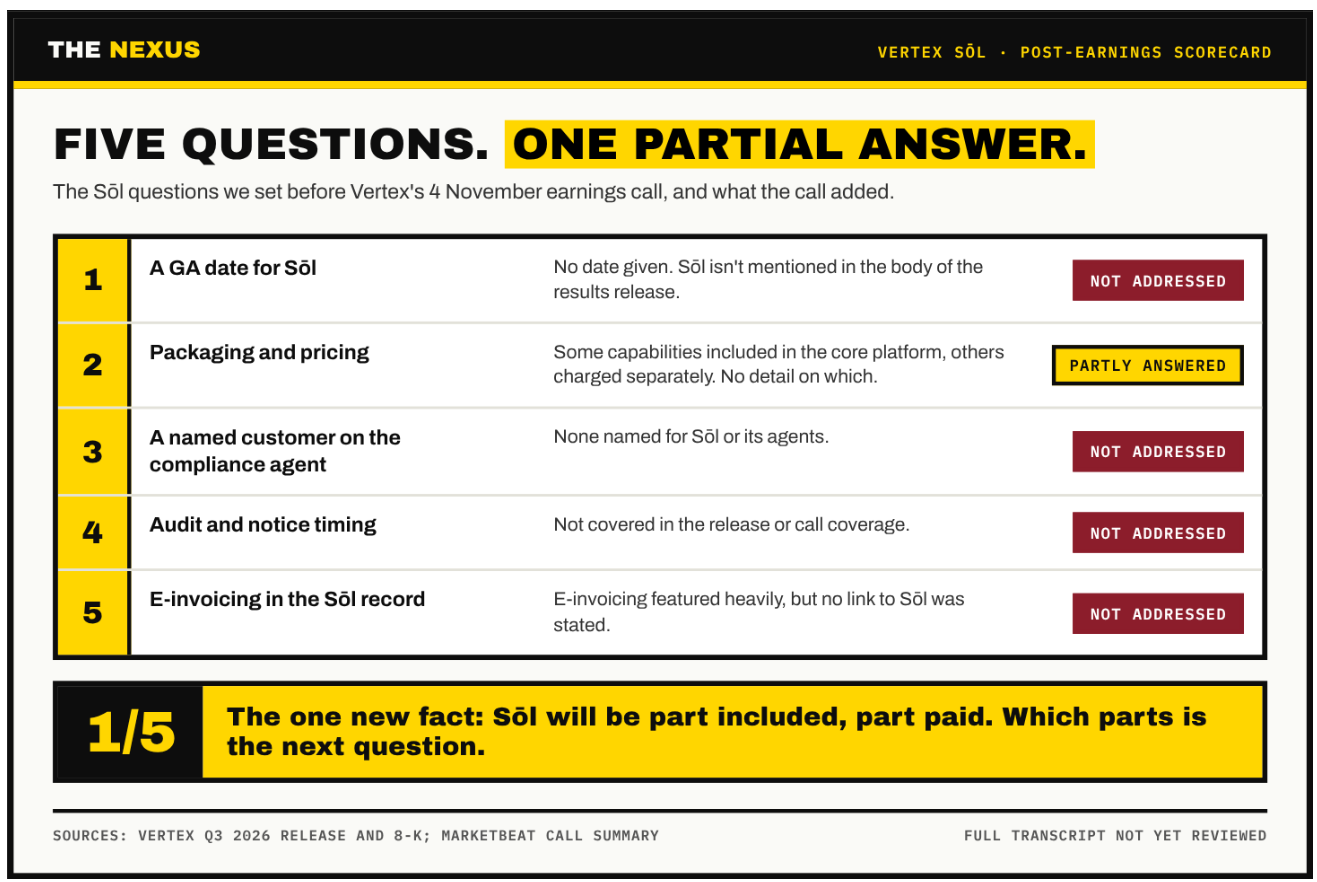
A GA date: not addressed. Sōl doesn’t appear in the body of the results release.
Packaging: partly answered. CEO Chris Young said some Sōl capabilities will be included in the core platform and others will carry separate charges.
A named customer on the compliance agent: not addressed.
Audit and notice timing: not addressed.
E-invoicing in the Sōl record: not addressed. E-invoicing featured heavily on the call, but nothing tied it to Sōl.
One out of five isn’t a criticism a week after launch. But it confirms where Sōl sits today: a direction, not yet a product with dates, customers or prices attached.
The one new fact matters, though. A part-included, part-paid model means Sōl will do two commercial jobs. The included layer gives existing customers a reason to adopt, and on-premise customers a reason to move to cloud. The paid layer is the upsell. Where each capability lands will tell buyers a lot about Vertex’s intent. If the connected record and audit evidence sit in the paid tier, the Decision-to-Defense promise becomes a premium product rather than the platform default.
The question is no longer whether Sōl gets monetised. It’s which parts customers will be asked to pay for, and when.
What to watch next
The included-versus-paid split, and pricing for the paid tier.
A GA date, or a defined early-adopter programme with named participants.
Audit and notice management timing. Until it ships, “Defense” remains the roadmap end of the tagline.
Evidence that e-invoicing data flows into the Sōl record, not just alongside it.
Decision-to-Defense is a credible strategy and Sōl is its first release. The real measure is a connected record customers can point to in an audit, not in a walkthrough.
Disclosure: the editor of The Nexus is a former employee at Vertex. This analysis uses only public sources.
Now something I’m super excited about. The Sales Tax Market has changed dramatically in the last 2 years and I’m excited to be delving deeper.
So to get started, here’s how the vendor landscape today at a high level and I’ll be individually analysing these indidivually over the next few weeks, enjoy!
🏈 SUT Market overview
Sales Tax Has a New Cap Table.
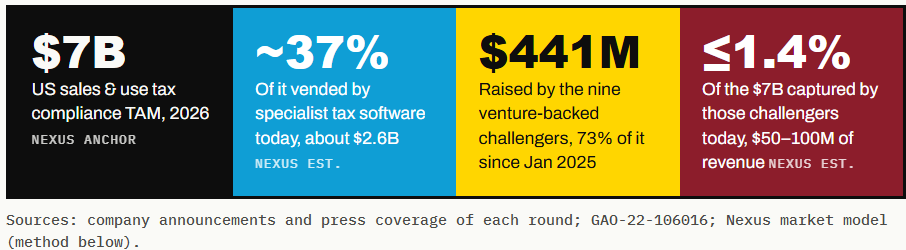
Nine venture-backed challengers have raised roughly $441M, three-quarters of it in the last 22 months. Add Stripe Tax and you have ten vendors chasing a low single-digit share of a market the incumbents have owned for a decade. This is the map before the profiles: who they are, who they sell to, and where the money says they’re going.
US sales tax was a solved market. Then it wasn’t.
For ten years the shape barely moved. Avalara owned the mid-market. Vertex, Thomson Reuters owned the enterprise tax department, SOVOS sat in the middle. Stripe bought TaxJar and brought calculation closer to the payment.
Then Wayfair turned every state into a nexus question, and remote sales tax collections went from $3.2B in 2018 to $23.1B by 2021. The compliance burden moved downmarket faster than the incumbents’ sales models could follow. That gap is where the new cohort lives.
A duopoly at the core. A noisy fringe at the edges.
The market: a $7B TAM, and only $2.6B of it is vended
Call the TAM $7B. That’s the total cost of getting US sales and use tax right each year, whoever does the work.
Most of it never reaches a tax software vendor. Vertex guides to $825–830M of revenue for 2026, and not all of that is US sales tax. Avalara was doing $789M of trailing revenue when Vista paid $8.4B for it in 2022, and has grown since. Add TR ONESOURCE, Sovos, Stripe Tax and the specialist long tail, and vended spend is roughly $2.6B.
The other $4.4B is handled three ways:
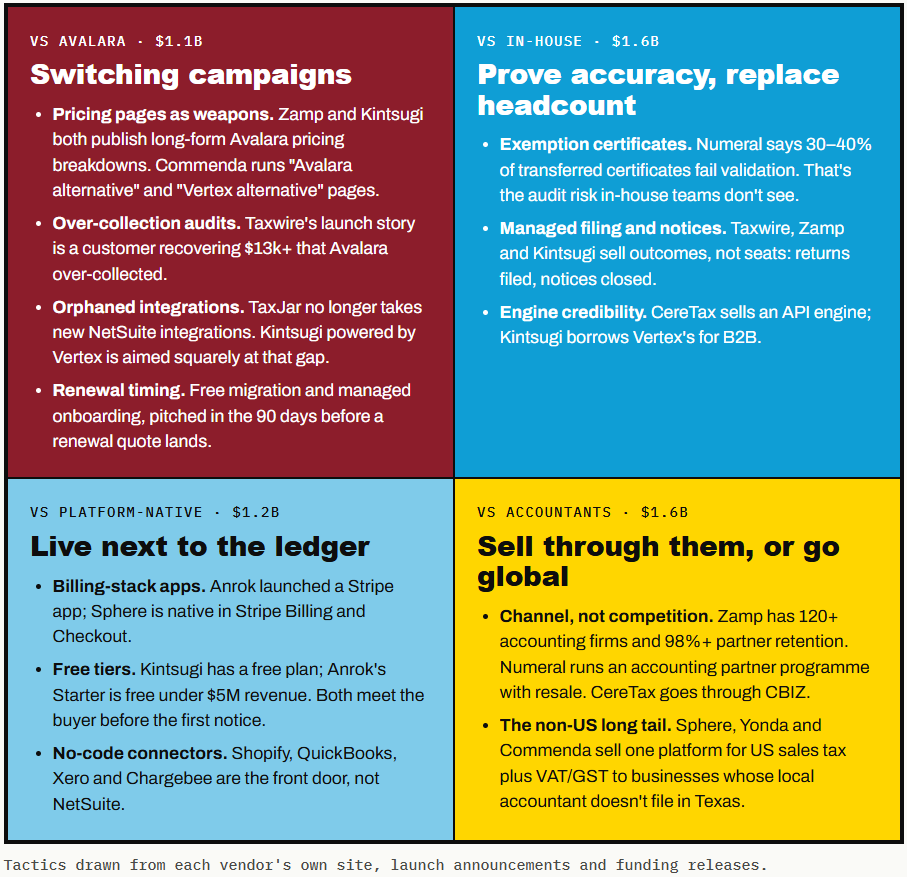
In-house. Tax and finance teams running calculation and returns from their own tables, ERP exports and spreadsheets. Common in mid-market and enterprise companies that decided the problem was manageable.
ERP and accounting-platform native. The tax settings built into QuickBooks, Xero, NetSuite, Shopify and SAP. Good enough until the first notice, then not.
Outsourced to accountants. CPA firms filing for a book of clients, often with their own tooling. This is the long tail: mostly SMBs, plus nearly every non-US-headquartered business selling into the US.
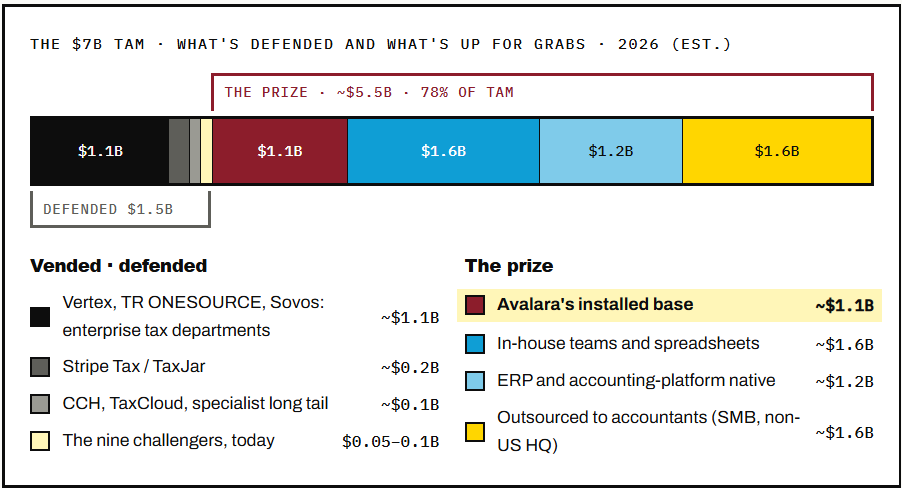
$7B is The Nexus’s TAM anchor. Vended figures are a bottom-up estimate; the split of non-vended spend is directional.
Avalara belongs in the prize column. Its base is mid-market, its pricing is the most-complained-about in the category, and its customers already accept that sales tax is a software purchase. That makes it the cheapest pool to switch. Vertex, TR and Sovos sit behind enterprise implementations, SI partners and audit trails. Nobody in the cohort is attacking them yet.
The rest of the prize has never been vended. Each bucket needs a different attack, and the cohort is already running all four.
The duopoly
Inside the vended slice, the shape is simple. Avalara and Vertex take roughly two of every three dollars. Thomson Reuters takes about one in seven. Stripe, Sovos and the long tail split most of the rest. Around the edges sits a noisy fringe: nine challengers with $441M of venture money and, at the high end, about $100M of revenue between them.
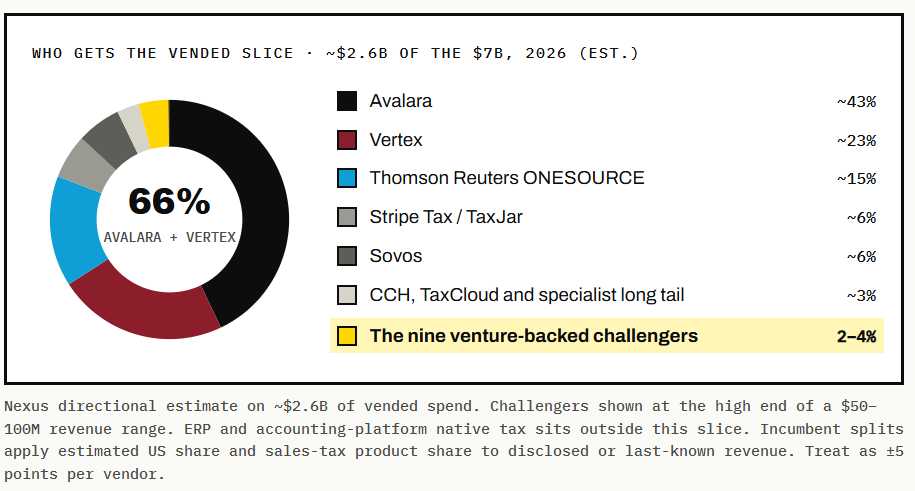
The duopoly is stable at the top and leaking at the bottom. Vertex reports NRR down to 105%, GRR flat at 95%, and 2025 attrition concentrated among smaller customers. The enterprise base renews. The small end churns, and most of the market below it was never vended in the first place.
The challengers haven’t taken share yet. They’ve taken the cap table.
The money: $441M, and most of it is new
Nine venture-backed companies, plus Stripe on its own balance sheet. Some are AI-native by founding story, some by marketing. All of them sell some mix of nexus monitoring, registration, calculation and filing. Most put a heavy managed-service layer on top.
The timing is the story. Roughly $324M of the cohort’s $441M closed after January 2025. Numeral alone raised $153M in that window, capped by a $100M Series C led by Insight Partners in September. Anrok more than doubled its valuation to $525M. Yonda landed $15M in December, its first serious institutional round.
The strategics are on the cap tables too. Vertex led Kintsugi’s $18M round at $150M. Thomson Reuters Ventures joined Zamp’s $17M round in April.
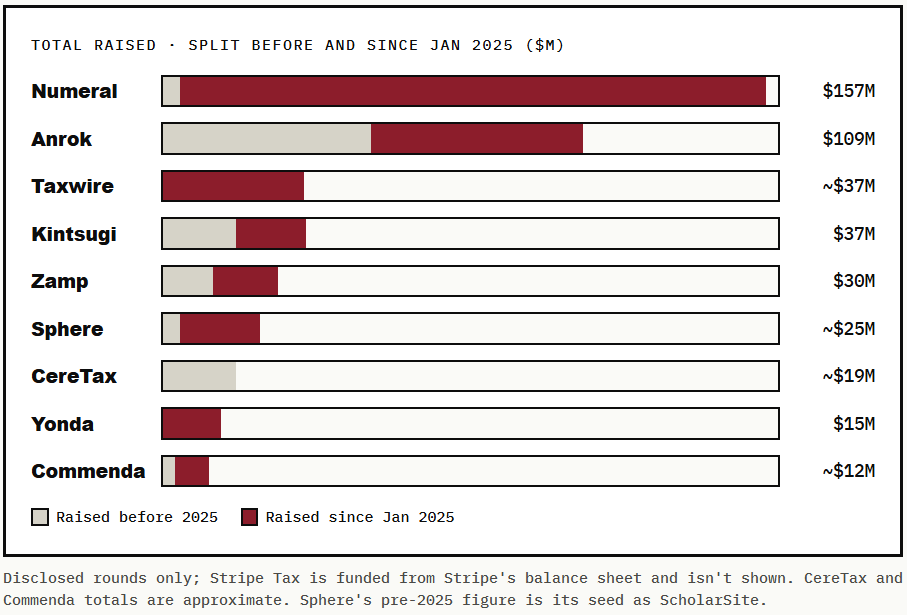
Now set that against the incumbents. Avalara’s take-private was $8.4B. The disclosed valuations across the cohort (Anrok $525M, Numeral $350M at its Series B, Kintsugi $150M) add up to roughly $1B. Venture investors have priced the three most-funded challengers at about an eighth of one incumbent, on revenue that is a small fraction of it.
That’s not a share story. It’s an option on a share story. Every round since 2025 is a bet that AI-native onboarding and managed filing can bend the cost to serve until the bottom half of the market becomes profitable to win, and then the middle.
Where they’re built: West Coast money, East Coast incumbents
Six of the ten are headquartered in the San Francisco Bay Area, and they hold 77% of the cohort’s venture capital. The incumbents they’re chasing sit the other side of the country: Vertex outside Philadelphia, Sovos in Boston. Avalara in Seattle is the exception.
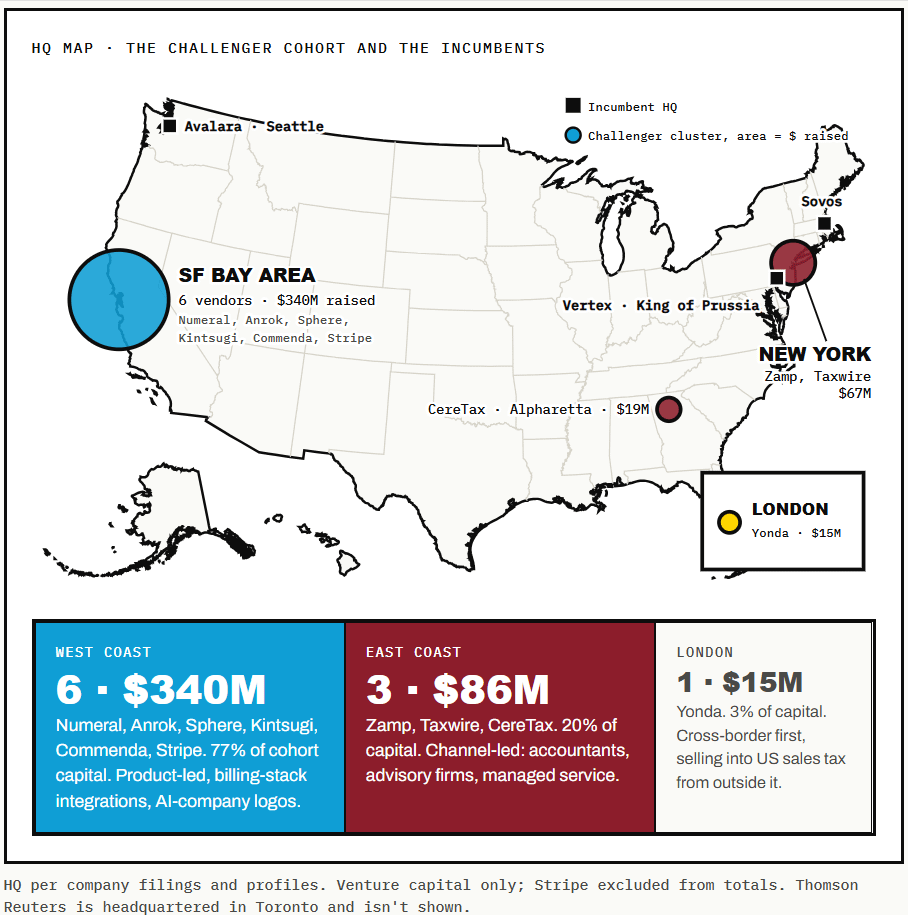
The geography tracks the go-to-market. The Bay Area cohort sells to the companies down the road: Anthropic, Cursor, Lovable, Replit, ElevenLabs. It wins through Stripe and product-led signup. The East Coast cohort sells through people: Zamp’s accounting firms, CereTax’s CBIZ partnership, Taxwire’s managed service. One coast builds for AI scale-ups. The other builds for the accountants who serve everyone else.
The cohort: ten wedges into one market
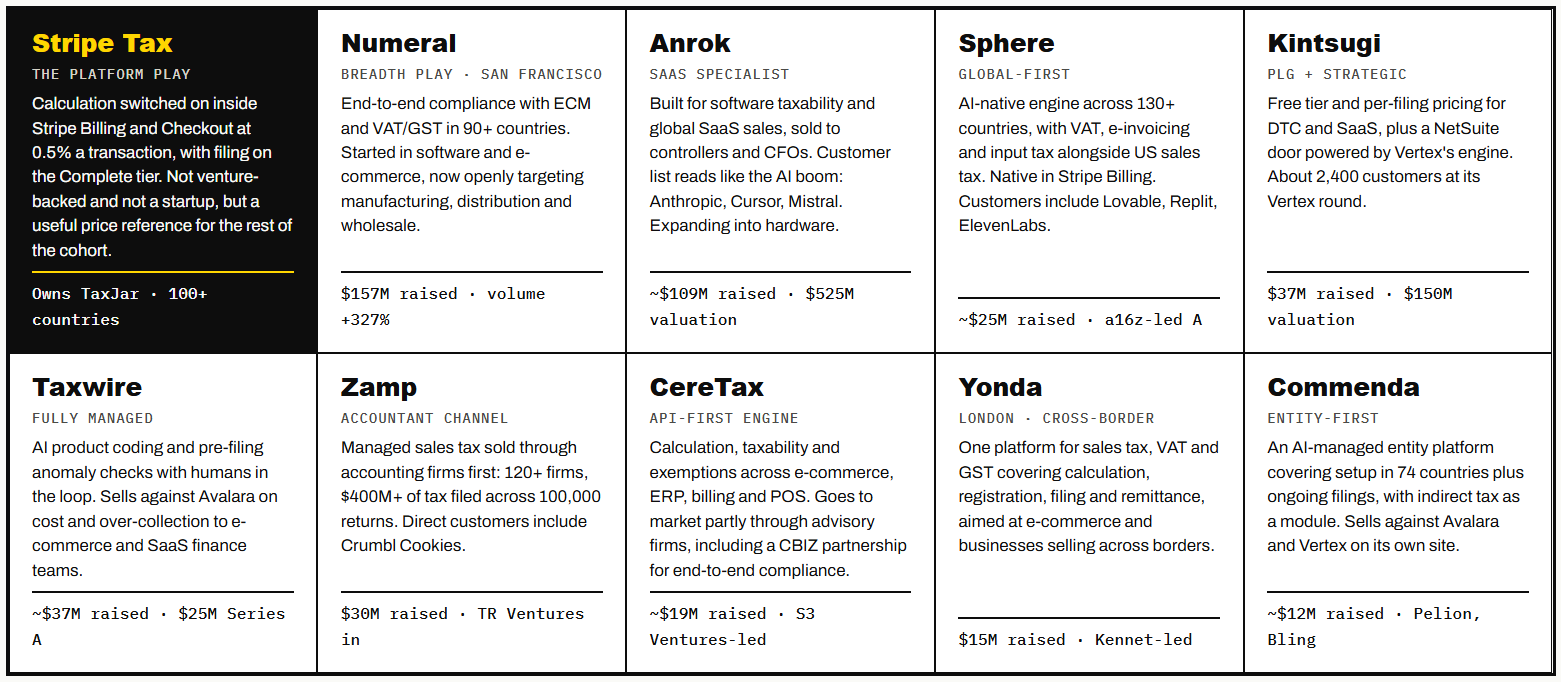
Where they play: ICP and segmentation
Strip out the AI language and every challenger started in the same place: digital businesses that got a nexus letter before they got a tax manager. The interesting part is where each one is trying to go next.
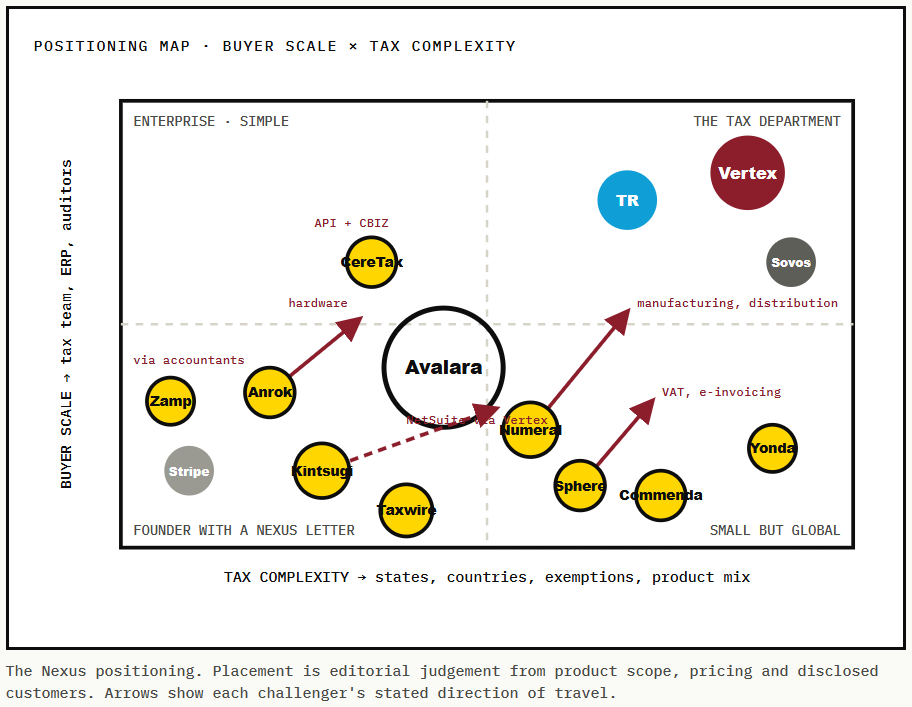
Read the map from the bottom left. That’s where nearly every challenger was born, and it’s crowded. The arrows all point the same way: up toward bigger buyers, right toward harder tax. Nobody is heading into the top-right corner yet. Vertex, TR and Sovos own it, and the cohort is building toward it one step at a time: hardware, distribution, VAT, an ERP connector. The segments below show who is winning which buyers today.
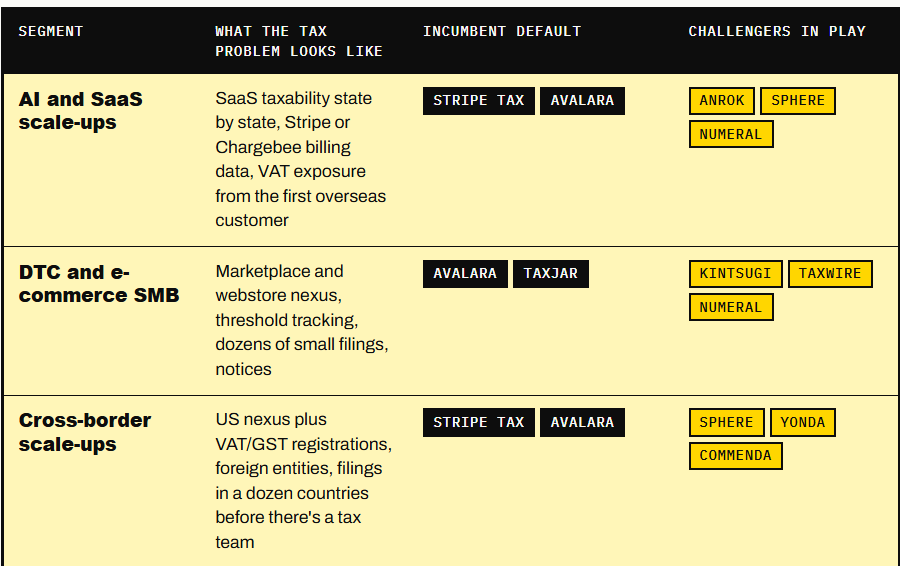
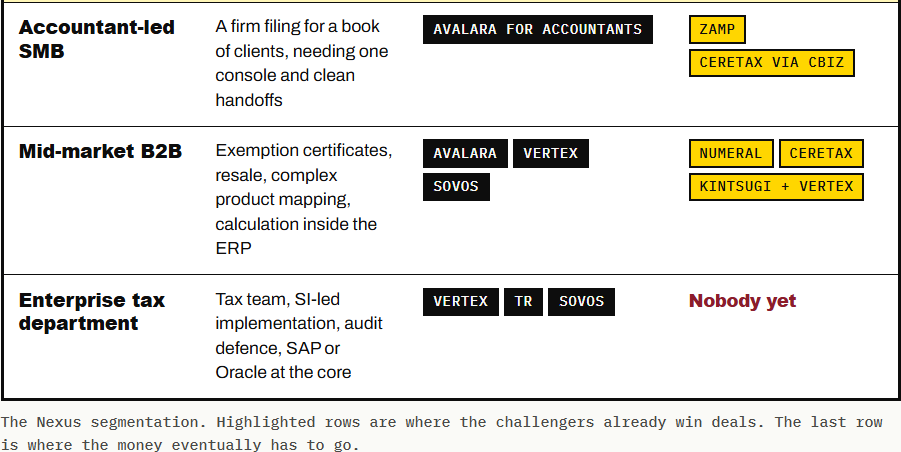
Two things jump out. First, the cohort is crowded into the first three segments. Seven of the nine venture-backed vendors share one buyer persona: a finance lead at a fast-growing digital business who would rather not hire a tax manager. That’s a real market, and a contested one: Stripe Tax is one integration away for many of the same buyers.
Second, every exit route runs through mid-market B2B. That’s where exemption certificates live, where the ERP is the system of record, and where Avalara has the deepest moat. Numeral’s Series C language says it out loud. Kintsugi rented Vertex’s engine to get there. CereTax is the only one that started there, as an engine. The others haven’t shown their hand.
The distribution bets are more varied than the product bets. Zamp and CereTax sell through accounting and advisory firms. Kintsugi sells through Vertex. Sphere and Anrok sell through billing stacks. Commenda sells entity setup first and tax second. Same product category, five different front doors.
Everyone in the cohort can win a founder. The series asks who can win a distributor.
What the incumbents are doing about it
Not nothing. Vertex invested in Kintsugi rather than build for SMB itself, which tells you how it reads its own cost to serve. Thomson Reuters Ventures is in Zamp’s round. CBIZ, now the home of Grant Thornton’s US practice, is packaging CereTax into a managed offering. Stripe has made calculation a toggle for anyone on its billing stack. Avalara, private and reportedly preparing a return to public markets, has every reason to protect its mid-market renewals before an S-1 puts its NRR in print.
The incumbents’ playbook is partner, invest, or bundle. Nobody is buying a challenger outright. Yet.
The series
The series
Over the coming weeks The Nexus profiles each vendor in the same structure: product, ICP, GTM motion, funding and investors, customer evidence, and where the story breaks. Each profile answers one question.
Stripe Tax: Tax as a payments feature. How far can a 0.5%-a-transaction add-on go before buyers need a specialist?
Numeral: Can $157M buy its way out of SMB, and into the distributors and manufacturers Avalara still owns?
Anrok: Is SaaS sales tax a market or a starting point? A $525M valuation says investors have decided.
Sphere: Global from day one. Is US sales tax the wedge or the side dish?
Kintsugi: Investor, engine supplier, channel. When Vertex is all three, who owns the customer?
Taxwire: Fully managed service: the moat, or the margin trap?
Zamp: Can the accountant channel out-sell product-led growth, with Thomson Reuters on the cap table?
Commenda: Is entity management a better front door to sales tax than sales tax itself?
CereTax: An API engine sold through advisory firms. Is it a software company or a services channel’s supplier?
Yonda: A London-built, global-first platform. Does the pitch travel into US sales tax?
$441M doesn’t buy market share. It buys time. $4.4B of this market has never been vended. The next 18 months will see which of these ten converts it first.
How we sized it. The $7B TAM is The Nexus’s anchor for the full cost of US sales and use tax compliance, whoever does the work. TAM is not vended spend. The ~$2.6B vended slice is a bottom-up model of specialist tax software revenue. We start from disclosed revenue (Vertex FY2026 guidance; Avalara’s last public LTM revenue grown forward at a mid-teens rate), apply estimated US and sales-tax product shares, then add estimates for TR ONESOURCE, Sovos, Stripe Tax and long-tail specialists. The remaining ~$4.4B is split across in-house effort, ERP and accounting-platform native tax, and outsourced accountants on a directional basis only. None of the nine challengers discloses revenue. Their $50–100M range is valuation-implied: disclosed valuations for Anrok, Numeral and Kintsugi at 20–40x ARR, plus an estimate for the six earlier-stage vendors. Charts use the $100M high end. Every incumbent figure here is an estimate and should be read as a range.
Sources
The Nexus has commercial relationships with some vendors covered in this piece. Scores are taken directly from published Nexus vendor profiles and are not adjusted for those relationships. Not intended for investment or purchasing decisions.
Evaluating global indirect tax or VAT vendors? see below ⬇️


A selection of of opportunities to connect in person and interact online over the next few weeks.
OCTOBER 2026
Preparing for the Future of Digital VAT Compliance: A Southern Europe Perspective (Roundtable)
Fintua | 28 October 2026, 09:00–11:20 WET | Embassy of Ireland, Lisbon, Portugal
Invitation-only executive roundtable for senior tax, VAT and finance leaders on ViDA, e-invoicing and digital reporting in Southern Europe, with perspectives from Cloudflare and NetJets.
ViDA — How New Changes Will Affect You (Webinar)
Vertex | 29 October 2026, 10:00–10:45 GMT | Online
Vertex on the EU VAT in the Digital Age package: mandatory B2B e-invoicing, real-time reporting, and how businesses can adapt systems and processes.
Complete the VAT Compliance Journey: Close the Payment Loop (Webinar)
Fintua | 29 October 2026, 11:00–12:00 | Online
Fintua on why VAT payments get overlooked in compliance, and how to link return submission to payment in a single workflow.
Building a Fiscalization App for Android: From Requirements to Production (Webinar)
Fiscal Solutions | 29 October 2026, 15:00–16:00 CET | Online
Fiscal Solutions’ R&D and Android leads on building a multi-country fiscalization app: architecture, hands-on development, and lessons learned.
NOVEMBER 2026
2026 TechTAXcelerate: Building Smarter Tax Functions Through Technology, Data & AI (Virtual Conference)
TEI — Tax Executives Institute | 9–13 November 2026 | Online
TEI’s dedicated technology-focused virtual conference, exploring how in-house tax functions are using data, automation and AI to modernize processes and build smarter, leaner tax departments.
Tax Technology Conference 2026 (Conference)
Tax Technology Academy / Verlag Dr. Otto Schmidt | 10–11 November 2026 | Kap Europa, Frankfurt am Main, Germany
Germany’s premier tax technology conference brings together over 500 tax and tech experts for two days of keynotes, deep dives, and project insights covering automation, GenAI, compliance process design, and digital transformation — with a focus on delivering measurable value.
Get Ready for the German Mandate Deadline: Go Live in 1 Month (Webinar)
Babelway (a Tradeshift company) | 10 November 2026, 14:00–15:00 CET | Online
Hands-on steps for issuing compliant e-invoices in Germany before the 1 January 2027 mandate: requirements, formats, channels, and how to go live in about a month.
CIOT Indirect Taxes Annual Conference 2026 (Conference)
Chartered Institute of Taxation | 12 November 2026 | One Great George Street, Westminster, London, UK
The Chartered Institute of Taxation’s flagship annual conference for indirect tax professionals, covering the latest VAT, customs, and excise developments, practical compliance guidance, and emerging issues for businesses operating in the UK and internationally.
SAP for Global Trade & Tax Conference 2026 (Conference)
TAC Insights / Meridian Global Services | 12–13 November 2026 | Hotel NH Malaga, Malaga, Spain
The premier annual forum for SAP users and experts dedicated to mastering the complexities of international commerce. Two days of actionable strategies in trade compliance, customs automation, and next-generation tax technology built on the SAP ecosystem. Meridian Global Services among key participants.
SYNERGY 2026 (Conference)
Thomson Reuters | 16–19 November 2026 | Fontainebleau Las Vegas, Las Vegas, NV
Thomson Reuters’ comprehensive annual conference for tax, accounting, audit, legal, and corporate professionals — the largest event in the Thomson Reuters calendar. Extensive product training, CPE/CLE credit opportunities, and insights from leading industry experts. In-person only in 2026.
SAPinsider Copenhagen 2026 (Conference)
SAPinsider (Basware attending) | 16–19 November 2026 | Copenhagen, Denmark
SAP decision-makers’ conference covering finance, data, AI and the partner ecosystem.
Tax Compliance Summit Paris 2026 (Conference)
Sovos | 17 November 2026, 08:00–18:00 | Le Cercle d’Aumale, 22 Rue d’Aumale, Paris, France
Third annual summit on what comes after e-invoicing and digital reporting mandates: real-time data exchange, ViDA, AI in compliance, with 25+ speakers. Free for qualified professionals; French/English interpretation.
Trade and Tariff Tuesdays: Navigate Shifting Trade Policy with Confidence (Webinar)
Avalara | 17 November 2026, 16:00 GMT (11am ET) | Online
Avalara experts on recent US and global tariff changes, a possible Supreme Court IEEPA ruling and de minimis changes, and how automation helps importers and ecommerce sellers adapt.
SSON Berlin (Conference)
SSON (Basware attending) | 17–19 November 2026 | Berlin, Germany
Shared services organisations on how they scale with AI-powered automation.
Tax Evolution Summit 2026 — From Evolution to Revolution: Accelerating the Tax Function (Conference)
Tax Evolution Summit / PwC | 18–19 November 2026 | FEMA Madrid, Av. del Partenón, 5, Madrid, Spain
Co-hosted with PwC and designed for senior audiences including CFOs, Tax Directors, and Tax Transformation/IT leads across EMEA, this year’s edition combines with a second PwC event in Madrid on 18 November for cross-event networking, exploring how tax functions move from incremental evolution to real technology-driven transformation.
14th Tax Strategies & Experiences (Forum)
Thought Leader Global | 18–19 November 2026 | Radisson Blu Centre, Amsterdam, Netherlands
A senior peer-to-peer forum for tax leaders to share strategies and experiences on tax technology, transformation, and evolving compliance demands — running in parallel with other major November tax events.
3rd Tax Technology & Compliance Summit 2026 (Conference)
Tax Technology Summit | 18 November 2026 | Grand Millennium Hotel, Dubai, UAE
The region’s premier gathering for tax technology and compliance leaders, focusing on VAT and e-invoicing readiness, AI-driven compliance, and the accelerated digital transformation of tax administration across the GCC. Expert panels, industry talks, and peer-level networking.
Basware World Tour — Sydney (Customer Event)
Basware | 19 November 2026, 10:00–16:30 AEST | Sydney, Australia
VIP customer event with product insights, innovation and networking.
Southern Europe Tax Summit (Conference)
Uniglobal | 24–25 November 2026 | Milan, Italy
Uniglobal’s Southern Europe gathering for indirect tax and tax technology professionals, covering regional VAT, e-invoicing, and compliance developments across Italy, Spain, and neighbouring markets.
VNSG — AI & Analytics (Conference)
VNSG / Basware | 26 November 2026 | Bunnik, Netherlands
Session on how Basware’s AI helps SAP customers turn procure-to-pay data into faster decisions.
SAP NOW AI (Conference)
SAP (Basware attending) | 26 November 2026, 08:00–22:00 CET | Wilhelm Studios, Berlin, Germany
AI-powered finance automation for SAP S/4HANA and turning AI investment into ROI.
Basware World Tour — Norway (Customer Event)
Basware | 26 November 2026, 11:00–16:30 CEST | Oslo, Norway
Half-day event for customers and AP and finance professionals.
UKISUG Connect 2026 (Conference)
UK & Ireland SAP User Group | 29 November – 1 December 2026 | Birmingham, UK
SAP user group conference covering e-invoicing, digital transformation and compliance.
DECEMBER 2026
SAPience — Annual Conference (Conference)
SAPience / Basware | 1 December 2026, 08:30–19:00 CET | Dilbeek (Waerboom), Belgium
Year-end SAP conference on AI-ready ERP and 2027 finance transformation.
Corptax CONNECT 2026 (Conference)
Corptax | 7–10 December 2026 | Resorts World, Las Vegas, NV
The ultimate event for corporate tax professionals using Corptax technology, featuring deep-dive product sessions, peer networking, expert-led workshops, and a look at the roadmap for one of the leading corporate tax compliance platforms. CPE credit available.
Inside the UK Mandate: Are You Ready for What’s Coming? (Webinar)
Basware / SharedServicesLink | 9 December 2026, 14:00–15:00 GMT | Online
What is confirmed and what is still uncertain in the UK e-invoicing mandate, and how finance teams should prepare ahead of 2029.
*any organisers or events I’ve missed? please let me know.

A curated selection of blogs, white-papers and on demand content published by multiple organisartions across the landscape, organised into a themed learning path.
Tax Technology Learning Program
November & December 2026
8 Weeks · 48 Resources · ~17–20 Hours
📖 = Article or guide
📄 = Whitepaper or report (free, registration required)
🎥 = On-demand webinar (free, most require simple registration)
NOVEMBER 2026
Direct Tax Technology, Agentic AI & the Post-Filing Landscape
November focuses on direct tax. The Pillar Two first filing cycle has closed, GIR amendments are being processed, and the provision platform market is consolidating around a smaller number of purpose-built enterprise systems. The agentic AI race between Thomson Reuters and Avalara is the competitive storyline of the month, with Wolters Kluwer’s more conservative, workflow-embedded model as a useful third position. The month closes with the first strand of a reconciliation thread that runs into December: as tax authorities gain transaction-level data, reconciling ERP, eInvoice and VAT return data becomes an audit-readiness control, not a period-end chore. By month end you will know what the first real Pillar Two cycle revealed operationally, how the three dominant platforms differ on AI, and why audit readiness is now a standing discipline.
Week 1 · 3–7 November
The Corporate Tax Reality Check: What 2026 Actually Delivered
📖 2026 Corporate Tax Trends: Predictions vs. Reality
insightsoftware / Longview · 12–15 min
📖 Orbitax Powers 1,700+ Pillar Two Filings Across 34 Jurisdictions
Orbitax · 10–12 min
📖 The Pillar Two Filing Landscape: Understanding Form Types and How to Stay on Top of Them
Orbitax · 10–12 min
🎥 Pillar Two Compliance: Grant Thornton & Orbitax Strategies
Orbitax / Grant Thornton · 60 min · CPE credit available
Week 2 · 10–14 November
The Agentic AI Race: Thomson Reuters vs. Avalara, and Wolters Kluwer’s Third Way
📖 Thomson Reuters Advances AI Market Leadership with New Agentic AI Solutions
Thomson Reuters · 8–10 min
📖 CoCounsel Reaches One Million Users: What This Means for the Tax Function
Thomson Reuters / independent analysis · 8–10 min
📖 Avalara vs. Thomson Reuters: Agentic AI Compared
Avalara · 8–10 min
📖 What’s New with CCH Axcess Tax: AI Integration and 2026 Enhancements
Wolters Kluwer / CCH · 8–10 min
📖 Why Defensible, Workflow-Embedded AI is the New Standard for Tax Firms
Wolters Kluwer / CCH · 8–10 min
🎥 Seamless Tax Data Integration: From Any System to Pillar Two Compliance
Orbitax / Deloitte · 45–60 min
Week 3 · 17–21 November
Pillar Two Post-Filing Deep Dive: SbS Package, GIR Amendments & the Operating Model
📖 OECD Side-by-Side Package: Relief for US Multinationals
RSM US · 12–15 min
📖 The New Pillar Two Framework: Unboxing the Side-by-Side Package
Alvarez & Marsal · 15–18 min
📖 Orbitax Introduces GIR Amendments for Pillar Two GloBE Returns
Orbitax · 8–10 min
📖 Understanding the GloBE Information Return: XML, XSD Schemas and Validation Rules
Orbitax · 12–15 min
🎥 Taking Corporate Tax Management Beyond Provision with Longview
insightsoftware / International Tax Review · 60 min
Week 4 · 24–28 November
AI Governance, Audit Readiness & Reconciliation as a Control
📖 Top 4 Tax Technology Trends for 2026 and Beyond
Thomson Reuters · 8–10 min
📖 The 2026 AI TaxTech Map: Every Major Partnership YTD
Independent analysis · 10–12 min
📖 Why eInvoicing Reconciliation Is Becoming Critical to VAT Compliance
Fintua · 8–11 min
📄 Reconciliation in the Era of eInvoicing: 2026 Benchmark Report
Fintua · 15–20 min
📖 Ready Before the Notice: A Sales Tax & VAT Audit Playbook
Anrok / KPMG · 20–25 min
🎥 Beyond the Return: How AI and Automation Are Reshaping Tax Preparation
Wolters Kluwer / CCH · 50–60 min
🎥 From VAT Reporting to Real-Time Control: The New Era of VAT Compliance
Sovos · 45–60 min
November: 16 articles · 1 report · 5 webinars · ~7.5–9 hours
DECEMBER 2026
Year-End Review, January 2027 Mandates & 2027 Planning
December runs two tracks: reviewing what 2026 delivered against what was forecast, and building the intelligence base for 2027 investment decisions. Several mandates go live on 1 January (Germany, Norway, UAE, Slovakia), which makes the middle weeks operationally time-critical for anyone exposed to those markets. The reconciliation thread from November resumes in the planning weeks, where the business case for connecting eInvoice, ERP and VAT return data meets the 2027 budget conversation. The payments piece in the final week asks the follow-on question of what happens after the return is filed. The month closes with a lighter capstone, built for reflection rather than consumption.
Week 5 · 1–5 December
2026’s Defining Market Events: Consolidation, Live Mandates & the AI Platform Race
📖 Fonoa Raises $110M and Acquires PwC’s Indirect Tax Edge
Fonoa · 10–12 min
📖 AI for Serious People: The Fonoa/PwC Edge Acquisition
Dawn Capital · 8–10 min
📖 Sovos Launches Compliance Network: Addressing the Global E-Invoicing Wave
Sovos · 10–12 min
📖 Several Indirect Tax and Digital Trade Trends Will Shape 2026 and 2027
Bloomberg Tax · 10–12 min
🎥 Sovos TaxScapes Q3/Q4 2026: What’s Changing in Indirect Tax
Sovos · 45–60 min
🎥 France 2026 eInvoicing: From Compliance to Operational Readiness
Fintua · 45–60 min
Week 6 · 8–12 December
What’s Mandatory from January 2027: Germany, Norway, UAE & Slovakia
⚠️ UAE: the ASP appointment deadline was 30 October. If not yet appointed, act immediately. AED 5,000/month penalties apply from day one of the January 2027 enforcement date.
📖 Sovos Brings Global 2000 Clients Live in France
Sovos · 8–10 min
📖 Global E-Invoicing Mandates Are Becoming an ERP Architecture Test
ERP.today · 8–10 min
📖 E-Invoicing Transformation: How to Get It Right
Pagero (Thomson Reuters) · 10–12 min
🎥 Countdown to Slovakia 2027: Preparing for Mandatory E-Invoicing
Sovos · 45–60 min
🎥 E-Invoicing in Eastern Europe: KSeF, ViDA, Romania, Hungary & Beyond
Pagero (Thomson Reuters) · 45 min
🎥 The Global eInvoicing Landscape: Models, Mandates and How to Prepare
Fintua · 45–60 min
Week 7 · 15–19 December
2027 Technology Investment Planning: Making the Case, Choosing the Platform
📖 6 Insights from the 2026 Corporate Tax Technology Report
Thomson Reuters / TEI · 10–12 min
📖 Top Trends for Tax Technology in 2026 and Beyond
RSM US · 8–10 min
📖 Projected 2027 Federal Tax Brackets and Inflation-Adjusted Amounts
Wolters Kluwer / CCH · 8–10 min
📖 The Majority of CFOs Require Human Oversight of Agentic AI: 4 Governance Frameworks
Anrok · 12–15 min
📖 8 Best Indirect Tax Software 2026
Kintsugi · 12–15 min
📄 Turning VAT & eInvoicing Reconciliation into Strategic Advantage
Fintua · 15–20 min
🎥 Taking Corporate Tax Management Beyond Provision with Longview
insightsoftware / International Tax Review · 60 min
🎥 The New Control Layer in VAT Compliance: Why Reconciliation Matters
Fintua · 45–60 min
Week 8 · 22–31 December
Capstone: What 2026 Changed and What It Means for 2027
📖 AI-Enabled Tax Transformation
Deloitte Global · 20–25 min
📖 How to Build a Winning Indirect Tax Maturity Roadmap
Fonoa · 12–15 min
📖 The Future of Indirect Tax: 3 Traits Every Modern Tax Team Needs
Fonoa · 8–10 min
📖 Why Global Businesses Need a Better Way to Pay VAT Liabilities
Fintua · 10–15 min
📄 The Business Case for eInvoicing
Fintua · 15–20 min
🎥 Closing the Loop: Reconciling VAT Returns with eInvoicing Data
Fintua · 45–60 min
December: 16 articles · 2 reports · 8 webinars · ~9.5–12 hours
Full program: 32 articles · 3 reports · 13 webinars · 48 resources · ~17–20 hours
*Any cool content I’ve missed? Want yours included?? please let me know.

Sponsors keep The Nexus independant and free, and each one is a true specialist in their field. For introductions, contact me, or go direct, it’s your choice.


A selection of open roles across tax tech vendors and tax advisory/consulting businesses who are involved in tax technology.
In house roles are provided courtesy of the smart people at https://taxjobs.ai
Use the column headers to sort, or the search function and don’t forget to navigate all pages! And feel free to share the love on socials.
*I do this using an AI agent and due to the volume, I don’t check every link, so please let me know if any of these don’t work or have disappeared when you follow them.
Want to go deeper? Let’s chat
For Buyers - bespoke vendor analysis, comparisons, tailored market research and vendor selection
For Vendors - Go To Market analysis, strategy and execution support, interim leadership
Click on the image below