

The Sales Tax Arms Race Heats Up
On Wednesday of this week Numeral announced series C funding of $100M, making them the most highly capitalised of the US venture backed cohort of firms that are disrupting sales tax market, long dominated by the likes of Avalara and Vertex.
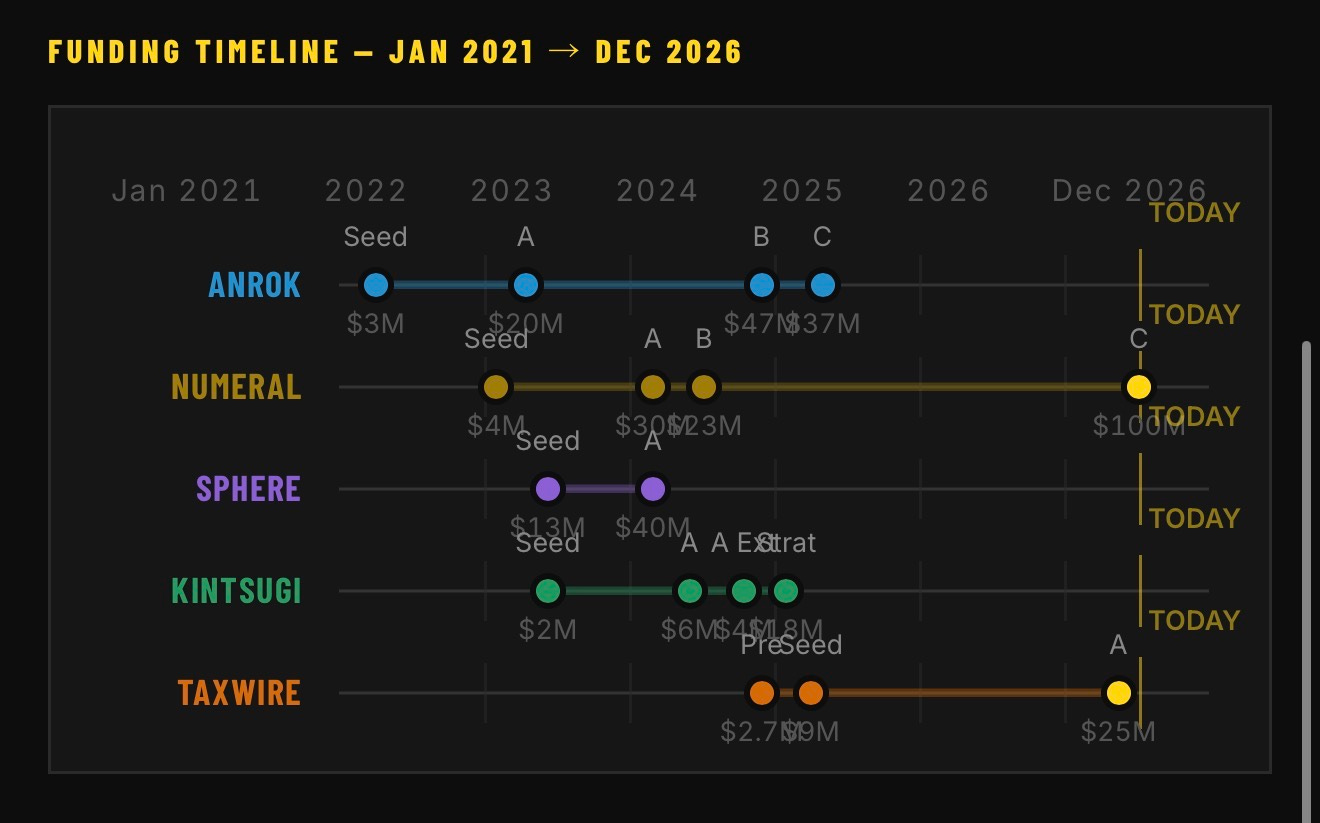
Also Fonoa, fresh off of their recent series C (and actually the most heavily invested of the lot, albeit not US based) leaked through their CEO’s LinkedIn post, the appointment of a new head of US tax engine, with some pretty serious heritage (Taxjar, Zamora, Taxwire) so are clearly gearing up to continue bridging the gaps in their portfolio and expand their ICP.
Outside of that, this week was a bit different for me, I had the pleasure of being interviewed for Alphatax’s Tax, Tech and other stuff podcast by Russell Gammon, resident AI supremo, cheif innovation officer, wine lover and all round nice guy.
I’ve done podcasts before as a vendor representative and it’s always been an effort to push a certain narrative and I think that comes through and tends to make them somewhat boring. This was nothing like that and I throughly enjoyed the conversation with Russell (who you should speak to if you ever get the chance) and I hope it comes through.
🌍 Feature: The Nexus on this week’s Tax, Tech and Other Stuff Podcast Interview with Alphatax & Russell Gammon
Behind the E-Invoicing Noise: The Nexus’ View on Mandates, AI, and What Comes Next
📽️ 𝗪𝗮𝘁𝗰𝗵 𝘁𝗵𝗲 𝗳𝘂𝗹𝗹 𝘃𝗶𝗱𝗲𝗼 𝗲𝗽𝗶𝘀𝗼𝗱𝗲: https://lnkd.in/e4Q7Nk5a
🎧 𝗣𝗿𝗲𝗳𝗲𝗿 𝗮𝘂𝗱𝗶𝗼? 𝗟𝗶𝘀𝘁𝗲𝗻 𝗵𝗲𝗿𝗲: https://lnkd.in/ebsNYjAK
This month I joined Russell Gammon on Alphatax’s Tax, Tech and Other Stuff podcast for the show’s first indirect tax episode in three years. Russell and I talked through why e-invoicing dominates every feed, whether the UK’s 2029 mandate is MTD all over again, why tax teams only buy on deadlines, what AI is really doing for vendors and in-house teams, and what happens to a market when the barriers to entry collapse. What follows is an edited version of that conversation.
Russell Gammon: Give us the potted history. Who are you, and how did you end up in indirect tax?
Paul Guyer: I’ve worked in indirect tax and tax technology for about 15 years, but I started somewhere completely different. I grew up in Essex and didn’t go to university. I went into chefing, lived in Spain for a couple of years and trained as a chef, came back to the UK, did that for a bit and hated it, then got into document management. That has come full circle, because invoice capture, invoice transmission and EDI are a big factor in the indirect tax world right now.
In 2011 I joined Thomson Reuters as they were building out their indirect tax line-up through acquisitions. I was one of the first few dozen people outside North America working in indirect tax, which was quite cool. A few years later I joined Avalara, which wasn’t well known over here. They were doing well in the US, disrupting the mid-market, and I joined as employee number ten in Europe. I headed up sales and partnerships there through the IPO, then decided it was time to try something new. For the last six years I’ve done a very similar thing at Vertex. Since earlier this year I’ve been independent, as a consultant and an investor. What I’m really interested in is helping smaller businesses in tax tech grow.
Building The Nexus: From Research Project to Community
Russell: You’ve been building a community called The Nexus, which is where we first got in touch. What’s it been like?
Paul: It’s been great, and really fun. I’ve learned how to start a business from scratch, which is intellectually rewarding. But it started as a research project. I knew I didn’t want to go back into a big corporate role and didn’t know what I did want, so I started looking around the market. So much is going on: indirect, direct, the operating layers, AI, research, tax credits. There are established incumbents and new players, communities of customers and partners, and around all of that the marketing, the events, the thought leadership and the job opportunities.
When I was on the vendor side I had my own little sphere: my customers, my competitors, my partners. That’s all I cared about for the longest time. There was a much broader environment I wasn’t aware of, and I thought it might be useful to other people, so I share it every week through Substack, which is a fancy name for a newsletter.
Close to a thousand people follow along each week and It’s brought me a load of interesting conversations. We wouldn’t be having this one otherwise. I’ve met founders and in-house practitioners, and I’ve just interviewed a tax tech product manager at Uber to find out what really matters when you run a scaled tax technology operation internally. These are things I’d never found out and people I’d never come into contact with.
Russell: It’s easy to sit in your bubble, knowing your space, your vendors and your networks, and forget how much bigger the world is. For everyone doing something, there’s at least one other saying “we do that too, differently and better.”
Why Is E-Invoicing So Busy? Lazy Marketing and a Real Regime
Russell: If my LinkedIn feed isn’t talking about AI, it’s talking about e-invoicing. For listeners who are heavier on direct tax: what’s the situation, and why is it so busy?
Paul: I’m going to say something contentious. Why it’s so busy on LinkedIn is a bit of lazy marketing, to be honest. If you’re in sales, one of the great things is having catalysts, or compelling events: lines in the sand where people have to do something. You have that with Pillar 2 on your side. E-invoicing is the same. A new mandate lands in France, or the UAE, or wherever, and suddenly there’s a net-new obligation you never had before. Because of the “e”, it lends itself to technology, so all the technology companies have jumped on it. A lot of indirect tax businesses have either built products or, more likely, procured and acquired their way into the market to capture this wave of software adoption.
“Why it’s so busy on LinkedIn — it’s a bit of lazy marketing, to be honest.”
Everyone is promoting it, and everyone is looking for someone who’s going to get triggered by the UAE or France. But in the background there’s a long-overdue modernisation of tax collection. It happened in direct tax as well. In Europe we talk about the VAT gap, which is the difference between the VAT that should be collected and the VAT that is. I don’t know the latest number, but it’s typically around €100 billion. Whether it’s fraud, inefficient collection or non-reporting, e-invoicing is a measure to bring that gap down. In some models the authority inserts itself between seller and buyer: if you want to raise an invoice and get paid, you have to communicate it to the authority. That stops some of the off-the-books activity and makes sure things are reported correctly.
Part of the noise is that none of it is harmonised. There’s overarching legislation, but as with most things in the EU there’s local derogation at member-state level, so everyone does something slightly different. France does it differently from Germany, which does it differently from Spain and Hungary, and outside the EU it diverges further. That’s why it’s hard.
Then there’s ViDA. Bits of it drop at different points, but the big one is digital reporting in 2030, which brings cross-border transactions into scope. Most of what’s happening today is domestic, a French entity selling to French customers, mostly B2B with some B2C. In 2030 it goes cross-border, so there’s a big jump in what gets transmitted, and I think it also becomes quite commoditised. My prediction is that the market settles on the Peppol standard, the divergence slows if not stops, and critical mass builds around a certain platform. Maybe I’m wrong.
Russell: Regulatory timelines that stretch out five to ten years tend to slip. But e-invoicing has real rubber on the road already, and people are doing things. So what does it mean for the UK, which is adopting in 2029?
The UK’s 2029 Mandate: MTD All Over Again?
Russell: Having lived through MTD for VAT, which looked like a big change, got watered down, then hit COVID and got messy, it doesn’t feel like it was the golden bullet HMRC wanted. Is e-invoicing round two, or is it more of the same rather than a replacement?
Paul: I think it’s incremental. MTD, and we’re getting acronym-heavy now, was a bit of a non-event. Maybe not for SMBs, but a sophisticated business, say a FTSE company already filing VAT with a corporate tax team, hardly found it groundbreaking to use a piece of software to do it. It’s probably trickier for smaller businesses, but I wasn’t involved in that layer of the market and haven’t stayed close to any published data on the net impact. I do think it got us ready for what’s coming.
I think HMRC did it in quite a good way. It was fairly progressive at the time. Most authorities mandate an output: you have to transmit this file in this format, and we don’t care how you arrive at it. HMRC said you need to use a piece of software, and there needs to be a trail showing how you got to the number. That gets people off home-built Excel spreadsheets and into a more controlled environment, which lays the foundation for what comes next. E-invoicing is a layer on top, and most taxpayers are used to dealing with HMRC digitally by now.
I’m not an expert on the legislation. I’m really a sales guy. But the UK is going with Peppol, so we’re not doing a Brexit.
“We’re not doing a Brexit. We’re not going off the rails and implementing something completely new.”
It also means there’ll be a lot of expertise in the market on Peppol, on developing systems, integrating and building the data models. You lean on an existing network of people who’ve done this before, maybe in different places, using the same underlying standards. So, again, maybe a bit of a non-event.
Russell: I’d love more of tax to be a non-event. This feels like an upgrade to what already happens rather than a breaking change, and by 2029 there’ll be even more expertise around.
Tax Buys on Deadlines: What MTD and Pillar 2 Teach Us
Paul: What’s it been like on the direct side? It’s still incremental, isn’t it?
Russell: The parallel in my head is MTD for VAT. Everyone ran up to a deadline, it moved back a year because of COVID, everyone ran up to the new one, and then there was a massive drop-off. Three, six, twelve months later people revisited it and realised the reason they were buying software wasn’t the transmission of nine boxes. It was that their Excel model was horrible and broken.
Pillar 2 has surprised me. A couple of months after the first deadlines I expected a big drop-off. No one’s ringing up to sign a contract tomorrow, but the number of conversations is striking. We got year one over the line, it was a bit challenging, maybe a bit expensive, so can we change our approach for year two? It’s incremental: take half a dozen of your 20 jurisdictions from outsourced to software, or move from a filing-only tool to a full calculation engine.
Paul: The readiness aspect is interesting. As software vendors or consultants, we’d like to sell customers on getting ready ahead of when it’s needed: use the downtime to change your processes and put a more robust operating model or technology backbone in place for next time. I never saw much of that. There was always another rush to the line. These projects are sensitive. They cost money, they tie up internal resources, and companies are trying to do other things.
“Tax suffers from not having discretionary budget for technology, and having to go cap in hand to finance or to IT.”
Burning platforms have been useful for tax teams to get the investment they need, but it’s hard to get projects spun up in the periods between deadlines.
Russell: I’ve seen good behaviour, a carrot-and-stick approach. Pillar 2 is coming, so we’ll need to buy something, whether software, outsourcing or a mix, and that means there’s a budget. But then people say: while we’re at it, let’s revisit provision, because it’s a massive source of information. Some are cutting their reliance on outsourcing from 20 countries to 10, and the savings fund software that fixes provision and country-by-country reporting as well as Pillar 2. That’s a good answer for the CFO: the outsourcing bill goes down and software usage goes up.
Paul: If you can make the economics work. Quite often the money doesn’t go down. That’s the challenge.
AI in Practice: Agents, Research and the Carpenter’s Jig
Russell: As a sole practitioner setting up a business, have you been using AI for absolutely everything? And how are you using it in indirect tax more generally?
Paul: For me it’s been a learning curve. I wouldn’t say I’ve gone all-in the way some people have. But I use it in the newsletter to scrape data sources. I collect jobs data every week across the industry and in-house teams, and to aggregate that you have to visit several dozen websites and get behind the third-party systems they use, the applicant tracking systems and so on. AI has been brilliant for that. You build an agent that crawls all the sites, brings the data back, formats it, and hands it to you ready to cut and paste.
I also use it for research. I have a standard format for researching a vendor, which I do quite often. The tool looks at the website and 20 or 30 public sources, aggregates it all and produces a report in a consistent format. Then I eyeball it, make changes, and add my own knowledge as context.
It must be hard for people in industry at the moment, because they’ve been told to use AI and it’s interesting to see how it gets measured. I spoke to someone at a large payments company who said they’d had a dashboard of token usage per person, and if you were high on it, you got slammed for costing too much. Now they track token usage per outcome. You don’t get dinged for usage if you’re generating outcomes. You get dinged if you’re creating bots that aren’t doing anything useful and that you’re not deploying. Often you need to blend two metrics to make sense of it.
Another idea stuck with me. A guy I follow on a podcast about software and GTM said that everything you build isn’t a product. What AI has allowed is for knowledge workers to build specialist tools. If you’re a carpenter and there’s a particular thing you do with the chairs you make, you build yourself a jig for it.
“If you do a certain thing in your job, you can build yourself a tool to do that.”
It might not be adopted by the whole company or the whole industry, but it might help you, and I think we all need to do some of that.
Vendor AI: Co-Pilots Look Nice, MCP Moves the Needle
Paul: On the vendor side, there’s an internal and an external application of AI. Internally, software engineering velocity has massively increased. You can have one developer doing the work of five, or whatever the latest number the AI labs quote is. That’s brilliant if you’re a software company.
The other area disrupted internally is tax research. One of the main selling points of a Vertex, a Thomson Reuters or a Sovos is that we can research indirect tax legislation across 190 countries and keep it up to date every month. That’s brilliant. It’s what you need and what you’re paying for. But you don’t need a team of 100 to do it now. You might need a team of ten. There’s some interesting data on job descriptions in tax, and we’re seeing a shift from research roles to technology roles. That’s not surprising, but I think it will be quite profound for that part of the industry.
On what vendors are actually shipping in AI, present company excepted, I think it’s been a bit underwhelming. We’ve seen co-pilots, and conversational interfaces where you say “create a bar chart of my UK tax exposure over the last three quarters.” It looks nice, but I don’t know if it really moves the needle. People are building MCP servers, and I think that’s where the value will be realised. If you’re operating a very agentic, AI-heavy environment internally and you just want the bits of the software you really need:
“You don’t want a UX anymore. You don’t want all of the features, because you’ve tooled yourself to do a lot of that.”
It’s not a particularly impressive feature, but I think it will deliver a lot of value to end users, especially on the transactional side.
Russell: Indirect tax is very different from corporate tax and Pillar 2, because it’s so data-heavy. There’s a lot of data in Pillar 2, but comparatively it’s tiny next to millions of rows. And MCP is a conversation I’ve been having this week. As a vendor, we want to build our own agents because we know how they work and can keep them within guardrails. But the customers at the leading edge say: we’ve got our agents, we just want to plug them in. That’s fine, and it means having APIs that let agents do what they need.
It also has big implications for audit trails. Do I want an audit trail that just says “done by agent”? That isn’t the same as “done by Joe Bloggs.” If someone comes in two years later because it went wrong, you want to know who did what, not just that an agent did it, and then whose fault is that? I don’t think we’ve got there yet, but we’ve been thinking about it.
Paul: I agree. It gets you away from the black box.
Warranty, Indemnity and the SaaSpocalypse
Paul: We had the SaaSpocalypse earlier in the year. A company’s valuation is a bet on its ability to make money ten years down the line, or twenty, depending on the ratios at the time, and that’s under pressure because AI might not disrupt everything today, but in ten years the market landscape will look a bit different. For tax tech, though, there’s a defensible layer around indemnity and warranty. You buy a piece of software because it’s warranted to do what it says. If I buy a vendor’s product and it doesn’t do what it said, I have recourse.
But say I build an agent to go and file my tax return.
“If the agent decides to go and do something differently because the model’s changed, then what’s my recourse?”
Am I going to get my money back? Am I going to be able to defend that in any way? Probably not. I think that’s one of the reasons there’s still quite a lot of hesitation around AI adoption in our part of the market.
Russell: It will all shake out over time, but it will take time. It’s not a case of everything happening tomorrow and the robots doing all our tax returns.
Who Wins? Incumbents, Start-Ups and a Fragmenting Market
Russell: You do weekly reports on vendors, and they’re thorough, so you must have a deep understanding of these businesses. Are there movers and shakers? Who wins: the heavy incumbents or the small start-ups? Is there enough pie for everyone?
Paul: I do have a theory. The market is still growing, but I don’t think it’s speeding up overall. The growth is speeding up in different areas. The financials tell the story, but a lot of these companies aren’t public, so you can’t see exactly what’s going on. Where you can, you see a slowdown in growth at some of the big companies, and at the same time heavy financing of smaller businesses. There’s one company, and I won’t name it, a US-based indirect tax company that has raised three rounds, pre-seed, seed and Series A, of around $30 million, something like that, in less than 18 months. That’s very quick cycling, but there’s growth commensurate with it: something like a 9x step in value between rounds within 18 months. The investors are seeing something.
Because of the engineering velocity and the ability to research tax so much more efficiently than before, I think the barriers to entry have really dropped. We’re seeing a slew of new entrants, AI-native, AI-first, AI-enabled, whatever you want to call them, making use of that, and some of them are winning, picking up funding and growing. So the market is fragmenting away from the big two or three giant vendors and distributing outward.
The other thing is platforming and M&A. Whether it’s under private equity or otherwise, we’re definitely seeing roll-up activity, and there are a lot of people buying up e-invoicing companies on the indirect side, which makes sense. We’ll see more of it as successful, growing companies want to assemble portfolios that give them a better wedge once they’ve acquired a customer. That’s how you drive share of wallet up, through new products and adjacent areas.
“It’s not going to be concentrated in two or three vendors. It’s going to be happening here and everywhere.”
Russell: One company doing three rounds in 18 months has shades of something bigger. A lot of the world is taking an existing process and putting some AI on the side to make it incrementally better. We may be seeing the first of those that says: let’s rethink the whole thing and work out how to do it from the start. Look at legal. Harvey announced this week that it has raised $550 million at a $15.5 billion valuation, and it’s about four years old. If you look at the ARR and the opportunity, it makes sense, even if it’s slightly bonkers. I think we’re seeing our own version of that in tax.
Paul: I spoke to two companies this week trying to do Harvey for tax research. You go in, it understands your business, you ask it a question, and it gives you an answer and cites all the legislation. It’s really good stuff. And there’s so much application beyond the core platforms, in all the jobs to be done: the little things people would have taken to in-house teams or paid consultants for. A lot of that is now being done by software, or can be.
Russell: The interesting flip is from software as a service to services as software.
Five Years Out: What Changes and What Doesn’t
Russell: The crystal ball question. Where are we in five years, and crucially, what has changed and what hasn’t?
Paul: A lot is going to change. On people, I really believe the entry layer of accounting and tax work is going to be challenged by AI, and that’s going to be really hard for people.
“If you can’t do the grunt work to learn how to manage, what do you do?”
I spoke with someone recently whose advice was: learn to orchestrate. Understand the data models you’re using, because increasingly you’ll be doing deterministic, decision-based work on data. You have to know how to prompt, but you also need to understand your underlying data and how to orchestrate work properly. That’s going to hit every industry, ours included. [Related: Diyan Mihaylov makes a similar argument in Inside Uber’s Tax Stack]
On vendors, we’re going to see more and more market entrants. You’ve probably heard of TaxTech 500. The thought that there’d be 500 vendors in tax tech ten years ago would have been bizarre. And that’s obviously not the whole field: they just did a report on the UAE, and there are 200 e-invoicing vendors there, and that’s probably only half of them. So I think there’s more fragmentation, and consolidation is still going to be a theme.
In-house, what I see at the moment is less aggregation of everything under one vendor. I think we’ll see more best-of-breed implementations stitched together with internal AI tooling: hybrid estates with a lot more in-house tooling doing the stitching, all the bits none of the vendors do, the seams between systems where things fall down, the process, the governance. I think that will accelerate.
Consulting and accounting firms will get hit from multiple ends. There’s PE and roll-up activity in accounting, and it will continue. If firms can use AI to reduce the cost of delivering a consultant’s output, there’s a big value multiple in it for the investors. But think also about the tax partners who’ve run advisory practices for a long time. They’re going to come under pressure and really transform. It will be hard for a tax practice at a Big Four or an accounting firm not to have a technology aspect anymore. And the moat advisers have around indemnity, the old line about nobody ever getting fired for hiring IBM, is a big part of what you buy when you buy advice. I think technology will figure that out at some point, or maybe it won’t be worth as much as it was, because of the way people get information and interact with authorities.
Legislation will change too. I was talking to someone about agentic commerce, and they were way too smart for me, but the question is who’s doing the buying, and where are they? Everything you base a tax decision on becomes opaque, with all the systems involved. I don’t think legislators will be able to keep up, so there’ll be a Wild West for a good few years while they work it out.
I don’t know if anything stays the same. I think we’ll still be talking about harmonisation in the EU, and still doing things differently. That might be a cop-out, but I don’t see the authorities coming together.
“I don’t think all of a sudden everyone’s just going to say, we’re just going to adopt a common standard.”
Russell: Too easy. It would put some of us out of a job. We need the annoying complexities to prove we’re a little bit different, a little bit special.
Paul: Exactly. And I think we’ll still have different and special people in tax tech for a long time. The innovation and the community won’t change either. I still hope to be going to conferences in five years and seeing the same people, maybe talking about different stuff. There’ll be continuity, and really smart, motivated people driving the agenda across legislation, the vendor landscape and in-house.
The full conversation is on [Podcast name]: [LINK].

A selection of of opportunities to connect in person and interact online over the next few weeks.
SEPTEMBER 2026
E-Invoicing Exchange Summit 2026 (Conference)
E-Invoicing Exchange | 30 September – 2 October 2026 | Hotel MOA Berlin, Berlin, Germany
The leading independent e-invoicing industry event returns to Berlin, bringing together enterprises, tax authorities, and technology providers to share insights on cross-border interoperability, regulatory readiness, and the growing impact of AI on e-invoicing and tax processes.
OCTOBER 2026
ITR AI in Tax Forum 2026 — Middle East (Conference)
International Tax Review | 6 October 2026 | Dubai, UAE
ITR’s AI in Tax Forum comes to the Middle East, bringing together in-house tax leaders, advisors, technology providers and tax authorities to examine the fast-evolving role of AI in the region’s tax landscape.
Digital Accountancy Show 2026 (Conference)
Easyfairs / Digital Accountancy | 7–8 October 2026 | ExCeL London, London, UK
The UK’s largest accountancy technology event, now in its sixth year, bringing together 7,000+ accountants and finance leaders to explore AI-driven automation, workflow tools, and digital transformation — co-located with the Digital Finance Show.
Join PwC and Meridian to Discuss Navigating the Future of Tax Compliance (Roundtable)
PwC / Meridian Global Services | 8 October 2026, 13:30–17:30 | PwC Amsterdam Offices, Thomas R. Malthusstraat 5, Amsterdam, Netherlands
An in-person roundtable bringing together finance, tax, and IT leaders to discuss the future of tax compliance, indirect tax automation, and readiness for evolving mandates.
Power of 3: PwC, SAP & Vertex (Roundtable)
PwC / SAP / Vertex | 15 October 2026 | TBC
A joint client event from PwC, SAP, and Vertex on e-invoicing, SAP transformation, and tax technology, flagged by PwC’s Ron Sperling as part of a run of autumn 2026 events. Private/invite-only — no public registration page found; details expected closer to the date.
TEI Annual Conference 2026 (Conference)
TEI — Tax Executives Institute | 21 October 2026 | Grand Hyatt Nashville, Nashville, TN
TEI’s flagship annual conference for senior in-house tax professionals, featuring high-level sessions on federal, state, and international tax developments, technology, and the evolving role of the corporate tax function.
5th Annual VAT Compliance and Indirect Tax Forum 2026 — ITX (Conference)
Amistat Group | 21–22 October 2026 | Van der Valk Hotel, Brussels, Belgium
Over 20 senior speakers across 20 high-level practical sessions on VAT compliance, AI in tax technology, and e-invoicing, plus 6+ hours of dedicated networking. Sponsored by Blue dot, Fintua, Meridian, 360WEDO, and VATabout.
IVA Autumn Conference 2026 (Conference)
International VAT Association (IVA) | 22–23 October 2026 | Marseille, France
The IVA’s flagship autumn gathering brings together VAT professionals, businesses, tax authorities, and international organisations from around the world for one of Europe’s leading VAT events. Full agenda and speakers to be announced closer to the date.
ITR AI in Tax Forum 2026 — USA (Conference)
International Tax Review | 26 October 2026 | New York, USA
ITR’s dedicated AI in Tax Forum returns to the US, examining how artificial intelligence is moving from early promise to everyday reality across direct and indirect tax functions — with senior in-house perspectives on implementation, governance, and what’s next.
E-Rechnungs-Gipfel 2026 — Repeat Edition (Conference)
Vereon AG / E-Invoicing Exchange Summit | 26–27 October 2026 | Frankfurt am Main, Germany
A second Frankfurt edition of Germany’s e-invoicing summit, added after the June Berlin edition sold out — covering XRechnung, ZUGFeRD, Peppol and EN16931 compliance ahead of the January 2027 mandate deadline.
*any organisers or events I’ve missed? please let me know.

A curated selection of blogs, white-papers and on demand content published by multiple organisartions across the landscape, organised into a themed learning path.
SEPTEMBER 2026
E-Invoicing, Direct Tax, Pillar Two & Synthesis
September covers the live mandate wave — France’s CTC goes mandatory this month — alongside Pillar Two post-filing analysis, corporate tax provision, and a synthesis capstone. Each week maintains the cross-theme mix, combining e-invoicing, direct tax, and operational content.
Week 1 · 7–11 September
The Live Mandate Wave: France, Slovakia, CTC Foundations & the Global Picture
📖Continuous Transaction Controls: The Future of Compliance Sovos12–15 min
📖Global VAT Guide: July 2026 VATupdate / Fintua 10–15 min
📖Sovos TaxScapes Q1 2026: France CTC Pilot, KSeF & Norway Acceleration Sovos 12–15 min
📖5 Things We Can Learn from Belgium’s 2026 E-Invoicing Mandate Innovate Tax 8–10 min
🎥E-Invoicing Trends and Obligations: 2026 and Beyond (feat. Forrester) Comarch / Forrester 60 min
🎥Countdown to Slovakia 2027: Preparing for Mandatory E-Invoicing and Digital Reporting Sovos 45–60 min
Week total: 4 articles + 2 webinars · ~147–175 min (~2.5 hrs)
Week 2 · 14–18 September
ViDA, Platform Architecture & Emerging Markets
📖What is ViDA? VAT in the Digital Age Initiative Q&APagero (Thomson Reuters) 12–15 min
📖Streamline the Future #6: Reporting Built for Global E-Invoicing Operations Comarch 8–10 min
📖Brazil 2026 Tax Reform: Key E-Invoicing Changes Fonoa 10–12 min
📖Leading the Charge: E-Invoicing as the Cornerstone of Future Compliance Vertex Inc. 10–12 min
📖E-Invoicing Transformation: How to Get It Right Pagero (Thomson Reuters) 10–12 min
📖E-Invoicing in Norway and Latest European VAT Updates Marosa VAT 8–10 min
🎥E-Invoicing in Eastern Europe: KSeF, ViDA, Romania, Hungary & BeyondP agero (Thomson Reuters) 45 min
Week total: 2 articles + 1 webinar · ~103–116 min (~1.75 hrs)
Week 3 · 21–25 September
Pillar Two, GIR Filing & the Side-by-Side Package
📖Orbitax Launches Global Pillar Two Compliance Accelerator Orbitax 10–12 min
📖Global Minimum Tax and the Data Management Dilemma Thomson Reuters / Orbitax 10–12 min
📖OECD Side-by-Side Package: Relief for US Multinationals RSM US 12–15 min
📖The New Pillar Two Framework: Unboxing the Side-by-Side Package Alvarez & Marsal 15–18 min
🎥Pillar Two Compliance: Grant Thornton & Orbitax Strategies Orbitax / Grant Thornton 60 min · CPE
🎥Seamless Tax Data Integration: From Any System to Pillar Two Compliance Orbitax / Deloitte 45–60 min
Week total: 4 articles + 2 webinars · ~152–177 min (~2.5 hrs)
Week 4· 28 September – 2 October (Capstone)
Provision, Maturity, US Tax Landscape & Full Synthesis
📖QDMTT: Stay Ahead of the Global Minimum Tax Curve Orbitax (Thomson Reuters) 12–15 min
📖How to Build a Winning Indirect Tax Maturity Roadmap Fonoa 12–15 min
📖The Future of Indirect Tax: 3 Traits Every Modern Tax Team Needs Fonoa 8–10 min
📖2025 Tax Recap & 2026 Preview: OBBBA Compliance UpdatesWolters Kluwer / CCH 8–10 min
📖2025 Tax Recap and 2026 Preview for Accounting Firms Wolters Kluwer / CCH 10–12 min
📖AI-Enabled Tax Transformation Deloitte Global 20–25 min
🎥Taking Corporate Tax Management Beyond Provision with Longview insightsoftware / International Tax Review 60 min
Week total: 6 articles + 1 webinar · ~130–147 min (~2.25 hrs)
September total: 20 articles + 6 webinars = 26 resources · ~532–615 min (~8.5–10 hrs)
*any cool content I’ve missed? please let me know.

A selection of open roles across tax tech vendors and tax advisory/consulting businesses who are involved in tax technology.
In house roles are provided courtesy of the smart people at https://taxjobs.ai
Use the column headers to sort, or the search function and don’t forget to navigate all pages! And feel free to share the love on socials.
*I do this using an AI agent and due to the volume, I don’t check every link, so please let me know if any of these don’t work or have disappeared when you follow them.

Want to go deeper? Let’s chat
For Buyers - bespoke vendor analysis, comparisons, tailored market research and vendor selection
For Vendors - Go To Market analysis, strategy and execution support, interim leadership
Click on the image below