

What’s happening in the latest IDC Marketscape report
In major taxtech news this week SOVOS acquired Blue Dot, reversing the market trend of VAT recovery businesses like VATIT and Fintua, building VAT compliance and E-invoicing SaaS suites. I’ll be doing a deeper analysis on this in the coming weeks.
Now to this week’s feature as we zoom in on the vendor landscape in the latest CTC hotspot, the United Arab Emeriates.
🌍 Feature: Navigating the United Arab Emirates E-invoicing Vendor Lanscape
Behind Every UAE ASP, Another ASP
Two hundred vendors, four tiers of truth, and the six-step sequence that gets you through the mandate without buying the wrong layer.
Two hundred vendors just showed up for one deadline. Most of them didn’t build what they’re selling.
Businesses with AED 50m+ revenue have until 30 October 2026 to appoint an Accredited Service Provider. Full compliance lands 1 January 2027. Smaller businesses phase in through the rest of the year. The market has responded the way markets always respond to a hard regulatory deadline: fast, crowded, and confusing. taxtech500’s Top 200 UAE E-invoicing directory is the best public map of that crowd — and read correctly, it tells a very different story than the one it thinks it’s telling.
The real segmentation isn’t six categories. It’s four tiers.
Taxtech500 sorts the market into six categories: tax compliance software, automation software, consultancy, ERP integration, implementation partners, SME accounting. That’s a fine map of what a vendor sells. It’s a poor map of what you’re actually exposed to, because the report itself admits the load-bearing fact: a significant share of the 200 are not accredited ASPs at all. Many sit on top of someone else’s Peppol infrastructure — some openly, some white-labelled so cleanly you’d never know.
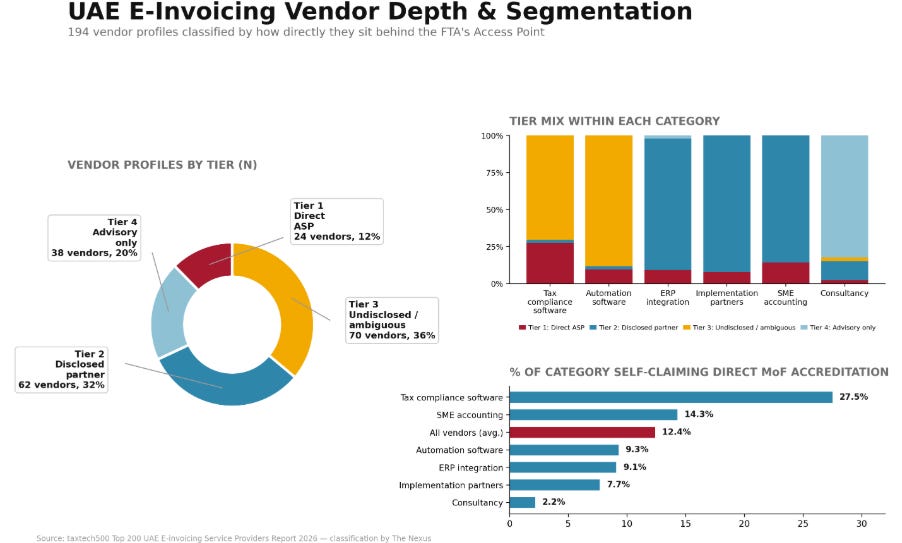
That single fact matters more than any category tag. So we re-sorted the market on a different axis: how directly does this vendor sit behind the FTA’s Access Point?
Tier 1 — Direct ASP. Runs its own Access Point. Self-declared, MoF accredited or pre-approved. e.g. SAP, Avalara.
Tier 2 — Disclosed partner. Doesn’t claim accreditation, but its category structurally admits it isn’t the ASP — ERP integrators, implementation partners, SME accounting platforms. e.g. Xero, NTT DATA.
Tier 3 — Undisclosed / ambiguous. Markets itself as a compliance or automation platform. Doesn’t claim accreditation. Doesn’t disclose a partner either. You genuinely cannot tell from the listing. e.g. Coupa, Tradeshift.
Tier 4 — Advisory only. No transmission technology. Guidance, impact assessment, change management. e.g. Deloitte, PwC Middle East.
Direct, self-declared accreditation is the smallest bucket in the market, not the largest.
What each tier actually exposes you to
Every tier trades a benefit for a risk. None of them is a free lunch — including the one that looks safest on paper.
Tier 1 — Direct ASP. The benefit is the shortest possible chain of accountability: one contract, one entity legally on the hook when an invoice fails validation, a direct line to the FTA with nothing in between. The risk is narrower than it looks — accreditation is a point-in-time claim, not a permanent state, and a UAE-only build wearing a global-sounding name may carry less multi-jurisdiction depth than the marketing implies. Verify the claim is current, not just present.
Tier 2 — Disclosed partner. The benefit is honesty by construction, and often real convenience: the vendor is usually a platform you already have a relationship with — your ERP reseller, your accounting software, your project delivery partner — so there’s no new vendor-management overhead to absorb. The risk is the extra hop itself: if the ASP sitting behind them has an outage, loses accreditation, or changes commercial terms, you inherit that risk with less visibility and less leverage than if you’d contracted with the ASP directly.
Tier 3 — Undisclosed / ambiguous. There’s no clean benefit here by design — but pragmatically, these are often the most feature-rich platforms on the list, bundling AP/AR automation, analytics and multi-country compliance into one product, so if it works, you get more than a bare invoice connection. The risk is that you cannot assess your own dependency chain from the outside. If something breaks during go-live, you don’t know in advance whether the vendor or whoever’s Access Point they’re quietly sitting on is the one responsible for fixing it.
Tier 4 — Advisory only. The benefit is real expertise in exactly the problem a mandate like this creates internally — impact assessment, stakeholder alignment, change management across finance and IT — which is a genuinely different skill from running compliant infrastructure. The risk is that they carry zero technology accountability by definition, and a number of firms in this tier hold referral or commission arrangements with specific ASPs, which can quietly shape which vendor they end up recommending. Ask directly before assuming the recommendation is neutral.
Tier 3 isn’t a red flag on any one vendor — it’s a gap in the marketing copy that’s yours to close.
Two markets colliding inside one directory
Roughly two-thirds of the 200 are UAE-headquartered. The remaining third splits mostly between India and the US, with a smaller European cluster — and that third is where the household names live. SAP, Avalara, Sovos, Coupa, Tradeshift, Basware, Comarch and Wolters Kluwer are the same names anchoring the broader ~$7–10B+ global indirect tax technology market, extending an existing platform into PINT-AE coverage. Set against that: close to one in six entries with a founding date on record were established in just the last three years, squarely because of the mandate. Two different kinds of vendor, two different risk profiles, one directory that doesn’t flag the difference.
Dealing with a global major carries its own trade-off. The benefit is institutional weight: a platform that’s already survived EU VAT in the Digital Age, Saudi’s ZATCA mandate, or a dozen other CTC rollouts elsewhere is unlikely to vanish mid-contract, and usually arrives with support infrastructure built for scale. The cost is attention. UAE is one jurisdiction among dozens on their roadmap, which means local PINT-AE nuance, UAE-specific support depth, and how fast they respond to an FTA guidance change can all lag a business that was built for nothing else.
A UAE-native, mandate-driven entrant flips that trade-off. The benefit is focus: a platform built specifically for PINT-AE and the DCTCE model from day one, often with faster local support and a genuine incentive to prove itself while the market is still forming. The cost is unproven longevity — a company founded in 2025 for a 2027 deadline has no track record surviving a renewal cycle, let alone the next regulatory shift, and a thin team means less resilience if key people leave or the business gets folded into a larger platform mid-contract. This is exactly why the same tier label can mean different things depending on which cohort it’s attached to: a Tier 3 global major is ambiguous about UAE accreditation because UAE is one listing among dozens on a much bigger site — the company itself isn’t going anywhere, so the real question is how deep its UAE-specific investment actually runs. A Tier 3 UAE-native entrant carries a different risk stack entirely — the ambiguity might mean accreditation genuinely isn’t finished yet, or that they’re quietly routing through a partner while they wait, and if it’s also a business with no track record before 2024, you’re stacking accreditation risk directly on top of longevity risk. Same tier label. Different question to ask.
The buyer’s decision sequence
Knowing the tiers exist doesn’t tell you what to do Monday morning. Here’s the sequence, in order.
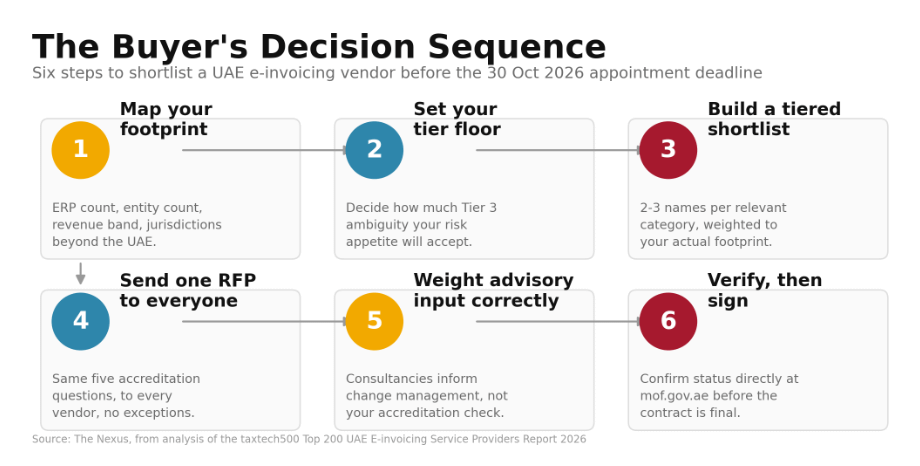
1. Map your footprint before you look at a single vendor. Count your ERPs, your legal entities, and check your revenue against the AED 50m threshold — that alone determines your compliance date. Note any jurisdictions you operate in beyond the UAE. This single step rules out three of the six categories before you’ve read a single pitch: a single-entity SME on one accounting platform has no business evaluating an implementation partner built for multi-ERP estates, and vice versa.
2. Set your tier floor before you’re charmed by a demo. Decide, in writing, how much Tier 3 ambiguity your risk appetite will actually accept — before you’re in a sales call. A regulated, high-volume, audit-intensive business should set the floor at Tier 1, or a Tier 2 vendor whose named underlying ASP you’ve independently verified. A low-volume SME may reasonably accept a Tier 3 platform if it’s paired with a Tier 2 or Tier 4 check elsewhere in the process. Set this number first. Vendor charisma has a way of moving it mid-conversation if you don’t.
3. Build a tiered shortlist, two to three names deep. Pull names from the category that matches your footprint, and deliberately include vendors from more than one tier — not three flavours of the same risk. This is where the composite chart above earns its keep: it tells you which categories are safe to shortlist on category alone (ERP integration, implementation partners and SME accounting are 85–92% Tier 2 by construction) and which categories need individual vetting no matter how polished the listing (tax compliance software and automation software, where the ambiguous share runs 71–88%).
4. Send the same five questions to every name on the list, no exceptions. Are you MoF-accredited yourselves, or routing through a partner’s Access Point — and if the latter, who, with accreditation we can check independently? What happens to our invoice flow and archive if that underlying relationship changes? Do you hold a referral, commission, or reseller arrangement tied to whichever ASP or platform you’re recommending? Outside the UAE, are you an established Peppol/CTC operator, or is this the first mandate you’ve built for? If compliance sits inside a broader product, how deep does that layer actually run versus how thin is the wrapper around a third-party connection? Identical questions, every vendor, so the answers are actually comparable — and treat vagueness on question one as an answer in itself.
5. Weight advisory input correctly. If a consultancy is involved, use their output for the impact assessment and the change management sequencing — not as your accreditation verification. Keep the two purchase decisions separate in your budget and your contract, so a referral arrangement can’t quietly re-enter through the back door of “our recommended partner.”
6. Verify, then sign, then verify again. Before the contract is final, check mof.gov.ae directly — regardless of what any vendor, consultancy, or directory (including this one) has told you. Build the 30 October 2026 appointment deadline and the 1 January 2027 compliance date explicitly into the contract’s milestone schedule, not just into the sales deck.
Ask the question the report won’t ask for you: who’s actually running your Access Point?
Quick reference: navigating each category
Tax compliance software — verify accreditation directly at mof.gov.ae; ask whether they run their own Access Point or route through a named partner.
Automation software — push on how deep the compliance layer runs versus how thin the wrapper is around a third-party ASP; a good default only if you already run their AP/AR workflow.
Consultancy — ask about referral arrangements up front; use for change management, not as a substitute for vetting the ASP they recommend.
ERP integration partners — confirm exact version/module coverage; expect to need more than one partner if you run more than one ERP.
Implementation partners — ask who they subcontract to for the platform-specific work; map the timeline explicitly to the mandate’s two key dates.
SME accounting software — most already route through a small number of accredited partners behind the scenes; differentiate on onboarding, support and price, not on which ASP.
The landing punch
Watch the next twelve months for the tell. Expect the global majors to keep quietly acquiring or partnering with the accredited local ASPs sitting underneath the white-label layer — because owning the rails is worth more than owning another logo in a 200-name directory. And expect the buyers who asked the depth question up front to be the ones who aren’t renegotiating their stack in Q2 2027.
Two hundred vendors. One real question. Ask it before you sign.
Graphics and data: The Nexus, from analysis of the taxtech500 Top 200 UAE E-invoicing Service Providers Report 2026. Tier classification is derived from each vendor’s own description text and category tags as published in the report — not verified against the Ministry of Finance’s live accreditation list. Always confirm current status directly at mof.gov.ae.

A selection of of opportunities to connect in person and interact online over the next few weeks.
SEPTEMBER 2026
Avalara CRUSH 2026 (Conference)
Avalara | 22–24 September 2026 | Fort Lauderdale, FL
Avalara’s premier annual conference returns as agentic AI reshapes tax and compliance. A key gathering for finance, tax, and technology professionals exploring the future of automated, AI-powered global tax compliance — with product deep-dives, partner sessions, and peer networking.
InnovAIT 2026 — AIT Annual Conference (Conference)
AIT UK (Accountants in IT) | 23–24 September 2026 | Sofitel London Heathrow T5, London, UK
Brings together IT directors and senior technology leaders from many of the UK’s top accountancy firms for presentations, roundtable discussions, and networking on how firms are adopting AI and automation — relevant context for tax technology stacks sitting inside accounting practices.
E-Invoicing Exchange Summit 2026 (Conference)
E-Invoicing Exchange | 30 September – 2 October 2026 | Hotel MOA Berlin, Berlin, Germany
The leading independent e-invoicing industry event returns to Berlin, bringing together enterprises, tax authorities, and technology providers to share insights on cross-border interoperability, regulatory readiness, and the growing impact of AI on e-invoicing and tax processes.
OCTOBER 2026
ITR AI in Tax Forum 2026 — Middle East (Conference)
International Tax Review | 6 October 2026 | Dubai, UAE
ITR’s AI in Tax Forum comes to the Middle East, bringing together in-house tax leaders, advisors, technology providers and tax authorities to examine the fast-evolving role of AI in the region’s tax landscape.
Digital Accountancy Show 2026 (Conference)
Easyfairs / Digital Accountancy | 7–8 October 2026 | ExCeL London, London, UK
The UK’s largest accountancy technology event, now in its sixth year, bringing together 7,000+ accountants and finance leaders to explore AI-driven automation, workflow tools, and digital transformation — co-located with the Digital Finance Show.
Join PwC and Meridian to Discuss Navigating the Future of Tax Compliance (Roundtable)
PwC / Meridian Global Services | 8 October 2026, 13:30–17:30 | PwC Amsterdam Offices, Thomas R. Malthusstraat 5, Amsterdam, Netherlands
An in-person roundtable bringing together finance, tax, and IT leaders to discuss the future of tax compliance, indirect tax automation, and readiness for evolving mandates.
Power of 3: PwC, SAP & Vertex (Roundtable)
PwC / SAP / Vertex | 15 October 2026 | TBC
A joint client event from PwC, SAP, and Vertex on e-invoicing, SAP transformation, and tax technology, flagged by PwC’s Ron Sperling as part of a run of autumn 2026 events. Private/invite-only — no public registration page found; details expected closer to the date.
TEI Annual Conference 2026 (Conference)
TEI — Tax Executives Institute | 21 October 2026 | Grand Hyatt Nashville, Nashville, TN
TEI’s flagship annual conference for senior in-house tax professionals, featuring high-level sessions on federal, state, and international tax developments, technology, and the evolving role of the corporate tax function.
5th Annual VAT Compliance and Indirect Tax Forum 2026 — ITX (Conference)
Amistat Group | 21–22 October 2026 | Van der Valk Hotel, Brussels, Belgium
Over 20 senior speakers across 20 high-level practical sessions on VAT compliance, AI in tax technology, and e-invoicing, plus 6+ hours of dedicated networking. Sponsored by Blue dot, Fintua, Meridian, 360WEDO, and VATabout.
IVA Autumn Conference 2026 (Conference)
International VAT Association (IVA) | 22–23 October 2026 | Marseille, France
The IVA’s flagship autumn gathering brings together VAT professionals, businesses, tax authorities, and international organisations from around the world for one of Europe’s leading VAT events. Full agenda and speakers to be announced closer to the date.
ITR AI in Tax Forum 2026 — USA (Conference)
International Tax Review | 26 October 2026 | New York, USA
ITR’s dedicated AI in Tax Forum returns to the US, examining how artificial intelligence is moving from early promise to everyday reality across direct and indirect tax functions — with senior in-house perspectives on implementation, governance, and what’s next.
E-Rechnungs-Gipfel 2026 — Repeat Edition (Conference)
Vereon AG / E-Invoicing Exchange Summit | 26–27 October 2026 | Frankfurt am Main, Germany
A second Frankfurt edition of Germany’s e-invoicing summit, added after the June Berlin edition sold out — covering XRechnung, ZUGFeRD, Peppol and EN16931 compliance ahead of the January 2027 mandate deadline.
*any organisers or events I’ve missed? please let me know.

A curated selection of blogs, white-papers and on demand content published by multiple organisartions across the landscape, organised into a themed learning path.
SEPTEMBER 2026
E-Invoicing, Direct Tax, Pillar Two & Synthesis
September covers the live mandate wave — France’s CTC goes mandatory this month — alongside Pillar Two post-filing analysis, corporate tax provision, and a synthesis capstone. Each week maintains the cross-theme mix, combining e-invoicing, direct tax, and operational content.
Week 1 · 7–11 September
The Live Mandate Wave: France, Slovakia, CTC Foundations & the Global Picture
📖Continuous Transaction Controls: The Future of Compliance Sovos12–15 min
📖Global VAT Guide: July 2026 VATupdate / Fintua 10–15 min
📖Sovos TaxScapes Q1 2026: France CTC Pilot, KSeF & Norway Acceleration Sovos 12–15 min
📖5 Things We Can Learn from Belgium’s 2026 E-Invoicing Mandate Innovate Tax 8–10 min
🎥E-Invoicing Trends and Obligations: 2026 and Beyond (feat. Forrester) Comarch / Forrester 60 min
🎥Countdown to Slovakia 2027: Preparing for Mandatory E-Invoicing and Digital Reporting Sovos 45–60 min
Week total: 4 articles + 2 webinars · ~147–175 min (~2.5 hrs)
Week 2 · 14–18 September
ViDA, Platform Architecture & Emerging Markets
📖What is ViDA? VAT in the Digital Age Initiative Q&APagero (Thomson Reuters) 12–15 min
📖Streamline the Future #6: Reporting Built for Global E-Invoicing Operations Comarch 8–10 min
📖Brazil 2026 Tax Reform: Key E-Invoicing Changes Fonoa 10–12 min
📖Leading the Charge: E-Invoicing as the Cornerstone of Future Compliance Vertex Inc. 10–12 min
📖E-Invoicing Transformation: How to Get It Right Pagero (Thomson Reuters) 10–12 min
📖E-Invoicing in Norway and Latest European VAT Updates Marosa VAT 8–10 min
🎥E-Invoicing in Eastern Europe: KSeF, ViDA, Romania, Hungary & BeyondP agero (Thomson Reuters) 45 min
Week total: 2 articles + 1 webinar · ~103–116 min (~1.75 hrs)
Week 3 · 21–25 September
Pillar Two, GIR Filing & the Side-by-Side Package
📖Orbitax Launches Global Pillar Two Compliance Accelerator Orbitax 10–12 min
📖Global Minimum Tax and the Data Management Dilemma Thomson Reuters / Orbitax 10–12 min
📖OECD Side-by-Side Package: Relief for US Multinationals RSM US 12–15 min
📖The New Pillar Two Framework: Unboxing the Side-by-Side Package Alvarez & Marsal 15–18 min
🎥Pillar Two Compliance: Grant Thornton & Orbitax Strategies Orbitax / Grant Thornton 60 min · CPE
🎥Seamless Tax Data Integration: From Any System to Pillar Two Compliance Orbitax / Deloitte 45–60 min
Week total: 4 articles + 2 webinars · ~152–177 min (~2.5 hrs)
Week 4· 28 September – 2 October (Capstone)
Provision, Maturity, US Tax Landscape & Full Synthesis
📖QDMTT: Stay Ahead of the Global Minimum Tax Curve Orbitax (Thomson Reuters) 12–15 min
📖How to Build a Winning Indirect Tax Maturity Roadmap Fonoa 12–15 min
📖The Future of Indirect Tax: 3 Traits Every Modern Tax Team Needs Fonoa 8–10 min
📖2025 Tax Recap & 2026 Preview: OBBBA Compliance UpdatesWolters Kluwer / CCH 8–10 min
📖2025 Tax Recap and 2026 Preview for Accounting Firms Wolters Kluwer / CCH 10–12 min
📖AI-Enabled Tax Transformation Deloitte Global 20–25 min
🎥Taking Corporate Tax Management Beyond Provision with Longview insightsoftware / International Tax Review 60 min
Week total: 6 articles + 1 webinar · ~130–147 min (~2.25 hrs)
September total: 20 articles + 6 webinars = 26 resources · ~532–615 min (~8.5–10 hrs)
*any cool content I’ve missed? please let me know.

A selection of open roles across tax tech vendors and tax advisory/consulting businesses who are involved in tax technology.
In house roles are provided courtesy of the smart people at https://taxjobs.ai
Use the column headers to sort, or the search function and don’t forget to navigate all pages!
*I do this using an AI agent and due to the volume, I don’t check every link, so please let me know if any of these don’t work or have disappeared when you follow them.

Want to go deeper? Let’s chat
For Buyers - bespoke vendor analysis, comparisons, tailored market research and vendor selection
For Vendors - Go To Market analysis, strategy and execution support, interim leadership
Click on the image below