


TL;DR , Fonoa and Avalara updates, 142 new Jobs, 8 events, 3:01 hours of learning and Fintua vendor profile
This week in Taxtech: A New owner for PwC’s Edge & a new CEO for Avalara
Somewhat annoyingly, just as I’d completed and published the Fonoa Vendor profile, they went ahead and acquired Edge from PwC and raised their Series C which is really cool news but sadly means my analysis was immediately rendered out of date. I’ll work to update this in the background but for now here’s my take on the new news:
My quick take on this:
✅ Gets them out of the digital services pigeonhole (for reporting)
Fonoa’s stack was credible but contextually narrow — reviewers and analysts (including this one) kept appending “for digital services businesses.” Edge changes that framing overnight. A VAT/GST compliance and e-filing system used by global enterprises across industries is not a niche play. Fonoa can now walk into a traditional multinational with a reporting capability that doesn’t require the buyer to be a marketplace or a SaaS company to see the value.
✅ Provides cross-sell opportunity into the Edge base
Edge’s existing client base almost certainly has indirect tax determination, e-invoicing, and tax-ID validation needs that Fonoa’s core platform was built to solve. They now own the relationship and the right to have that conversation — without winning a single new logo. That installed base is the most valuable commercial asset in this deal, and it compounds: every Edge client that Fonoa upsells onto the broader platform becomes evidence that the unified lifecycle story isn’t just positioning.
✅ Adds some 💶 runway after a long funding gap
Forty-four months between priced rounds is a long time to be running on Series B fumes, whatever the internal cash dynamics actually looked like. The $110M Series C resolves that publicly — it resets the conversation with enterprise procurement teams who were quietly asking the runway question, restores the narrative momentum needed to accelerate hiring, and (hopefully) gives Fonoa the capital to actually integrate two acquisitions simultaneously without a race to profitability forcing product compromises. The timing, a day before we published this profile, was either very good luck or very deliberate.
✅ Cements a structurally differentiated relationship with PwC (started with GITC)
One acquisition from a Big 4 firm is opportunistic. Two is a strategy. PwC is now an anchor customer across both GITC and Edge, a named endorser at the Global Tax & Legal Services Leader level, and the most recognisable brand in professional services telling the market that Fonoa is where it sends its compliance infrastructure when it wants to divest. No other indirect tax challenger has that (since 2010 anyway when TR bought Deloitte’s abacus). It also creates a quiet distribution lever: every PwC indirect tax engagement globally is now a potential conversation about Fonoa’s platform, without Fonoa having to run a single sales motion to get in the room.
⚠️ How much of Edge is actually SaaS and how much is PwC service wraparound
This is the question that should be at the top of everyone’s list, and the one Fonoa has the least incentive to answer publicly. Edge was built inside a consulting firm to support consulting engagement and to support PwC’s managed compliance services. The pattern is consistent: these tools were designed to make PwC’s people more efficient, not to stand alone. If a meaningful portion of Edge’s revenue only flows when a PwC partner is in the room, Fonoa hasn’t bought a SaaS product — it’s bought a dependency. The valuation multiple, the integration thesis, and the cross-sell story all look materially different depending on the answer.
⚠️ The single platform story just got complicated
This was Fonoa’s cleanest competitive advantage over the established market: one data model, one API surface, no acquisition patchwork. That story is now harder to tell. Fonoa is simultaneously integrating GITC (partial exemptions, FS clients, mid-integration as of today) and Edge (transactional monitoring, compliance reporting, enterprise multi-industry clients, just announced). Two acquisitions in eighteen months, both from the same firm, both requiring data model reconciliation with the unified platform — that’s not a roadmap risk, it’s an execution test. The “we built it once, right” positioning was always the implicit dig at legacy vendors who stitched together their global footprint through M&A. Fonoa just became that vendor, at least temporarily. The question is how long “temporarily” lasts.
🍊So last week Avalara got a new CEO, big news for sure and anyone who’s ever worked othere will understand how deep the cult of orange culture that Scott McFarlane created goes. But it got me thinking, what does it mean for Avalara’s customers and employees?
We already know what they think of Avalara but what sort of experience did Narrazin create at Udemy and what does that tell us about what’s potentially coming down the line?
Let’s look at the data:
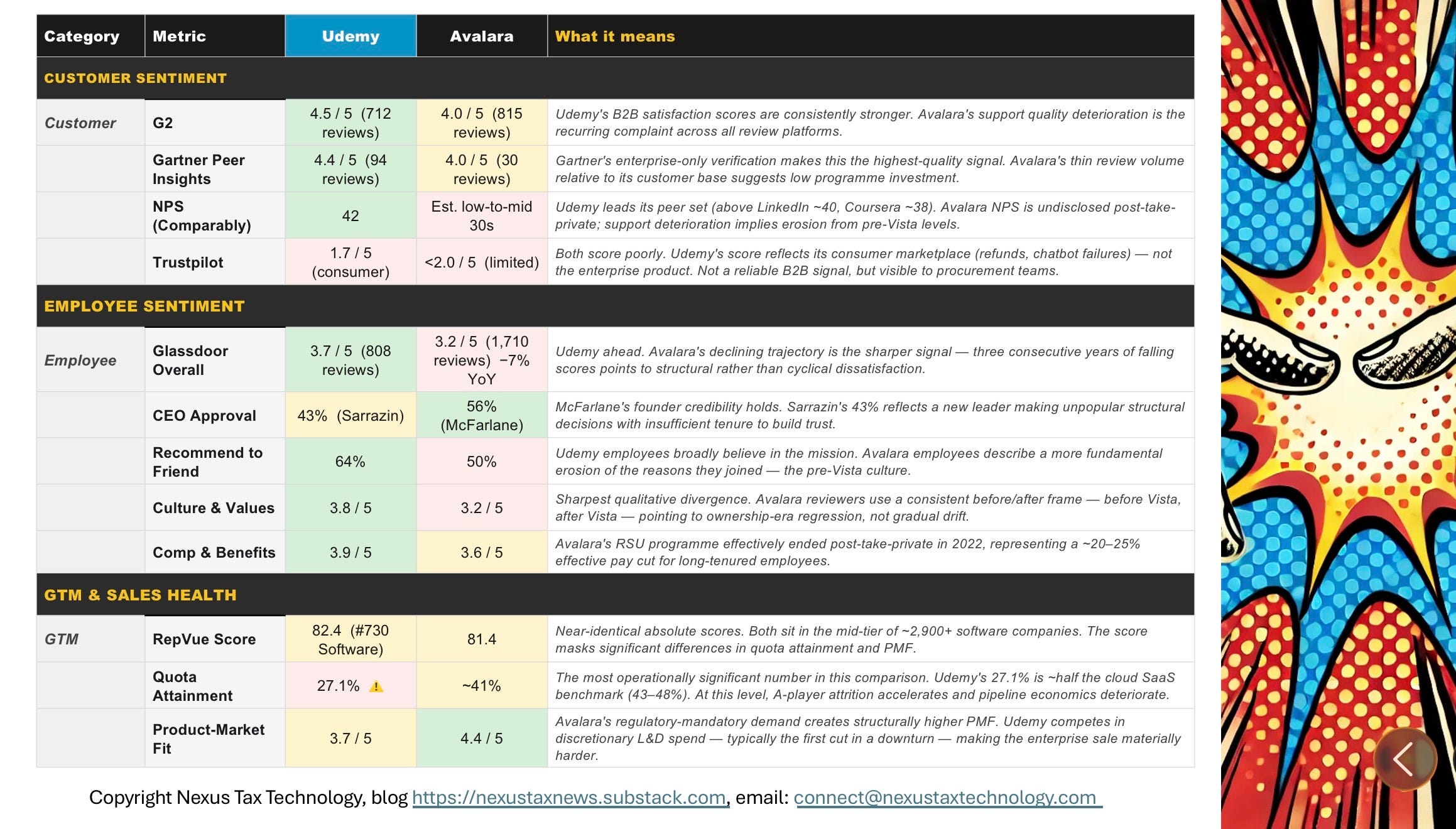
✅ Customer Sentiment - Good News - G2, #NPS and Gartner all ahead of Avalara’s
On the customer side, Udemy holds a consistent edge across every B2B review platform — 4.5/5 on G2 against Avalara’s 4.0, matched on Gartner Peer Insights, and ahead on NPS (42 vs an estimated low-to-mid 30s for Avalara post-take-private). The gap isn’t dramatic, but the direction of travel is. Avalara’s scores are declining; Udemy’s are stable. The shared weak point is support quality — both vendors draw the same complaint — but for Avalara it’s a structural deterioration tied to Vista-era cost extraction, not a product problem. That distinction matters for renewal conversations.
⚠️ CEO approval - Not so good - Glassdoor has Sarrazin at 43% vs McFarlane at 56% ✅ Employee Sentiment - culture, benefits & general health all ahead at Udemy
The employee picture tells a sharper story. Udemy’s 3.7 Glassdoor rating sits half a point above Avalara’s 3.2, which has fallen 7% in twelve months — three consecutive years of declining scores that point to something structural rather than cyclical. Fifty percent of Avalara employees would recommend working there; 64% would at Udemy. The one metric Avalara wins is CEO approval: McFarlane’s 56% reflects founder credibility doing real work against a difficult backdrop, while Sarrazin’s 43% reflects a new leader making unpopular calls — RTO, merger, layoffs — without enough tenure yet to build trust. Culture and values is where the divergence is most acute: Avalara reviewers frame everything in a before/after structure — before Vista, after Vista — that describes ownership-era regression, not drift.
🚨 GTM - Oh dear - RepVue #PMF down and #quota attainment way below (and Avalara was already pretty bad on that one)
GTM is where the comparison gets uncomfortable for Udemy. Quota attainment of 27.1% is roughly half the cloud SaaS benchmark and less than half Avalara’s ~41% — and Avalara itself is below par. The structural reason is product-market fit: Avalara’s 4.4/5 PMF score reflects regulatory-mandatory demand where the sale is largely about implementation timing, not conviction. Udemy competes in discretionary L&D spend, typically the first line item cut in a cost cycle, which makes the enterprise motion materially harder regardless of product quality. Revenue per employee tells the other side of that story — Udemy’s ~$631K reflects genuine marketplace leverage; Avalara’s lower ratio reflects the cost of running a compliance infrastructure business at scale. Both numbers are defensible. Only one of the GTM machines is currently working.
🇮🇪 Vendor Spotlight: Fintua
Fintua: The Self-Funding Compliance Stack That VAT Recovery Built
Every CFO is sitting on a pot of unreclaimed VAT they don’t know about. Fintua — formerly Taxback International, now rebranded and retooled as a SaaS compliance platform — has built its entire commercial logic around that fact. As VAT recovery funds compliance, and as e-invoicing mandates from Warsaw to Brussels accelerate through 2025 and 2026, the question is whether a 30-year-old services business can complete its SaaS transformation before the next wave of complexity lands.
What Fintua Actually Is
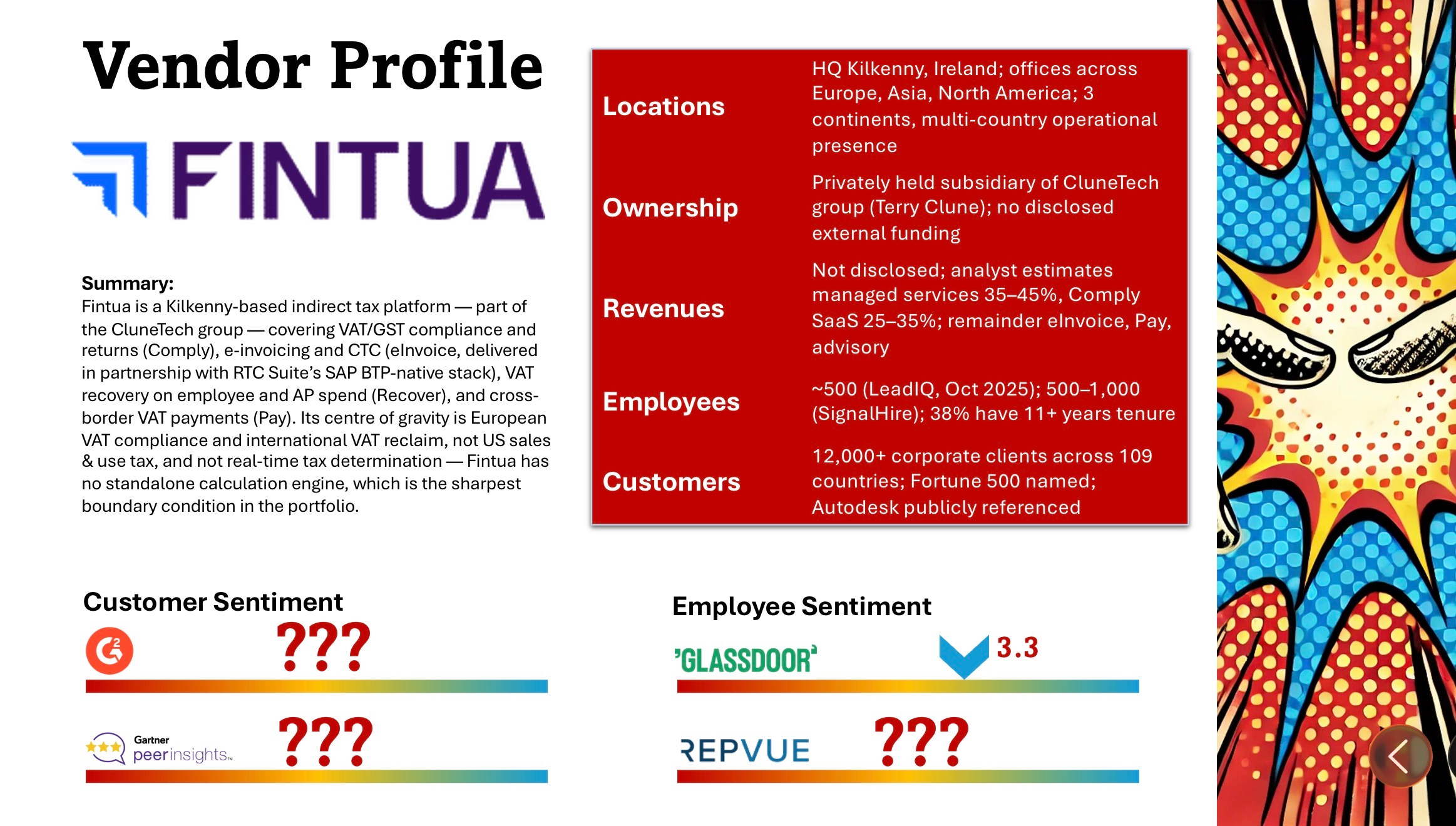
Fintua is a Kilkenny-based indirect tax platform — part of the CluneTech group — covering VAT/GST compliance and returns (Comply), e-invoicing and CTC (eInvoice, delivered in partnership with RTC Suite’s SAP BTP-native stack), VAT recovery on employee and AP spend (Recover), and cross-border VAT payments (Pay). Its centre of gravity is European VAT compliance and international VAT reclaim, not US sales & use tax, and not real-time tax determination — Fintua has no standalone calculation engine, which is the sharpest boundary condition in the portfolio.
Scale: approximately 500 employees (LeadIQ, October 2025), 12,000+ corporate clients across 109 countries including Fortune 500 names, and VAT recovery coverage in 180+ countries. Revenue is not separately disclosed from CluneTech group; the profile estimates services (reclaim) at 35–45% of revenue and Comply SaaS at 25–35%, with eInvoice, Pay, and advisory making up the balance. CluneTech is privately held with no disclosed external funding — a stability signal and an opacity one simultaneously.
The buyer who puts Fintua on a longlist is a multinational finance or tax director managing cross-border VAT filings across Europe, running meaningful travel and AP spend with unreclaimed input tax, and looking for a single vendor relationship across compliance, e-invoicing, and — crucially — recovery. If your team is building that business case, the numbers on recoverable VAT will almost always surprise you.
Where It Beats the Market Baseline
The self-funding model is genuinely unusual and consistently undersold. Fintua’s Recover product operates on a contingency basis — it earns a share of recovered VAT on travel, hotel, and AP spend across 180+ countries. For a multinational business with significant European supplier and travel spend, that reclaim can run to six or seven figures annually and materially offset the cost of Comply and eInvoice. No pure-SaaS compliance platform offers this dynamic. It is not a gimmick: it is a structural TCO advantage that buyers routinely miss because they compare headline SaaS pricing without modelling the recovery offset.
VAT filing coverage is genuinely broad: 109 countries for managed filing services, with 30 years of operational depth that no challenger built in the last five years can replicate. The Conferma partnership and SAP Concur App Center listing for Recover validate the operational maturity of the recovery motion at scale. And the RTC Suite partnership meaningfully upgrades the e-invoicing story — RTC is a SAP Build & OEM Partner, Peppol and EESPA member, with EY and Alvarez & Marsal as SI partners — bringing SAP BTP-native CTC coverage for Italy SDI, Poland KSeF, Belgium Peppol, and Germany XRechnung into Fintua’s platform.
Where Fintua is at or below baseline: no tax calculation engine (a firm gap, not a roadmap item); no US S&U depth beyond a service add-on; no Big-4 / SI partnership in Fintua’s own name; zero peer reviews on G2, Capterra, TrustRadius, or Gartner Peer Insights under either brand; and API maturity that is not yet developer-portal-grade.
Portfolio Analysis
Fintua’s portfolio shape is that of a services business in mid-transition to SaaS — not a built-from-scratch platform company. Recover (VAT reclaim) is the oldest, deepest, and most operationally mature product line; it funds the others, both commercially and reputationally. Comply (VAT returns) is the primary SaaS growth bet and the product Fintua markets most aggressively to new enterprise buyers. eInvoice is strategically important and now better supported by the RTC Suite partnership, but it is early-stage in terms of commercial maturity and the product boundary between what Fintua delivers and what RTC delivers is not publicly documented. Pay is the most speculative line — cross-border payments via what is almost certainly TransferMate’s rails — and potentially the most interesting for digital and e-commerce buyers who need to close the compliance-to-settlement loop without stitching two vendors together.
The practical implication for operators: this is a services-plus-SaaS portfolio, not a clean-room platform. Different products are at very different levels of maturity, the brand transition from Taxback International is still landing, and the managed-service heritage means implementation motions and commercial structures may blend services and software fees in ways that require careful diligence. The Autodesk webinar reference is a strong signal of enterprise SaaS traction, but it is currently a data point of one, not a validated pattern.
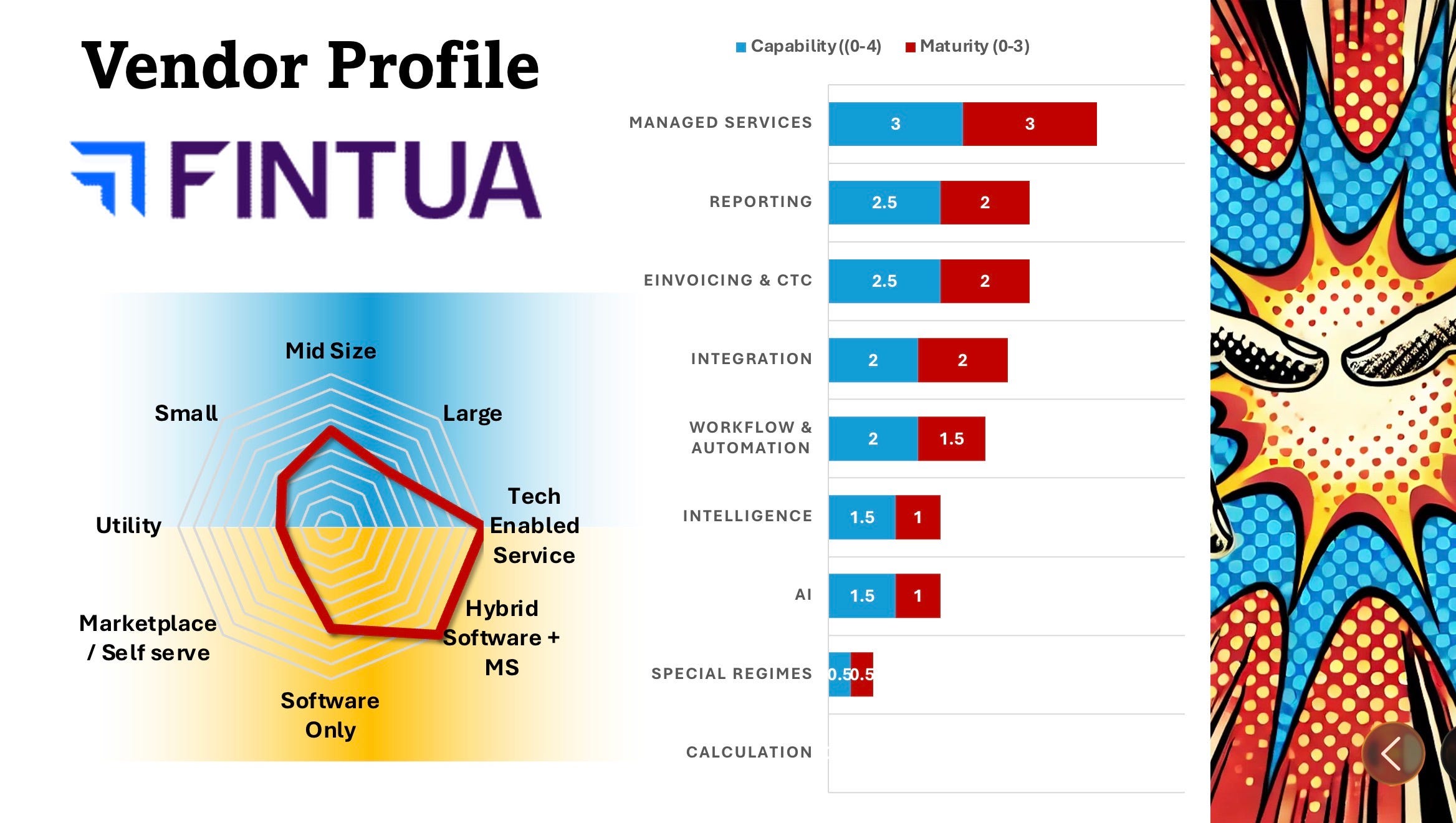
Business Model and Size Band Fits
Business model fit
• B2B/B2C services (non-digital): 3 – Strong fit. the natural home. Managed filing, advisory, and recovery depth align cleanly with professional services, financial services, and enterprise service businesses managing cross-border VAT.
• B2B goods: 2 – Good fit. solid for compliance and recovery on procurement spend; no calculation engine limits the upstream determination use case.
• B2C goods: 2 – Good fit. good for cross-border e-commerce with European VAT exposure; Pay adds settlement value; no e-commerce platform integrations and no OSS/IOSS self-serve automation limit the ceiling.
• B2B/B2C digital services: 2 – Good fit. — Comply covers multi-jurisdiction VAT filing, RTC Suite covers mandated e-invoicing, and Pay closes the settlement loop. Still no calculation engine for real-time transaction tax.
Size band fit
• Medium: 2 – Good fit. the sweet spot — multi-country VAT, meaningful travel and AP spend, SAP/Oracle/Dynamics ERP, enough complexity to justify the platform. Recover’s self-funding dynamic lands best here.
• Large: 2 – Good fit. credible for European multinationals with managed-service appetite; RTC Suite strengthens the SAP enterprise story. SI partner thinness and review footprint absence are procurement friction points.
• Small: 1 – Patchy fit. generally over-engineered and potentially over-priced without sufficient recoverable VAT to offset subscription costs.
Customer and Employee Sentiments
Customer sentiment is structurally unusual: Fintua has 12,000+ clients and 30 years in market, but zero reviews on G2, Capterra, TrustRadius, and Gartner Peer Insights under either brand. The most likely explanation is that the legacy Taxback International go-to-market relied entirely on referral and relationship sales — review platforms were simply not part of the motion. The rebrand has not yet generated a peer-review base. For buyers, this means reference calls are mandatory, not optional.
What is available is directionally positive:
• FeaturedCustomers (curated): 21 testimonials, 23 case studies, 9 videos — consistently praise VAT recovery quality, specialist domain knowledge, long-term relationship management (5+ years cited), and proactive account engagement.
• SAP Concur App Center: Recover listed as a trusted integration — implicit validation of technical and compliance standards without a public rating.
• Irish Accountancy Awards 2025: Best Use of Technology in Accounting & Finance and Client Services Award — credibility signal in the accountant channel.
• Tax Intelligence Frankfurt 2026: Fintua presented alongside RTC on reconciling VAT returns with e-invoicing data — active practitioner community presence.
Employee sentiment (Glassdoor, ~37 reviews under legacy Taxback entities): 3.3/5 overall, 3.1 on compensation, 3.6 on work-life balance. The 38% of staff with 11+ tenure is the standout data point — it signals genuine culture stickiness but also a talent base still weighted toward services roles rather than SaaS product and engineering. No RepVue data found for either brand.
Operator implication: strong managed-service delivery culture and high client retention are the clearest positive signals. SaaS product experience and commercial aggressiveness are harder to assess without peer reviews; expect the diligence process to be heavier than for a vendor with an established review footprint.
If You’re Building or Buying Indirect Tax Capability — Here’s the Read
For buyers
If you’re a medium or large enterprise finance team managing cross-border VAT across Europe, with meaningful employee-expense and AP spend, this vendor belongs on your shortlist — and the first thing you should do before any other analysis is model your recoverable VAT. Run the Recover numbers with your travel, hotel, and supplier spend data before you compare Fintua’s headline pricing against anything else. The net TCO picture will look different, and in some cases the platform is effectively self-funding.
If you’re an accounting or tax advisory firm wanting a platform to run client VAT compliance on, ‘Comply for Accountants’ is a named product, the advisory partner network (Forvis Mazars, WTS Global, KMLZ) adds depth, and the two Irish Accountancy Awards in 2025 are a genuine credibility signal in that channel. Shortlist with confidence and pilot on one client first.
If you’re an e-commerce or digital services business managing multi-currency VAT settlement, the combination of Comply, eInvoice/RTC, and Pay is more compelling than it looks on first pass — it is one of the few vendor relationships that covers the full compliance-to-payment workflow without a second contract. Confirm the Pay infrastructure (TransferMate relationship) and the RTC Suite integration SLA ownership before signing.
If you need real-time tax determination, do not shortlist Fintua. There is no calculation engine. This is a firm boundary, not a roadmap item. Source that capability separately and treat Fintua as a complement for compliance, recovery, and e-invoicing.
Regardless of segment: zero peer reviews on any structured platform means reference calls are not a nice-to-have. Request three calls with current SaaS clients (Comply and eInvoice, not legacy managed-service accounts) who went live in the last 24 months before you commit.
For prospective employees
• Strong move for tax domain specialists and managed-service delivery professionals: 30 years of operational depth, genuine jurisdictional breadth, and a client base that demands real expertise.
• Potentially attractive for SaaS product and implementation roles: the platform pivot is real and underway, but comp competitiveness (3.1/5 on Glassdoor) may not yet match pure-SaaS employer comparables — negotiate accordingly.
• The high-tenure culture is a double-edged signal: strong knowledge base and stable environment, but potentially slower career velocity than a venture-backed growth-stage platform.
• No RepVue data means sales org health is unverifiable publicly — ask directly about quota attainment, territory design, and pipeline generation support before accepting an AE or BDR offer.
• CluneTech group structure provides cross-business mobility (TransferMate, Immedis, Sprintax) as a retention and development lever — understand what that looks like in practice before evaluating the role purely on Fintua’s own footprint.
Want the full 26 page analyst report?

A selection of of opportunities to connect in person and interact online over the next few weeks
June 2026
**E-Invoicing Webinar Series (Webinar)**
**EDICOM** | 4–9 June 2026 | Online/Virtual
A series of educational sessions covering e-invoicing compliance across different regions and sectors, including global enterprises, law firms, and APAC-specific implementation, co-presented with Deloitte and KPMG respectively.
[Register →](https://edicomgroup.com/resources/webinars)
**Modernising E-Commerce with AI-Enabled Strategies: Shopify, Microsoft, and Vertex (Webinar)**
**Vertex, Inc.** | 9 June 2026, 14:00–15:00 EDT | Online/Virtual
A joint webinar exploring how AI-enabled tax and compliance strategies are transforming e-commerce operations, covering automated tax determination, real-time compliance, and the integration of Vertex’s engine within the Shopify and Microsoft ecosystem.
[Register →](https://www.vertexinc.com/resources/upcoming-webcasts-events)
**8th Annual VAT Management Summit (Conference)**
**Uniglobal** | 9–10 June 2026 | London, UK
Uniglobal’s annual London gathering for senior VAT managers and indirect tax leaders from multinational corporations, focused on VAT governance, technology, e-invoicing readiness, and compliance management across complex global organisations.
[Register →](https://www.uni-global.eu/future-events/)
Trade and Tariff Tuesdays — June (Webinar)
Avalara | June 16, 2026 | Online/Virtual
Avalara experts provide guidance on evolving international trade and tariff policy and its business implications in this recurring webinar session.
Register →
**ITR Indirect Tax Forum 2026 (Conference)**
**International Tax Review** | 23–24 June 2026 | Amsterdam, Netherlands
ITR’s flagship indirect tax conference bringing together senior in-house indirect tax professionals and industry experts for two days of curated discussion on VAT, e-invoicing, and digital transformation. Vertex and Fintua among sponsors.
[Register →](https://registration.crowdcomms.com/itrindtax)
Tax & Legal Tech Summit (In-Person)
KPMG | June 25, 2026 | Zurich, Switzerland Summit focused on AI, analytics, and automation transforming tax and legal functions.
Event Page → https://kpmg.com/ch/en/events/2026/06/tax-legal-tech-summit.html
**The Future of Tax Is Tech-Savvy (Webinar)**
**insightsoftware / KPMG** | 25 June 2026, 14:00 BST / 09:00 EST | Online/Virtual
Featuring KPMG’s Global Tax Transformation Leader alongside insightsoftware, this webinar examines how the corporate tax role is being redefined by technology — and how the right platform choices make the difference between keeping up and leading.
[Register →](https://insightsoftware.com/resources/the-future-of-tax-is-tech-savvy/)
July 2026
Global Withholding Tax Summit 2026 (In-Person)
Withholding Tax Summit | July 1, 2026 | London, UK Conference dedicated to withholding tax and cross-border compliance challenges, with emphasis on regulatory change and digitalisation.
Event Page → https://withholdingtaxsummit.com/
*any organisers or events I’ve missed? please let me know.

A curated selection of blogs, white-papers and on demand content published by multiple organisartions across the landscape, organised into a themed learning path.
MONTH ONE · JUNE 2026
Landscape, AI Strategy & the New Shape of the Tax Tech Market
This month maps the terrain: where the tax technology market is in mid-2026, how AI has moved from experimentation to deployment, what the data tells us about how tax teams are actually investing, and what differentiated strategies look like across the full spectrum from enterprise platforms to AI-native SMB tools.
Week 1 · 1–5 June
The State of the Market: What the Data Actually Says
We open with two benchmark research pieces that together paint the most accurate picture available of where corporate tax technology investment, adoption, and sentiment stands in mid-2026 — the Thomson Reuters Institute’s 2026 Corporate Tax Technology Report (built on 170 US tax decision-makers surveyed Nov–Dec 2025, in partnership with TEI) and Vertex’s Indirect Tax Trends report, which covers the regulatory and policy shifts driving the spending. KPMG’s freshly published connected modelling framework provides the advisory firm’s strategic synthesis.
01 📖 6 Insights from the 2026 Corporate Tax Technology Report Thomson Reuters Institute / TEI 10–12 min
02 📖 2026 Indirect Tax Trends Vertex Inc. 8–10 min
03 📖 The Future of Tax: Connected Modeling and an AI-Enabled Tax Function KPMG 8–10 min
Week total: 3 articles · ~26–32 min
Week 2 · 8–12 June
AI in Practice: From Bolt-On Tools to Agentic Workflows
A deliberately varied week — Wolters Kluwer on the organisational transformation challenges of AI adoption (not just the technology), Thomson Reuters on how indirect tax teams are building agility into their function, and Sphere’s independent overview of the AI tools landscape for tax professionals. Together these avoid the vendor echo chamber and give a rounded view of where AI is genuinely landing versus where it is still aspirational.
04 📖 Survive or Thrive? 2026 Will Test Tax Teams’ Limits Wolters Kluwer / CCH 6–8 min
05 📖 Indirect Tax Transformation: Navigating Change, Embracing Technology Thomson Reuters 10–12 min
07 📖 AI Tools for Tax Professionals: Automate Smarter, Not Harder Sphere 10–12 min
Week total: 3 articles · ~26–32 min
Week 3 · 15–19 June
The New Vendor Landscape: Enterprise to AI-Native, and Everything Between
This is the week where the expanded vendor universe comes into focus. Kintsugi’s 2026 SaaS guide is an unusually candid market map — covering the full spectrum from Avalara and Vertex at the enterprise end through to Anrok, Numeral, and Kintsugi itself for SMBs and SaaS companies, with honest commentary on where each fits and fails. Fonoa’s tech stack strategy piece provides the architectural counterpoint: how do you build a coherent compliance infrastructure rather than accumulating point solutions? The webinar from Wolters Kluwer closes the week with a live practitioner lens on the transformation challenge.
06📖Best Sales Tax Software for SaaS Companies: 2026 Guide Kintsugi 12–15 min
10📖Tax Tech Strategy: Integrate Technology for Compliance Fonoa 10–12 min
09🎥Beyond the Return: How AI and Automation Are Reshaping Tax Preparation Wolters Kluwer / CCH 50–60 min
Week total: 2 articles + 1 webinar · ~72–87 min
Week 4 · 22–26 June
The Strategic Lens: From Compliance Tool to Business Partner
Month One closes with two pieces that zoom out to the strategic and organisational challenge — Wolters Kluwer on the shift from compliance to advisory services, and Fonoa’s SYNAPSE 2026 practitioner takeaways on what the tax function looks like when real-time compliance is the baseline. The Vertex / Kintsugi investment announcement is included as a signal piece: what does it mean when the largest indirect tax enterprise vendor makes a strategic bet on an AI-native SMB platform?
08📖Beyond Compliance: How Tax Professionals Are Becoming Strategic Advisors Wolters Kluwer / CCH 8–10 min
11📖5 Key Indirect Tax Trends from SYNAPSE 2026 Fonoa 10–12 min
36📖Vertex Announces Strategic Investment in Kintsugi: What It Means for the Market Vertex / Kintsugi 6–8 min
Week total: 3 articles · ~24–30 min
Month One total: 9 articles + 1 webinar · ~148–181 min
*any cool content I’ve missed? please let me know.

A selection of open roles across tax tech vendors and tax advisory/consulting businesses who are involved in tax technology.
Use the column headers to sort, or the (new) search function and don’t forget to navigate all pages!
*I do this using an AI agent and due to the volume, I don’t check every link, so please let me know if any of these don’t work or have disappeared when you follow them.
✌ Last thoughts
Thanks again for reading! If you have any feedback, suggestions, want to contribute, share gossip or would like to work together in any way, email me here or hit the button below!