


TL;DR , Job market analysis, 150 new Jobs, 12 events, 5 hours of learning and Fonoa vendor profile
❤ Current state of tax tech hiring
This week I did a major refresh of the job data and the picture has changed somewhat. Bearing in mind that we’ve also seen some fairly significant headcount reduction activity from vendors like Vertex (discussed previously) and Intuit the tax technology labour market is still in active hiring mode. In particularl CCH, who has a whopping 500+ roles open, seems to be bucking the trend on human capital investment.
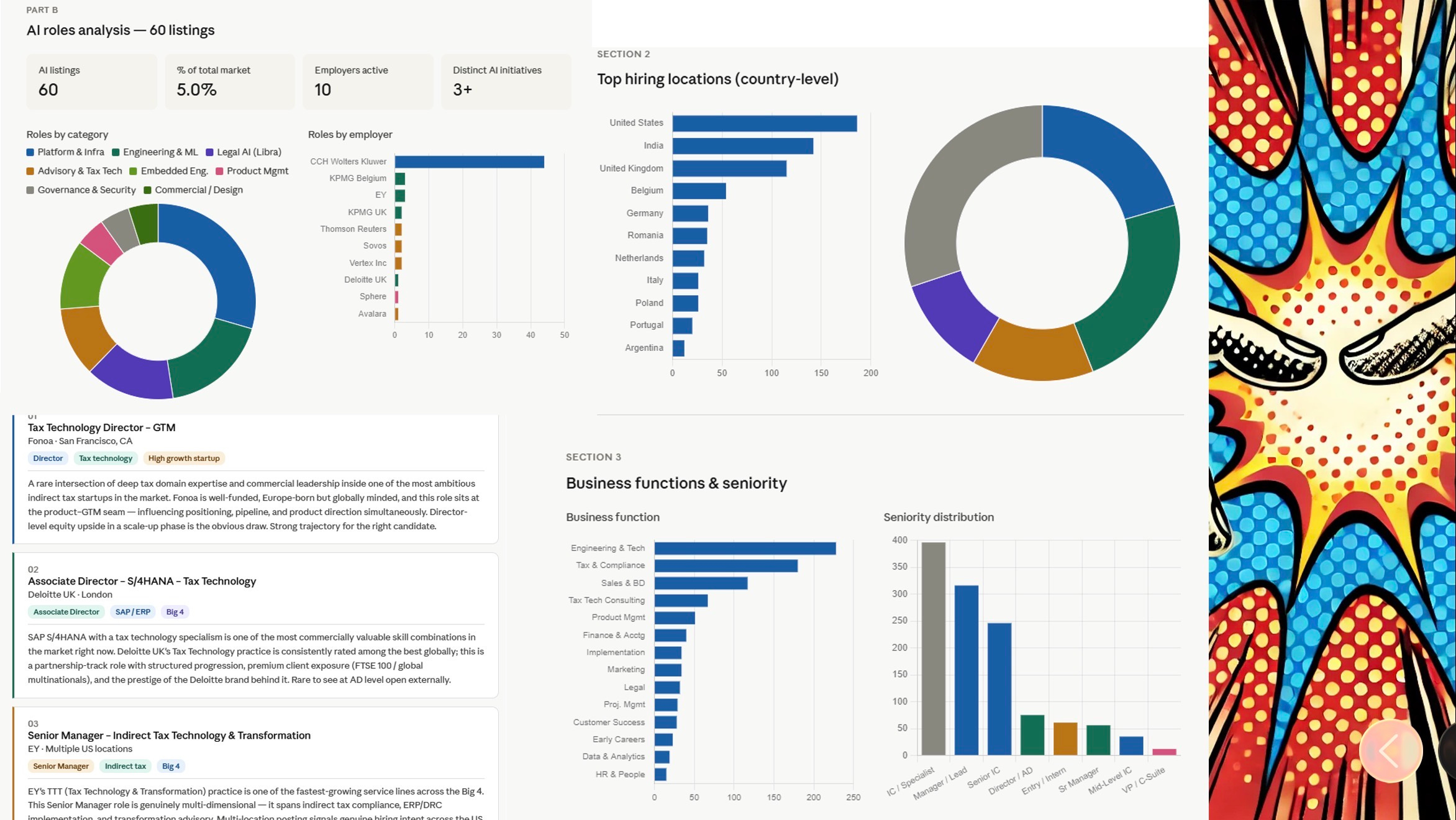
Across the 1,197 open positions from 32 employers I compiled, the functional mix tells a market-level story: engineering leads at 228 roles, with tax and compliance advisory close behind at 180 and sales and business development a solid third at 117 — a composition that reflects an industry simultaneously scaling build capacity and commercial reach. Seniority weighting is firmly toward experience, with IC and manager-level roles accounting for nearly 60% of listings and entry-level at just 5%. The US leads on geography at 186 listings, India follows at 142 as a delivery and engineering hub, and the UK sits third at 115, with a further European cluster across Belgium, Germany, Romania, and the Netherlands.
Market concentration is a structural feature of the current data. The Big 4 collectively account for around 150 listings across indirect tax advisory, tax technology consulting, and transfer pricing — active and competitive. Among dedicated vendors, Avalara, Sovos, Thomson Reuters ONESOURCE, and Vertex post between 13 and 71 roles each, a spread that signals meaningfully different growth postures heading into H2 2026. The dataset also captures a cohort of specialist challengers — Fonoa, Sphere, Anrok, Numeral, Marosa — whose targeted listings point to continued build-out across e-invoicing, sales tax automation, and cross-border compliance.
One data point requires context. CCH Wolters Kluwer’s 541 listings represent 45% of the total, creating an inherent skew across market-level aggregates. The remaining 31 employers account for 656 roles — a dataset that reads as more advisory-weighted, more US-concentrated, and with a thinner AI hiring profile (61 roles, 5% of total). The Nexus treats this not as noise to be smoothed over but as signal in its own right: concentration at this level reflects a vendor investing at a different order of magnitude from its peers, and that asymmetry is itself the story.
Now to move onto the first Vendor spotlight in the new series focussed on VAT native tech providers, or as I like to call them, the VAT Challengers.
💻Vendor Spotlight: Fonoa
Built Right (For Digital), Not Built Wide.
Digital-first businesses spent the last decade bolting legacy compliance stacks onto modern architectures. Fonoa was built for the other way around — and as tech enabled sales channels & ViDA’s platform economy and DRR regimes reshape global compliance for this category, the architecture question has become the strategy question.
WHAT FONOA ACTUALLY IS
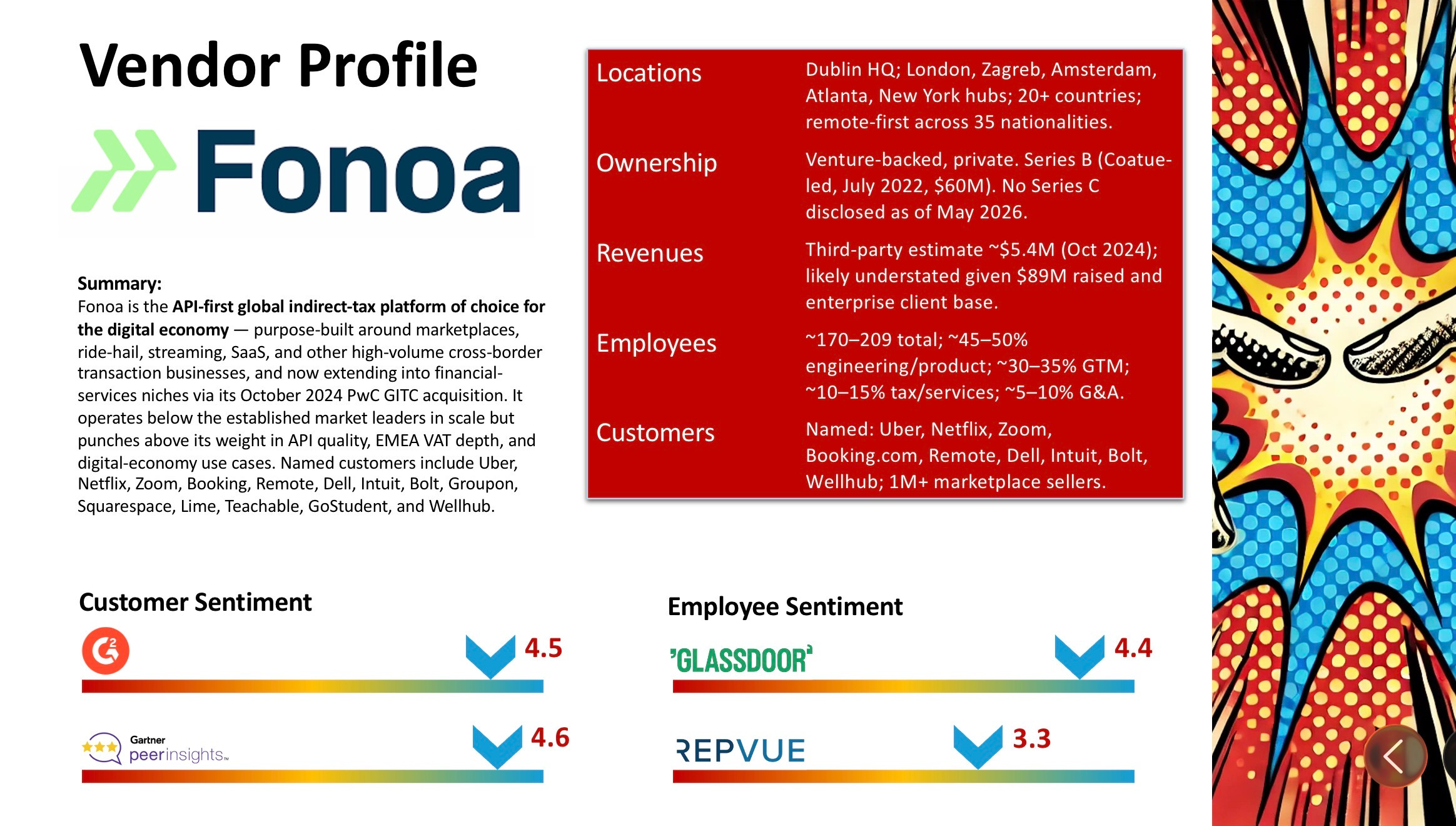
Fonoa is a Dublin-based indirect tax platform purpose-built for digital services and marketplace businesses — covering VAT/GST determination, tax-ID validation (Lookup), e-invoicing and CTC compliance, compliant invoicing, returns, and an AI-assisted regulatory intelligence layer. The Tax Engine was designed from day one for high-volume, cross-border digital transactions — not adapted from a US goods-first legacy — which shows in both the architecture and the client list: Uber, Netflix, Zoom, Booking.com, Remote, Dell, Intuit, Bolt, and Wellhub. Estimated headcount sits at 170–210, with ~$85–89M in disclosed venture funding across three rounds (last priced July 2022, Series B, Coatue-led). Three capabilities set it apart structurally: a tax determination engine purpose-built for digital services; a standalone tax-ID validation API (Lookup) with 115+ government sources that no established platform matches in breadth; and a single unified platform for returns and e-invoicing covering all regimes — VAT, US sales tax, LATAM CTC — on one data model. If your indirect tax problem is global digital VAT on a modern stack, this goes on your longlist.
WHERE IT BEATS THE MARKET BASELINE
Three structural advantages sit clearly above market baseline. First, the tax determination engine was purpose-built for digital services and marketplace transactions — SaaS, streaming, ride-hail, digital goods — not retrofitted from a goods-first platform. For this ICP the capability is leading; for B2B physical-goods supply chains, HS code classification, and exemption certificates, it drops materially and buyers should look elsewhere. Second, Lookup (tax-ID validation) is a standalone best-in-class USP with no close equivalent: 115+ government sources, fuzzy matching, real-time and batch modes. Established platforms typically embed lighter validators within their determination flow with a fraction of this source breadth. It is worth procuring independently of any broader Fonoa decision. Third, returns and e-invoicing run on a single unified global platform — VAT/GST, US sales tax, and LATAM CTC on one data model, not three inherited products from three separate acquisitions on three different schemas. Legacy vendors assembled their global footprint through regional buys; Fonoa built once. For a global tax team managing multiple regimes simultaneously, the operational benefit compounds. Where Fonoa is at or below baseline: US sales tax and goods content depth, no SAP-certified add-on, a thin SI ecosystem, and no purpose-built managed-services offering.
PORTFOLIO ANALYSIS
Fonoa has followed the classic API-platform arc — Lookup first, then Tax Engine, Invoicing, E-Invoicing/Reporting, Returns — adding one strategic acquisition: PwC’s Global Indirect Tax Compliance (GITC) product in October 2024, importing 40+ financial-services clients and partial-exemption automation. The acquisition count is itself a signal: where established platforms assembled global capability through repeated regional buys — a US filing tool here, a LATAM CTC tool there, a VAT returns engine from somewhere else — Fonoa built a single platform on one data model from day one. Tax Determination and E-Invoicing/CTC are estimated to account for roughly 55–65% of revenue combined, with Lookup adding 15–20% — a high attach rate reflecting its standalone marketability. The GITC deal is the most telling portfolio move: a gated FS vertical acquired without organic win cost, with PwC publicly committing to remain an “enthusiastic customer” post-sale. The gap remains delivery infrastructure — SI partner ecosystem and enterprise implementation capability are thin relative to the complexity of large-scale multi-country deployments.
SEGMENT, DELIVERY MODEL, AND SIZE BAND FITS
Segment archetype fit
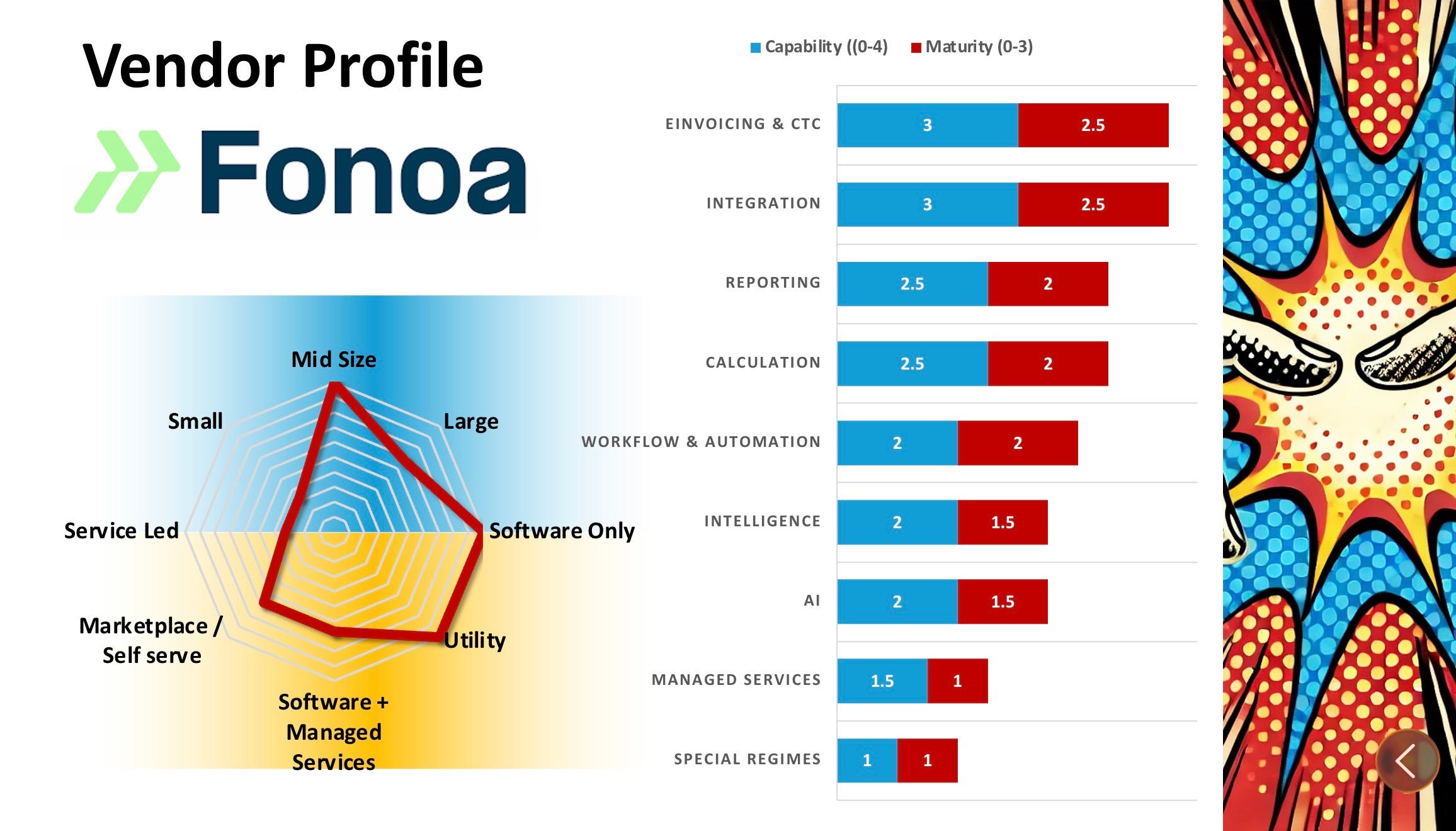
• Digital-first: 3 – Strong fit — the home segment. Tax Engine + E-Invoicing + Lookup across Uber, Netflix, Zoom, Booking-scale deployments. No material gaps for this buyer.
• E-commerce (cross-border): 2 – Good fit — strong EMEA VAT/OSS/IOSS depth; US S&U home-rule coverage and physical-goods workflows are secondary strengths at best.
• Enterprise (traditional multinational): 2 – Good fit — compelling where revenue is digital or services-led; SAP certification gap and thin SI ecosystem limit ceiling for ERP-heavy procurement teams.
• Managed-service-led: 1 – Marginal — some advisory wrap exists at onboarding but Fonoa is not a BPO and should not be evaluated as one.
• Utility / point solution: 3 – Strong fit — Lookup (tax-ID validation) is best-in-class as a discrete API; worth buying even if the broader platform is not in scope.
Delivery model fit
• Software-only: 3 – Strong fit — the native delivery model; API-first, modular, minimal implementation overhead for tech-ready buyers.
• Software + managed services: 1 – Marginal — onboarding hand-holding and CSM support are well-rated; not a full managed-filing or BPO capability.
• Managed-services-led: 1 – Marginal — not Fonoa’s delivery DNA; buyers needing a services-led operating model should look elsewhere.
• Marketplace / self-serve: 2 – Good fit — Lookup in particular can be consumed self-serve via API; pricing is negotiated rather than true freemium.
• Utility: 2 – Good fit — Lookup as a standalone utility is the clearest single-job-to-be-done case in the portfolio.
Size band fit
• Small: 1 – Marginal — over-engineered and likely overpriced for sub-$50M or single-jurisdiction buyers.
• Medium: 3 – Strong fit — $50M–$1B digital businesses with multi-country VAT and modern stacks are the sweet spot.
• Large: 2 – Good fit — serves billion-dollar clients (Uber, Netflix) but partner ecosystem thinness and the SAP certification gap constrain enterprise ceiling.
CUSTOMER AND EMPLOYEE SENTIMENTS
Customer reviews are unusually cohesive — Fonoa’s reviewers are almost entirely enterprise digital-platform buyers, and they broadly like what they bought. Employee signals are more mixed, with the sales organisation the clearest area of concern.
• G2 (4.5/5, 34 reviews): API quality and setup ease (8.7/10) consistently above category average; “best onboarding experience we’ve had with any tax finance provider” is a recurring theme.
• Gartner Peer Insights (4.6/5, 19 reviews; 58% five-star, 42% four-star, zero below): “unique multi-product proposition under one banner” cited repeatedly; geographic completeness flagged as still maturing.
• Glassdoor (4.4/5, 54 reviews): strong on culture, autonomy, and remote-first; growth-stage instability and sales-leadership friction flagged by multiple reviewers.
• RepVue (~24% quota attainment): roughly half the SaaS industry median (~43% for the sector in 2024). The clearest single risk signal in the profile.
The product and CS experience looks solid for the right ICP. But ~24% quota attainment means AE turnover is a live risk during longer procurement cycles — lock down named account owners for continuity in your contract terms.
IF YOU’RE BUILDING OR BUYING INDIRECT TAX CAPABILITY — HERE’S THE READ
For buyers
If you’re a medium or large digital-first business — marketplace, SaaS, platform, ride-hail — with cross-border VAT/GST across 20+ countries and a modern engineering stack, Fonoa belongs near the top of your shortlist. The determination engine was designed for your use case, the unified returns and e-invoicing platform removes the multi-system reconciliation overhead your current stack probably carries, and API quality is genuinely differentiated. If you’re a B2B physical-goods business with complex supply-chain tax obligations — HS codes, exemption logic, goods-specific workflows, SAP-certified add-on requirements — Fonoa is not the right anchor today; look to established ERP-certified platforms. If you need tax-ID validation at scale — for DAC7 compliance, marketplace seller verification, or B2B invoice validation — evaluate Lookup as a standalone procurement regardless of broader platform fit: 115+ government sources with fuzzy matching has no close equivalent in the market and is worth buying on its own. If US sales & use tax is your primary obligation, assess US-specialist platforms first — Fonoa is growing here but it is not its strongest suit. If you are in financial services with partial-exemption complexity, the GITC acquisition makes Fonoa worth a conversation that was not justified 18 months ago. Regardless of where you land, probe hard on three things before signing: SOC 2/ISO attestations (not publicly confirmed), volume-based pricing mechanics at your projected transaction growth rate, and funding runway — no priced primary since July 2022 is a material procurement risk variable you should resolve before committing.
For prospective employees
• Strong move for product and backend engineers: modern cloud-native stack (Kubernetes, GCP, Postgres), remote-first autonomy, and genuine technical complexity in tax-data and CTC plumbing.
• Attractive for tax-technology specialists: regulatory depth in VAT/CTC is real, GITC adds FS exposure, and the AI Tax Intelligence layer is a genuinely interesting career problem.
• High-risk for AEs and BDRs: ~24% quota attainment and reported leadership friction — go in with firm non-negotiables on territory design, targets, and reporting lines.
• Worth assessing for CS and Solutions Engineering: the enterprise ICP delivers complex, interesting work, but sales-org instability can bleed across GTM teams.
• Funding clarity is an open question: a Series C or exit event in the next 12–18 months is plausible; understand how that shapes equity, roadmap commitments, and role stability before you sign.
Want the full 26 page analyst report?

A selection of of opportunities to connect in person and interact online over the next few weeks
June 2026
Tax Tech Live 2026 (In-Person)
Tax Systems | June 2, 2026 | London, UK
Exclusive customer-focused event bringing together tax professionals for a day of cutting-edge insights, expert discussions, and the latest innovations in tax technology. Contact your Tax Systems Client Executive to register.
Event Page →
Private Equity & Private Capital Quarterly Tax Update — Q2 2026 (Webinar)
EY | June 4, 2026 | Online/Virtual
Quarterly update on strategic influences shaping private equity and capital funds, including US legislative updates, global macro trends, and tax implications.
Register →
8th Annual VAT Management Summit (In-Person)
Fintua (Gold Sponsor) | June 9–10, 2026 | The Tower Hotel, London, UK
Summit bringing together industry leaders to explore the latest developments in VAT compliance, digital reporting, and regulatory change.
Event Page →
Trade and Tariff Tuesdays — June (Webinar)
Avalara | June 16, 2026 | Online/Virtual
Avalara experts provide guidance on evolving international trade and tariff policy and its business implications in this recurring webinar session.
Register →
ITR Indirect Tax Forum 2026 (In-Person)
Fintua (Silver Sponsor) / Vertex Inc | June 23–24, 2026 | Amsterdam, Netherlands
Premier indirect tax forum exploring the latest developments in VAT, e-invoicing, and digital transformation, with a focus on practical insights and peer-to-peer exchange.
Register →
Tax & Legal Tech Summit (In-Person)
KPMG | June 25, 2026 | Zurich, Switzerland Summit focused on AI, analytics, and automation transforming tax and legal functions.
Event Page → https://kpmg.com/ch/en/events/2026/06/tax-legal-tech-summit.html
Global Withholding Tax Summit 2026 (In-Person)
Withholding Tax Summit | July 1, 2026 | London, UK Conference dedicated to withholding tax and cross-border compliance challenges, with emphasis on regulatory change and digitalisation.
Event Page → https://withholdingtaxsummit.com/
*any organisers or events I’ve missed? please let me know.

A curated selection of blogs, white-papers and on demand content published by multiple organisartions across the landscape, organised into a themed learning path.
MONTH THREE · JUNE–JULY 2026
Direct Tax, Pillar Two & Corporate Tax Provision
The GIR filing window is now open — calendar-year groups face a June 30, 2026 deadline for their first live GloBE Information Return. The OECD Side-by-Side Package has materially changed what US-headquartered MNEs must do, but QDMTTs remain, GIR obligations continue, and non-US MNEs face unchanged IIR/UTPR exposure. This month goes deep on the technology implications of all of it.
Week 9 · 2–6 June
Pillar Two 2026: The Side-by-Side Package and What It Means for Technology
25 📖 QDMTT: Stay Ahead of the Global Minimum Tax Curve Orbitax (TR) 12–15 min
26 📖 OECD Side-by-Side Package: Relief for US Multinationals RSM US 12–15 min
27 🎥 Pillar Two Compliance: Grant Thornton & Orbitax Strategies Orbitax / Grant Thornton 60 min · CPE
Week total: 2 articles + 1 webinar · ~84–90 min
Week 10 · 9–13 June
Unpacking the Side-by-Side Package & the First GIR Filing Cycle
Having established the context in Week 9, this week goes deeper into the technical and compliance architecture of the new Pillar Two framework — including an authoritative technical breakdown of the four new safe harbours (SbS, UPE, SBTI, and Simplified ETR) and what GIR data collection must look like in practice for first-wave filers.
28 📖 The New Pillar Two Framework: Unboxing the Side-by-Side Package Alvarez & Marsal 15–18 min
29 📖 2026 Indirect Tax Trends Vertex Inc. 8–10 min
30 🎥 Seamless Tax Data Integration: From Any System to Pillar Two Compliance Orbitax / Deloitte 45–60 min
Week total: 2 articles + 1 webinar · ~68–88 min
Week 11 · 16–20 June
BEPS, Transfer Pricing & the Broader Global Reform Landscape
31 📖 Bloomberg Tax Leadership Forum 2025: Global Tax Reform — Are We There Yet? Bloomberg Tax 15–20 min
32 📖 Practical Advice for Managing Pillar Two: Global Minimum Tax Technology BDO / Thomson Reuters 10–12 min
33📖How to Build a Winning Indirect Tax Maturity Roadmap Fonoa 12–15 min
Week total: 3 articles · ~37–47 min
Week 12 · 23–27 June
Capstone: The Future-Ready Tax Function — Where Direct Tax, Indirect Tax & AI Converge
34 📖 AI-Enabled Tax Transformation Deloitte Global 20–25 min
35 🎥 VAT Snapshot: Navigating E-Invoicing Changes from Europe to Southeast Asia Sovos 30 min
36📖 AI-Powered Efficiency: Bloomberg Tax’s Technology Bloomberg Tax 6–8 min
Week total: 2 articles + 1 webinar · ~56–63 min
Month Three total: 9 articles + 4 webinars · ~245–288 min
*any cool content I’ve missed? please let me know.

A selection of open roles across tax tech vendors and tax advisory/consulting businesses who are involved in tax technology.
Use the column headers to sort, or the (new) search function and don’t forget to navigate all pages!
*I do this using an AI agent and due to the volume, I don’t check every link, so please let me know if any of these don’t work or have disappeared when you follow them.
✌ Last thoughts
Thanks again for reading! If you have any feedback, suggestions, want to contribute, share gossip or would like to work together in any way, email me here or hit the button below!