


TL;DR , 116 Jobs, 7 events, 5:09 hours of learning and VAT Market Assessment
❤Next at the Nexus: VAT Tech
OK so a few weeks ago some of you kindly responded to a survey on here and LinkedIn regarding which way you’d like the research to go. Sadly the responses were tied 3 ways between European VAT providers, US AI based sales tax and direct tax providers, so I made the decision to follow what I think the bulk of my followers (right now) would be interested in which is the VAT market, I’ll get to the others I promise!!
Otherwise it’s been a slow news week for me, I guess everyone’s busy attending conferences… so time to introduce “the challengers” ✌
🧨Europe VAT Market Landscape and Challengers
If we want to understand the VAT technology vendors better, first we need to understand the landscape they’re playing in, because - like VAT and everything else in Europe (!) - it’s not that simple:
The platform story isn’t the endgame
The customer segments and ICP’s aren’t consistent
The origin stories of the vendors are very different
For me that means the old rules don’t apply, we need a news lense, new rubrics and new criterea for this, which means we need to learn something new, perfect!
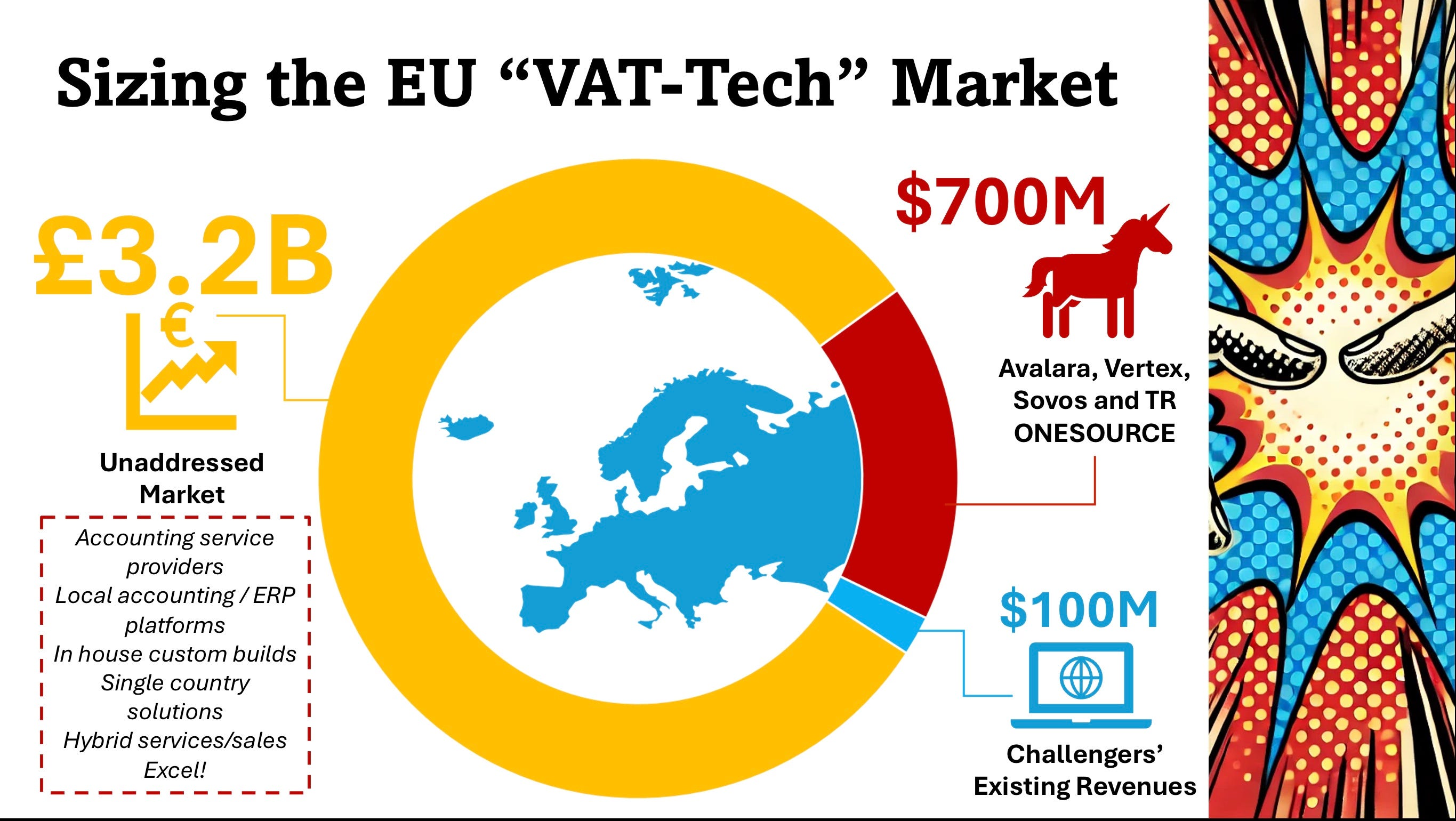
Sizing the European VAT Technology Market
First stop is understanding the addressable market. The market-size debate usually starts with two camps: one says indirect tax tech is a fairly focused compliance niche, the other says it is really a broader automation layer sitting inside the oCFO tech stack.
The first camp tends to anchor on a core Europe VAT number like the $4Bn market view (proportional to an overal $14Bn Global TAM), while the second points to much larger global tax-management or tax-tech estimates that include e-invoicing, CTC, reporting, workflow, and adjacent automation. As we’re not a VC firm or Mckinsey, it’s largely academic, so let’s use the conservative figure of $4Bn (EUR 3.44Bn)
Estimating Market Share
Over the last few weeks we’ve profiled the largest players in the market, and helpfully estimated their revenues by product, which is a useful proxy for regional revenue. This is somewhat complicated by the dynamic of where the customer sits - and where the revenue is counted - vs where the obligation being solved is, via specific product/s, but some of this is a wash so we’ll keep it simple(ish) and directional for now.
Using the data previously collected in the vendor profiles and honing in on a subset of calculation revenues, reporting, CTC and managed services products lines, we could infer the revenues as being something like the table below.
Taking the mid point of those gives us a vended market penetration of around $687M (EUR 590M) or around 17% penetration.
Given that most of these companies have been operating in Europe for 15 years or so, with significant investment and north american customers/revenues you might be taken to wonder why the share isn’t greater. For that we need to look at the customer segments….
Analysing the Customer Segments
The market in Europe is much more fragmented, given that calculating tax rates isn’t the core challenge and cross border tends to be the antagonist for VAT complexity. So let’s take a look at some customer archetypes:
Digital businesses usually want the lowest-friction product: API-first, fast implementation, and minimal finance-team drag. They are often more tolerant of a narrower feature set if the product fits modern billing, subscription, and platform workflows.
Marketplace sellers care less about enterprise governance and more about speed, self-serve setup, and whether the tool understands platform-led selling. They often need enough compliance to stay out of trouble, but not the full heavyweight stack.
Cross-border e-commerce buyers are more demanding than digital-only firms because VAT complexity rises sharply with geography. They tend to value jurisdiction coverage, e-commerce integrations, and clear handling of OSS/IOSS or equivalent cross-border rules.
Multinational enterprise finance teams are the classic enterprise tax-tech buyer: they want control, coverage, auditability, and ERP depth. They usually care less about slick UX than about reliability, governance, and support quality.
Accounting/tax service-led clients often buy around workflow, not just software. They want tools that make it easier for an external adviser or internal compliance team to manage multiple clients, multiple filings, and multiple jurisdictions efficiently.
Hybrid managed-service buyers are typically less interested in pure software elegance and more interested in whether the vendor can take work off their plate. This segment will often pay for support, managed operations, and outcomes rather than standalone product purity.
Sizing the Segments
The biggest share goes to multinational enterprise finance teams because they buy the broadest stacks, need the deepest integrations, and tolerate the longest implementations; that is where the highest ACVs and most durable renewals sit. Cross-border e-commerce comes next because it is both structurally fragmented and high growth, but average deal sizes are usually smaller than large enterprise finance deployments.
The lighter segments — digital businesses and marketplace sellers — are numerically broad but usually buy simpler, lower-price tools, so they take less of the TAM than their user counts would suggest. Accounting/tax service-led clients and hybrid managed-service buyers sit in the middle: they can be sticky and operationally valuable, but the spend is split between software and service, which caps pure software TAM share.
Looking at Deployment Options
The deployment stack in this market runs from heavy enterprise software to very light self-serve tools, and the differences matter a lot. At the top end you have cloud/SaaS and on-premise platforms for multinational finance teams, where the product is deeply integrated into ERP and compliance workflows; then there are software-plus-managed-services models, where the vendor does part of the compliance work as well as providing the software; and at the lighter end you get calculator-style utilities and marketplace/self-serve products built for speed, simplicity, and lower admin overhead.
The practical takeaway is simple: deployment model is often a better buying signal than feature list. If a vendor is software-only, the buyer is usually buying control and integration depth; if it is software plus managed services, the buyer is buying relief and operational coverage; if it is a lightweight utility, the buyer is usually a digital business or marketplace seller that wants compliance without enterprise baggage. That is why the same “VAT compliance” label can hide very different commercial motions and very different fit for tax, finance, and e-commerce teams
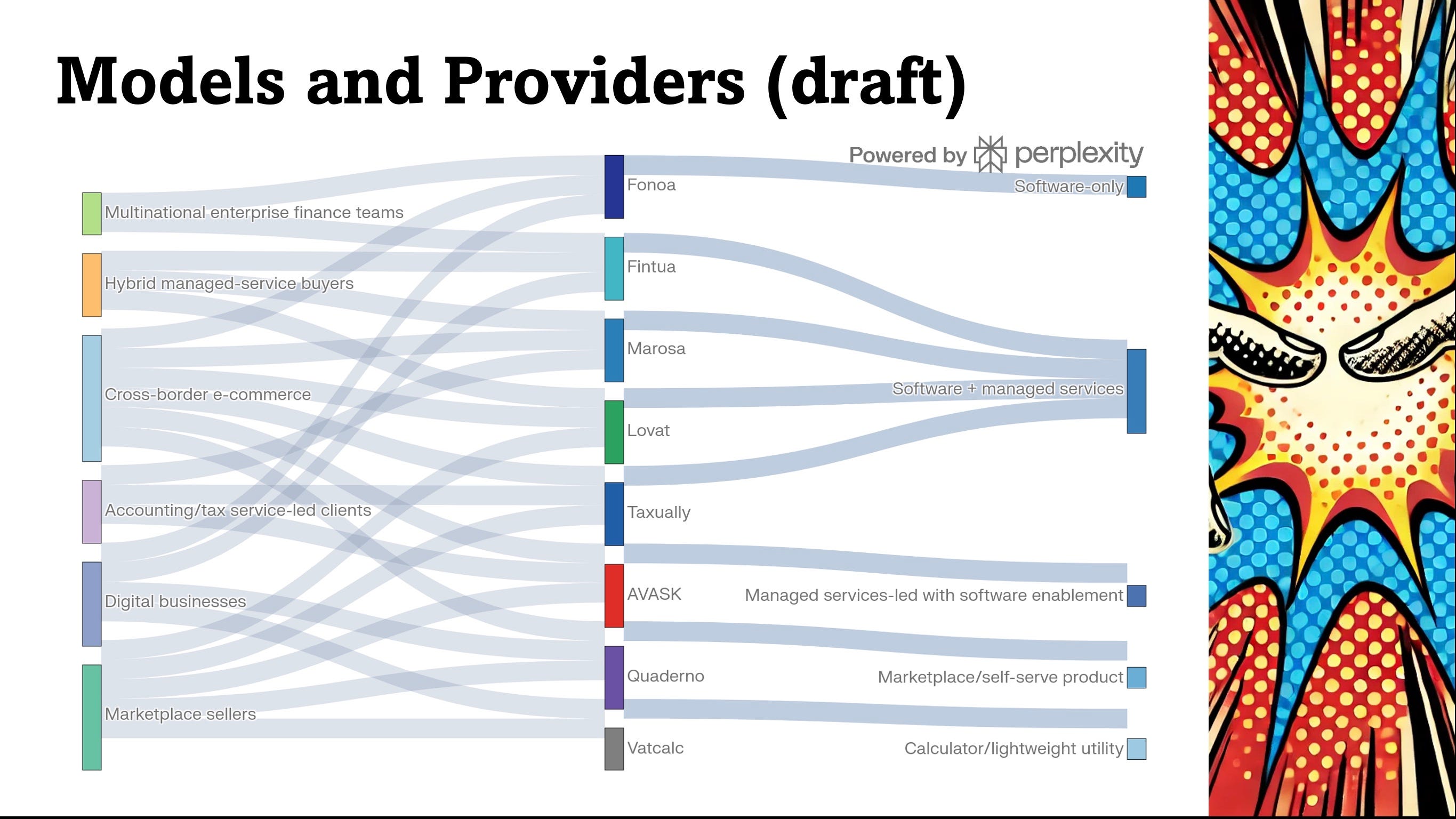
The five main delivery models identified are:
Software-only — pure product, buyer owns all implementation, configuration, and ongoing operations
Software + managed services — product plus a vendor-led service wrap covering filings, compliance operations, or ongoing support
Managed services-led with software enablement — the service is the primary commercial offer, software sits underneath as the delivery mechanism rather than the sellable product
Marketplace / self-serve product — low-friction, self-onboarding model, typically lower ACV, built for speed and simplicity over depth and governance
Calculator / lightweight utility — narrow single-function tools such as VAT rate lookup or basic tax determination, often embedded, white-labelled, or API-called rather than deployed as a standalone platform
Grouping the Vendors
These vendors split somewhat neatly into three camps* Fonoa is the purest product-led play, with a single-platform, API-first model for tax ID validation, calculation, e-invoicing, and returns; Quaderno and Vatcalc sit at the lighter end of the spectrum, with self-serve or utility-style offers aimed at lightweight VAT calculation and filing use cases.
On the other side, Marosa, Fintua, Taxually, and AVASK are more hybrid or service-augmented, pairing software with consulting, filings, registrations, or operational support. Lovat sits in the middle as a broader compliance platform with e-commerce and multi-country coverage.
*note that for now I’m excluding SAP Add-ons and eInvoice vendors, as IMO they have their own segment views.
Next Step: Reframing the Evaluation Methodology
So for now my work involves rewriting the evaluation critera to take into account these new factors, which will keep me busy through the next week for sure. Once that’s done, we’ll start to look at the individual vendors/solutions.
Until then, stay tuned for more and please feel free to give feedback. If you have a viewpoint on the market or the work I’m doing, I’d love to speak with you, drop me a line below.

A selection of of opportunities to connect in person and interact online over the next few weeks
May 2026
Gartner Finance Symposium/Xpo™ 2026 (In-Person)
Vertex Inc | May 27–29, 2026 | Gaylord National Resort, National Harbor, MD, USA
Finance leaders forum with Vertex providing practical strategies on indirect tax compliance within the enterprise technology ecosystem.
Register →
What to Expect from Global Tax Policy and Controversy in 2026 (Webinar)
EY | May 28, 2026 | Online/Virtual
A panel of EY Tax Policy and Controversy leaders discusses strategic priorities for tax departments as they address changing global tax policy and enforcement landscapes.
Register →
June 2026
Tax Tech Live 2026 (In-Person)
Tax Systems | June 2, 2026 | London, UK
Exclusive customer-focused event bringing together tax professionals for a day of cutting-edge insights, expert discussions, and the latest innovations in tax technology. Contact your Tax Systems Client Executive to register.
Event Page →
Private Equity & Private Capital Quarterly Tax Update — Q2 2026 (Webinar)
EY | June 4, 2026 | Online/Virtual
Quarterly update on strategic influences shaping private equity and capital funds, including US legislative updates, global macro trends, and tax implications.
Register →
8th Annual VAT Management Summit (In-Person)
Fintua (Gold Sponsor) | June 9–10, 2026 | The Tower Hotel, London, UK
Summit bringing together industry leaders to explore the latest developments in VAT compliance, digital reporting, and regulatory change.
Event Page →
Trade and Tariff Tuesdays — June (Webinar)
Avalara | June 16, 2026 | Online/Virtual
Avalara experts provide guidance on evolving international trade and tariff policy and its business implications in this recurring webinar session.
Register →
ITR Indirect Tax Forum 2026 (In-Person)
Fintua (Silver Sponsor) / Vertex Inc | June 23–24, 2026 | Amsterdam, Netherlands
Premier indirect tax forum exploring the latest developments in VAT, e-invoicing, and digital transformation, with a focus on practical insights and peer-to-peer exchange.
Register →
*any organisers or events I’ve missed? please let me know.

A curated selection of blogs, white-papers and on demand content published by multiple organisartions across the landscape, organised into a themed learning path.
MONTH TWO · MAY 2026
E-Invoicing, CTCs & Real-Time Compliance
Belgium is now live, Brazil is overhauling its entire indirect tax system, Poland’s KSeF mandate is entering enforcement, and France’s September 2026 deadline is approaching. The e-invoicing landscape has never moved faster.
Week 8 · 26–30 May
Intelligence & Emerging Markets: SYNAPSE Insights, Brazil’s Reform & AI in Indirect Tax
22 📖 5 Key Indirect Tax Trends from SYNAPSE 2026 Fonoa 10–12 min
23 📖 Brazil 2026 Tax Reform: Key E-Invoicing Changes for Businesses Fonoa 10–12 min
24 🎥 Embracing the Future of Tax Compliance with AI Avalara 45–60 min
Week total: 2 articles + 1 webinar · ~65–84 min
MONTH THREE · JUNE–JULY 2026
Direct Tax, Pillar Two & Corporate Tax Provision
The GIR filing window is now open — calendar-year groups face a June 30, 2026 deadline for their first live GloBE Information Return. The OECD Side-by-Side Package has materially changed what US-headquartered MNEs must do, but QDMTTs remain, GIR obligations continue, and non-US MNEs face unchanged IIR/UTPR exposure. This month goes deep on the technology implications of all of it.
Week 9 · 2–6 June
Pillar Two 2026: The Side-by-Side Package and What It Means for Technology
25 📖 QDMTT: Stay Ahead of the Global Minimum Tax Curve Orbitax (TR) 12–15 min
26 📖 OECD Side-by-Side Package: Relief for US Multinationals RSM US 12–15 min
27 🎥 Pillar Two Compliance: Grant Thornton & Orbitax Strategies Orbitax / Grant Thornton 60 min · CPE
Week total: 2 articles + 1 webinar · ~84–90 min
Week 10 · 9–13 June
Unpacking the Side-by-Side Package & the First GIR Filing Cycle
Having established the context in Week 9, this week goes deeper into the technical and compliance architecture of the new Pillar Two framework — including an authoritative technical breakdown of the four new safe harbours (SbS, UPE, SBTI, and Simplified ETR) and what GIR data collection must look like in practice for first-wave filers.
28 📖 The New Pillar Two Framework: Unboxing the Side-by-Side Package Alvarez & Marsal 15–18 min
29 📖 2026 Indirect Tax Trends Vertex Inc. 8–10 min
30 🎥 Seamless Tax Data Integration: From Any System to Pillar Two Compliance Orbitax / Deloitte 45–60 min
Week total: 2 articles + 1 webinar · ~68–88 min
Week 11 · 16–20 June
BEPS, Transfer Pricing & the Broader Global Reform Landscape
31 📖 Bloomberg Tax Leadership Forum 2025: Global Tax Reform — Are We There Yet? Bloomberg Tax 15–20 min
32 📖 Practical Advice for Managing Pillar Two: Global Minimum Tax Technology BDO / Thomson Reuters 10–12 min
33📖How to Build a Winning Indirect Tax Maturity Roadmap Fonoa 12–15 min
Week total: 3 articles · ~37–47 min
Month Two/Three total: 9 articles + 3 webinars · ~254–309 min
*any cool content I’ve missed? please let me know.

A selection of open roles across tax tech vendors and tax advisory/consulting businesses who are involved in tax technology.
Use the column headers to sort, or the (new) search function and don’t forget to navigate all pages!
*I do this using an AI agent and due to the volume, I don’t check every link, so please let me know if any of these don’t work or have disappeared when you follow them.
✌ Last thoughts
Thanks again for reading! If you have any feedback, suggestions, want to contribute, share gossip or would like to work together in any way, email me here or hit the button below!