

This week in Taxtech
OK so it wasn’t this week but Billentis published their 2026 report on 8th June and at a whopping 147 pages, it’s a bit of a brick and takes a while to get through. Incase you missed it or don’t have the time to read it all (who does? me it seems!), I sifted the good stuff out for you.
Riding the Tornado: What the 2026 Billentis Report Really Says
1. The market is bigger, earlier, and more uneven than most boards think
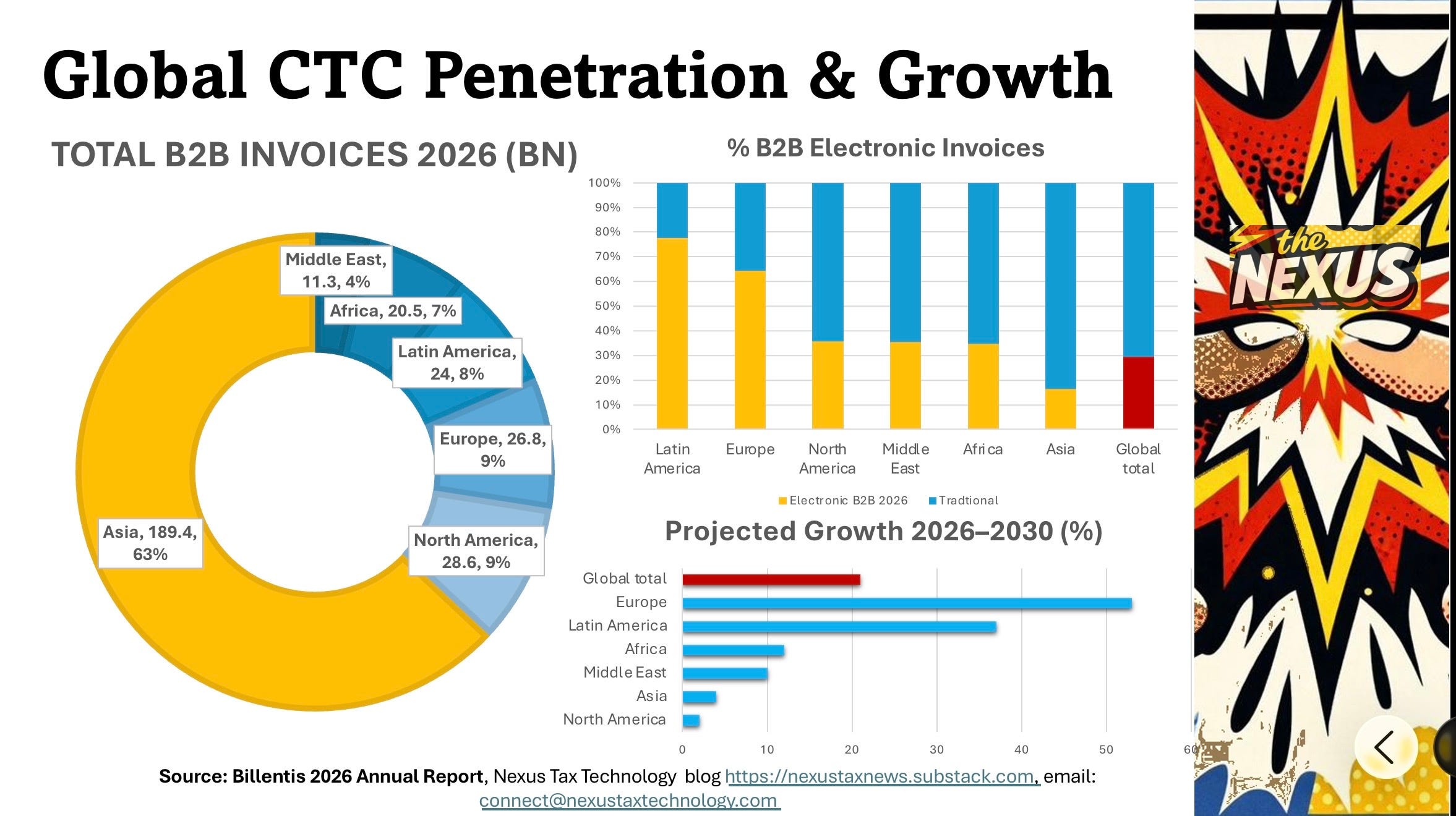
If you work in indirect tax or taxtech, the Billentis 2026 report is a reminder that we’re still early in the game, even if your inbox feels like “CTC all the way down.” The model puts global B2B invoice volume at roughly 300 billion documents a year in 2026, with only about 87–88 billion of those exchanged electronically – an electronic penetration of just 29%. In other words: seven out of ten B2B invoices worldwide are still analog or semi‑digital, even as governments push toward real‑time controls.
On a mandate‑only forecast, electronic B2B volumes grow from 88.3 billion in 2026 to 107.0 billion by 2030, about a 21% uplift that doesn’t assume any new laws beyond what’s already on the books. The regional split is where it gets interesting. Europe and Latin America are the efficiency and control labs: Europe goes from 17.2 to 26.3 billion e‑B2B invoices (+53%), and LatAm from 18.6 to 25.5 billion (+37%) by 2030 under Billentis’ conservative scenario. Asia, by contrast, is the sleeping giant – 189.4 billion B2B invoices in 2026 but only 31.3 billion electronic (17% penetration), creeping to 32.5 billion by 2030 (+4%). North America barely moves, from 10.2 to 10.4 billion, because adoption remains more business‑led than mandate‑driven.
2. Fragmented vendors, consolidating rails
The structural picture is messy. In Europe alone, around 1,000 service providers are operational, handling significantly more than half of all B2B/B2G e‑invoice transactions, and that intermediary share has been growing faster than direct point‑to‑point exchange for at least five years. On the customer side, large multinationals commonly juggle 3–20 providers just for inbound e‑invoicing, and 20–160 different portals and platforms for outbound flows and tax/reporting obligations. The market is fragmented in logos, but de‑facto consolidating around a smaller set of networks, access‑points, and “backbone” platforms that sit on top of multiple CTC and exchange models.
3. What’s signal, what’s noise in a 147‑page PDF
The real signal in this year’s report is the reframing: e‑invoicing is now positioned as the foundational layer of Integrated Digital Trade – the data spine that connects tax, finance, procurement, logistics, and payments. Governments use CTC and digital reporting to close 20–30% VAT gaps; enterprises use the same rails to automate P2P and O2C. Everything else – specific file formats, local models, sponsor profiles – is execution detail and, frankly, noise.
Second signal: fragmentation is not a bug, it’s the current market design. Multiple CTC archetypes (clearance, real‑time reporting, centralised exchange, decentralised five‑corner) and several private exchange models co‑exist and will continue to do so. Waiting for “the standard” is a career‑limiting move. Third signal: AI is treated sensibly – as an accelerant on top of structured data, not a magic trick, with data quality, legacy ERP sprawl, and accountability called out as the real brakes.
4. Three moves for tax professionals
1) Turn mandates into a quantitative risk‑and‑value map
Don’t just track “where mandates are coming”; quantify where they actually matter for your business.
Build a simple heatmap: start with two inputs—your invoice volumes by region and your revenue mix by region. Plot them on a grid that shows: high/low mandate intensity on one axis; high/low business exposure on the other.
Rank regions on two axes: for each region, score (a) how aggressive the regulatory pipeline is over the next 3–5 years (CTC, e‑reporting, SAF‑T, etc.), and (b) what share of your global invoices and revenue sits there. This gives you four boxes: “regulatory hot + high volume,” “regulatory hot + low volume,” “quiet + high volume,” “quiet + low volume.”
Tie this to budget and phasing: use that ranking to decide where you centralise first, where you accept “good enough local” for now, and where you only fund minimal controls because the combination of mandates and volume is low.
Outcome: your C‑suite sees a simple picture—“if we get Europe and LatAm wrong, we get audited; if we get Asia wrong, we drown in volume”—instead of drowning in a 40‑page mandate tracker.
2) Own the architecture conversation with a concrete consolidation plan
Most multinationals are quietly running a zoo of providers: multiple e‑invoicing and CTC vendors, dozens of portals, and a long tail of local tools. Use that as your burning‑platform story, then show a path out.
Baseline the sprawl: run a quick inventory of everything involved in issuing, receiving, reporting or archiving invoices—CTC gateways, AP/AR portals, local e‑invoicing tools, tax‑reporting uploads, custom scripts. Map which countries and processes each one touches.
Define an end‑state pattern: design a target architecture with a small number of “rails”: one or two global networks/backbones, a handful of certified service providers in markets that require it, and clear rules for when a local point solution is allowed. Make it explicit which flows must go through the backbone (e.g. all cross‑border, all CTC countries, all B2G).
Agree a decommission list and timeline: for each region, choose 3–5 portals or tools you will retire as you onboard to the new rails. Tie those retirements to specific project milestones—“when we switch Poland to the backbone, we shut down these three portals.”
Outcome: tax stops being “the team that reads legislation” and becomes co‑owner of a tangible simplification agenda—fewer vendors, fewer interfaces, fewer surprises when mandates change.
3) Make AI part of your control framework, starting with one or two concrete pilots
Treat AI as a control‑room workhorse, not a shiny front end. The best early wins come from embedding AI in the parts of the invoice and reporting lifecycle where you already bleed time and headcount.
Pick two boring, high‑impact use cases: for example, (1) automated three‑way match and anomaly detection on high‑volume AP, and (2) continuous validation of VAT fields and tax treatments in one or two CTC countries. Avoid “cute” generative use cases; go straight for error‑prone, repetitive work.
Fix the data first: run a short “data boot camp” before you let any model loose. Clean up supplier master data (VAT IDs, tax codes, bank details), harmonise invoice schemas, and standardise reason codes for exceptions. Make data quality KPIs part of the pilot.
Define control metrics upfront: set clear targets for reductions in manual touches per invoice, exception rates, post‑filing adjustments, and audit findings. Track close times and on‑time filing as headline metrics. Use those numbers to show the board: “AI reduced exceptions by X%, cut manual review time by Y%, and shortened the close by Z days.”
Outcome: AI is positioned as a way to harden your second line of defence—continuous controls and audit‑ready history—rather than as a nebulous innovation project that dies after the first demo.
I’d love to get into more conversations with anyone this, so if you have a view, please let me know or weigh in on the Linkedin Post
Now on to this week’s vendor spotlight on taxually.
🌐 Vendor Spotlight: Taxually
Taxually: The E-Commerce Compliance Platform That’s Quietly Going Enterprise
Most enterprise tax teams haven’t shortlisted Taxually. Some of them should have. The platform handles EU VAT, OSS/IOSS, US sales & use tax, and environmental compliance in a single stack, at pricing that undercuts legacy alternatives, with native integrations into Amazon, Shopify, eBay, and Stripe. The product has outgrown its e-commerce origin story. The brand hasn’t caught up yet — and that gap is where the opportunity lies for buyers willing to look past the homepage.
WHAT TAXUALLY ACTUALLY IS
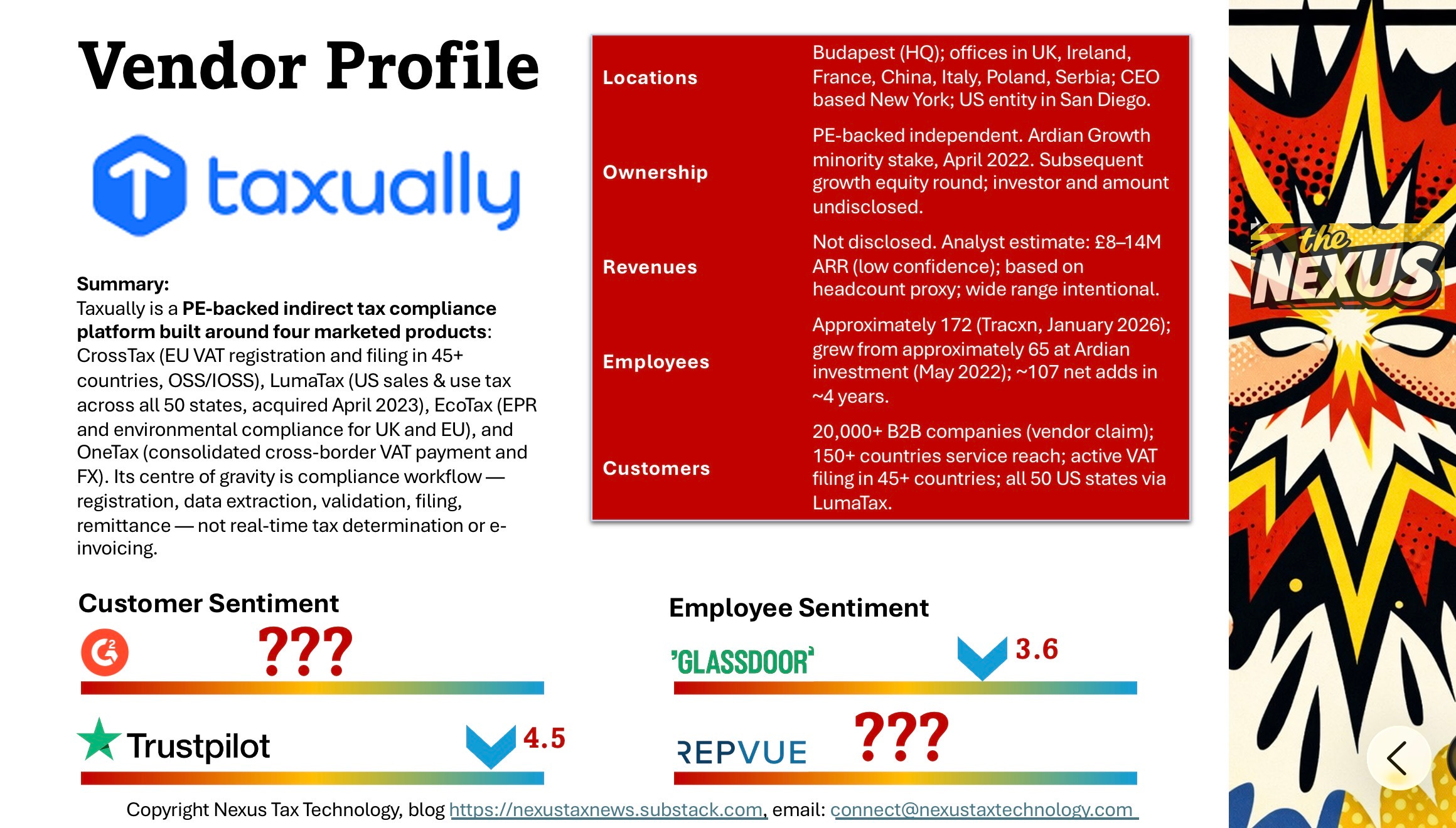
Taxually is a PE-backed indirect tax compliance platform built around four marketed products: CrossTax (EU VAT registration and filing in 45+ countries, OSS/IOSS), LumaTax (US sales & use tax across all 50 states, acquired April 2023), EcoTax (EPR and environmental compliance for UK and EU), and OneTax (consolidated cross-border VAT payment and FX). Its centre of gravity is compliance workflow — registration, data extraction, validation, filing, remittance — not real-time tax determination or e-invoicing. Data flows in automatically from Amazon, eBay, Shopify, and Stripe (where Taxually is a named filing partner), removing the manual extraction step that defines most legacy compliance operations. Estimated headcount sits at approximately 172, with PE backing from Ardian Growth (April 2022) and a subsequent growth equity round; revenue is directionally in the £8–14M ARR range (analyst estimate; not disclosed). The natural shortlist profile: cross-border e-commerce and marketplace sellers, accounting firms wanting a white-label compliance platform, and mid-market businesses managing multi-jurisdictional VAT and SUT with lean internal tax functions.
WHERE IT BEATS THE MARKET BASELINE
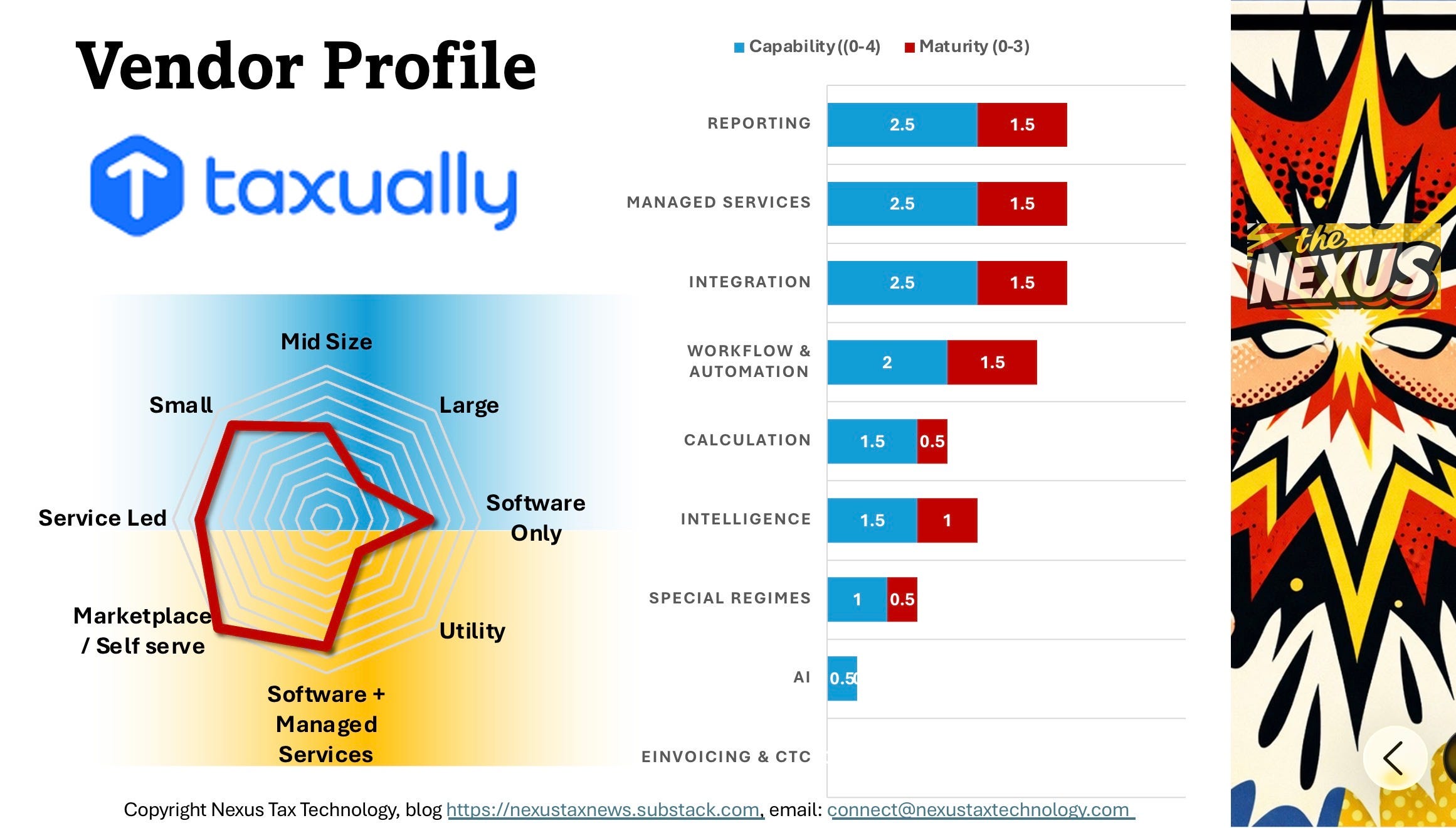
Three structural advantages sit clearly above the indirect tax market baseline. First, EU VAT and US SUT in a single platform at competitive pricing is rare in the challenger market: most peers handle one geography or one regime, not both simultaneously. CrossTax’s 250-rule validation engine and LumaTax’s Compliance Score™ give tax teams automation depth that manual-process alternatives can’t match at the price point. Second, the e-commerce integration stack is genuinely deep: native Amazon, eBay, Shopify, and Stripe data feeds remove the most painful step in compliance workflow, and 327 Trustpilot reviews specifically validate the data import experience. Third, EcoTax (EPR/GPSR) is a niche differentiator with no close equivalent — increasingly material for EU and UK online sellers as EPR enforcement expands. Where Taxually is at or below baseline: no real-time determination API, no e-invoicing or CTC capability (a widening gap as ViDA accelerates), no SAP integration, and a brand presence that significantly underrepresents the product’s enterprise capability.
PORTFOLIO ANALYSIS
The four-product portfolio has been assembled deliberately over six years: CrossTax as the original core, LumaTax via acquisition in 2023 to add US coverage, EcoTax rebranded from Greenifi for environmental obligations, and OneTax launched in 2024 for payment consolidation. CrossTax and managed services (fiscal representation, notice management, filing) are estimated to account for roughly 60–65% of revenue combined, with LumaTax adding a further 15–20%. The portfolio is directionally coherent — all four products serve the same buyer — but integration is still in progress: LumaTax and CrossTax operate as separate environments today, which limits the single-stack global story in live procurement conversations. OneTax is real but nascent; its revenue contribution is minimal. The practical operator read: you get genuine multi-product breadth, but you buy it as a staged journey. Plan for a combined platform in 12–18 months, not day one.
SEGMENT, DELIVERY MODEL, AND SIZE BAND FITS
Business model fit
• B2C goods: 3 – Strong fit core ICP; Amazon/Shopify/eBay native, OSS/IOSS, EU VAT + US SUT combined. Strongest product-market alignment in the portfolio.
• B2B goods: 2 – Good fit multi-country VAT filing and nexus management well supported; no SAP integration or CTC for complex supply chains.
• B2B/B2C digital services: 2 – Good fit Stripe filing partnership provides OSS/IOSS and ESS coverage at scale; no real-time determination API for checkout-time tax.
• B2B/B2C services (non-digital): 1 – Patchy fit limited specialist content; no non-goods workflow tools or vertical-specific coverage.
Size band fit
• Small: 2 – Good fit competitive pricing confirmed across 327 Trustpilot reviews; self-serve via Amazon/Shopify native; low onboarding friction for e-commerce scope.
• Medium: 2 – Good fit NetSuite and Dynamics connectors enable mid-market ERP deployment; four-product scope suits lean tax teams with wide geographic obligations.
• Large: 1 – Patchy fit no SAP, no e-invoicing/CTC, no SI partner ecosystem, no published SLAs; enterprise ceiling not yet credible for complex large-scale procurement.
CUSTOMER AND EMPLOYEE SENTIMENTS
Customer review coverage is concentrated on Trustpilot. There are no G2, Capterra, Gartner Peer Insights, or TrustRadius profiles — a significant gap for enterprise buyers who start diligence on structured review platforms and will not find Taxually there. The Trustpilot signal is clear: 327 reviews validate the e-commerce product experience convincingly. Employee signals are mixed at a small sample size.
• Trustpilot (327 reviews, 4.5+/5 est.) pricing, ease of data import, and support responsiveness are the dominant positive themes. Isolated delays on complex registrations (e.g. German VAT timing) are the only consistent criticism.
• G2 / Gartner Peer Insights / Capterra / TrustRadius no profile found as of June 2026. Enterprise buyers must rely on vendor-supplied references rather than independent platform reviews.
• Glassdoor (3.6/5, 15 reviews) remote-first culture and salary competitiveness praised; management friction and contractor-only structure for some non-Hungarian roles flagged.
• RepVue no profile found. Sales organisation health is not independently verifiable from public data; probe quota attainment and sales leadership directly in any hiring conversation.
The operator implication: for e-commerce buyers, Trustpilot provides real confidence. For enterprise buyers, the absence of structured platform reviews means your diligence depends entirely on reference quality — so push hard for references at comparable scope and complexity to your own.
IF YOU’RE BUILDING OR BUYING INDIRECT TAX CAPABILITY — HERE’S THE READ
For buyers
If you’re a cross-border e-commerce or marketplace seller managing EU VAT, OSS/IOSS, US multi-state SUT, and EPR obligations simultaneously, Taxually belongs at the top of your shortlist — the combination of native e-commerce integrations, OSS/IOSS automation, US SUT via LumaTax, and EcoTax for EPR is hard to match at comparable pricing. If you’re an accounting or tax firm looking to white-label a compliance platform for your clients, the CrossTax and LumaTax white-label motion is commercially well developed and worth a structured conversation. If you’re a mid-market multinational with a lean tax team, wide geographic footprint, and no SAP dependency or e-invoicing obligation, Taxually is a credible shortlist candidate — but validate LumaTax integration status, OneTax maturity, and SLA framework before signing. If your scope includes SAP, e-invoicing or CTC compliance (Italy, France, Poland, ViDA), or large-enterprise SI delivery, Taxually does not answer those requirements today and will not by year-end on current public evidence. Know what you’re buying: a compliance workflow platform with genuine multi-regime breadth, not a tax engine.
For prospective employees
• Strong move for indirect tax professionals ex-KPMG founding leadership and domain-deep content team make this a credible place to build EU VAT, US SUT, and EPR expertise across real client complexity.
• Attractive for enterprise sales professionals who thrive in growth-stage environments structured, process-driven team with a clear enterprise ICP. Brand awareness is still building, so outbound effort is above average until inbound demand gen catches up.
• Mixed for non-Budapest staff Glassdoor signals a contractor-only model for some roles outside Hungary; confirm employment structure, benefits, and equity participation before accepting.
• PE-backed pace is real two investors on the cap table and approaching the back half of a typical hold window means exit planning will shape the agenda over the next 24 months. Upside is real; so is restructuring risk.
• No RepVue data sales org health cannot be independently calibrated from public sources. Ask direct questions about quota attainment history, territory design, and sales leadership tenure in interviews.
Want the full 26 page analyst report?

A selection of of opportunities to connect in person and interact online over the next few weeks
July 2026
Global Withholding Tax Summit 2026 (In-Person)
Withholding Tax Summit | July 1, 2026 | London, UK Conference dedicated to withholding tax and cross-border compliance challenges, with emphasis on regulatory change and digitalisation.
Event Page → https://withholdingtaxsummit.com/
August 2026
US International Tax Course 2026 (Course)
TEI — Tax Executives Institute | 3–7 August 2026 | Seattle, WA, TEI’s intensive week-long course for in-house tax professionals covering the full spectrum of US international tax — from Subpart F and GILTI through FDII, BEAT, and transfer pricing — with substantial CPE credit available.
*any organisers or events I’ve missed? please let me know.

A curated selection of blogs, white-papers and on demand content published by multiple organisartions across the landscape, organised into a themed learning path.
MONTH ONE · JUNE 2026
Landscape, AI Strategy & the New Shape of the Tax Tech Market
This month maps the terrain: where the tax technology market is in mid-2026, how AI has moved from experimentation to deployment, what the data tells us about how tax teams are actually investing, and what differentiated strategies look like across the full spectrum from enterprise platforms to AI-native SMB tools.
Week 1 · 1–5 June
The State of the Market: What the Data Actually Says
We open with two benchmark research pieces that together paint the most accurate picture available of where corporate tax technology investment, adoption, and sentiment stands in mid-2026 — the Thomson Reuters Institute’s 2026 Corporate Tax Technology Report (built on 170 US tax decision-makers surveyed Nov–Dec 2025, in partnership with TEI) and Vertex’s Indirect Tax Trends report, which covers the regulatory and policy shifts driving the spending. KPMG’s freshly published connected modelling framework provides the advisory firm’s strategic synthesis.
01 📖 6 Insights from the 2026 Corporate Tax Technology Report Thomson Reuters Institute / TEI 10–12 min
02 📖 2026 Indirect Tax Trends Vertex Inc. 8–10 min
03 📖 The Future of Tax: Connected Modeling and an AI-Enabled Tax Function KPMG 8–10 min
Week total: 3 articles · ~26–32 min
Week 2 · 8–12 June
AI in Practice: From Bolt-On Tools to Agentic Workflows
A deliberately varied week — Wolters Kluwer on the organisational transformation challenges of AI adoption (not just the technology), Thomson Reuters on how indirect tax teams are building agility into their function, and Sphere’s independent overview of the AI tools landscape for tax professionals. Together these avoid the vendor echo chamber and give a rounded view of where AI is genuinely landing versus where it is still aspirational.
04 📖 Survive or Thrive? 2026 Will Test Tax Teams’ Limits Wolters Kluwer / CCH 6–8 min
05 📖 Indirect Tax Transformation: Navigating Change, Embracing Technology Thomson Reuters 10–12 min
07 📖 AI Tools for Tax Professionals: Automate Smarter, Not Harder Sphere 10–12 min
Week total: 3 articles · ~26–32 min
Week 3 · 15–19 June
The New Vendor Landscape: Enterprise to AI-Native, and Everything Between
This is the week where the expanded vendor universe comes into focus. Kintsugi’s 2026 SaaS guide is an unusually candid market map — covering the full spectrum from Avalara and Vertex at the enterprise end through to Anrok, Numeral, and Kintsugi itself for SMBs and SaaS companies, with honest commentary on where each fits and fails. Fonoa’s tech stack strategy piece provides the architectural counterpoint: how do you build a coherent compliance infrastructure rather than accumulating point solutions? The webinar from Wolters Kluwer closes the week with a live practitioner lens on the transformation challenge.
06📖Best Sales Tax Software for SaaS Companies: 2026 Guide Kintsugi 12–15 min
10📖Tax Tech Strategy: Integrate Technology for Compliance Fonoa 10–12 min
09🎥Beyond the Return: How AI and Automation Are Reshaping Tax Preparation Wolters Kluwer / CCH 50–60 min
Week total: 2 articles + 1 webinar · ~72–87 min
Week 4 · 22–26 June
The Strategic Lens: From Compliance Tool to Business Partner
Month One closes with two pieces that zoom out to the strategic and organisational challenge — Wolters Kluwer on the shift from compliance to advisory services, and Fonoa’s SYNAPSE 2026 practitioner takeaways on what the tax function looks like when real-time compliance is the baseline. The Vertex / Kintsugi investment announcement is included as a signal piece: what does it mean when the largest indirect tax enterprise vendor makes a strategic bet on an AI-native SMB platform?
08📖Beyond Compliance: How Tax Professionals Are Becoming Strategic Advisors Wolters Kluwer / CCH 8–10 min
11📖5 Key Indirect Tax Trends from SYNAPSE 2026 Fonoa 10–12 min
36📖Vertex Announces Strategic Investment in Kintsugi: What It Means for the Market Vertex / Kintsugi 6–8 min
Week total: 3 articles · ~24–30 min
Month One total: 9 articles + 1 webinar · ~148–181 min
*any cool content I’ve missed? please let me know.

A selection of open roles across tax tech vendors and tax advisory/consulting businesses who are involved in tax technology.
Use the column headers to sort, or the (new) search function and don’t forget to navigate all pages!
*I do this using an AI agent and due to the volume, I don’t check every link, so please let me know if any of these don’t work or have disappeared when you follow them.
✌ Last thoughts
Thanks again for reading! If you have any feedback, suggestions, want to contribute, share gossip or would like to work together in any way, email me here or hit the button below! And if you haven’t already, please subscribe to get The Nexus each and every Friday!