

👶The Nexus Turns 10 (weeks)
So 10 weeks in and I wanted to share a milestone with you, the nexus now has over 500 subscribers!! and the growth rate isn’t slowing down! Because I love GTM and stats, here are some from the last 2 and a bit months:
Subscriber Acquisition
2000 LinkedIn connection requests sent (200/wk limit)
1533 new linkedin connections (c90% outbound, approx. 69% connect rate)
1533 manual “please signup” emails (100% follow up!)
515 subcribers (34% conversion rate)
Content
6 Vendor analyses, 3 special features
173 pages of research
1512 jobs posted
33 events shared
23 LinkedIn posts
14 hours of elearning curated
Engagement (the best bit!)
100’s of 1:1 emails
>25 meetings, coffees and chats

It’s been great fun and I’ve had many really rewarding and interesting interactions and I’m so thankful to all of you whether you joined in week 1 or yesterday, I genuinely think we’re onto something.
And particularly for everyone who engages with the content on LinkedIn and refers their network to the sub. This really helps me spread the message and saves me time as I’ve found out that growing subscribers takes as much time, if not more, than creating the content!
Elswehere in the nexus
So this week the news has been slow, hence the chance to look inward but elsewhere my friends at Harvey John have released their 2026 Salary Guide a must read for anyone in the sector.
So enough on the present, now a look at the past and the future!
1️⃣Q1 Public Markets Insights
The Machine Is Running. Are You In Front Of It?
Q1 2026 Tax Technology Market Review — The Nexus
The Q1 2026 earnings season closed last month. Ten companies. Four months of results. One signal that cuts through all of it:
The enterprise cloud migration cycle is generating the largest compliance software procurement pipeline in a decade.
That’s the headline. Here’s the story behind it.
Two Markets in One Quarter
Q1 2026 did not produce a single verdict. It produced two.
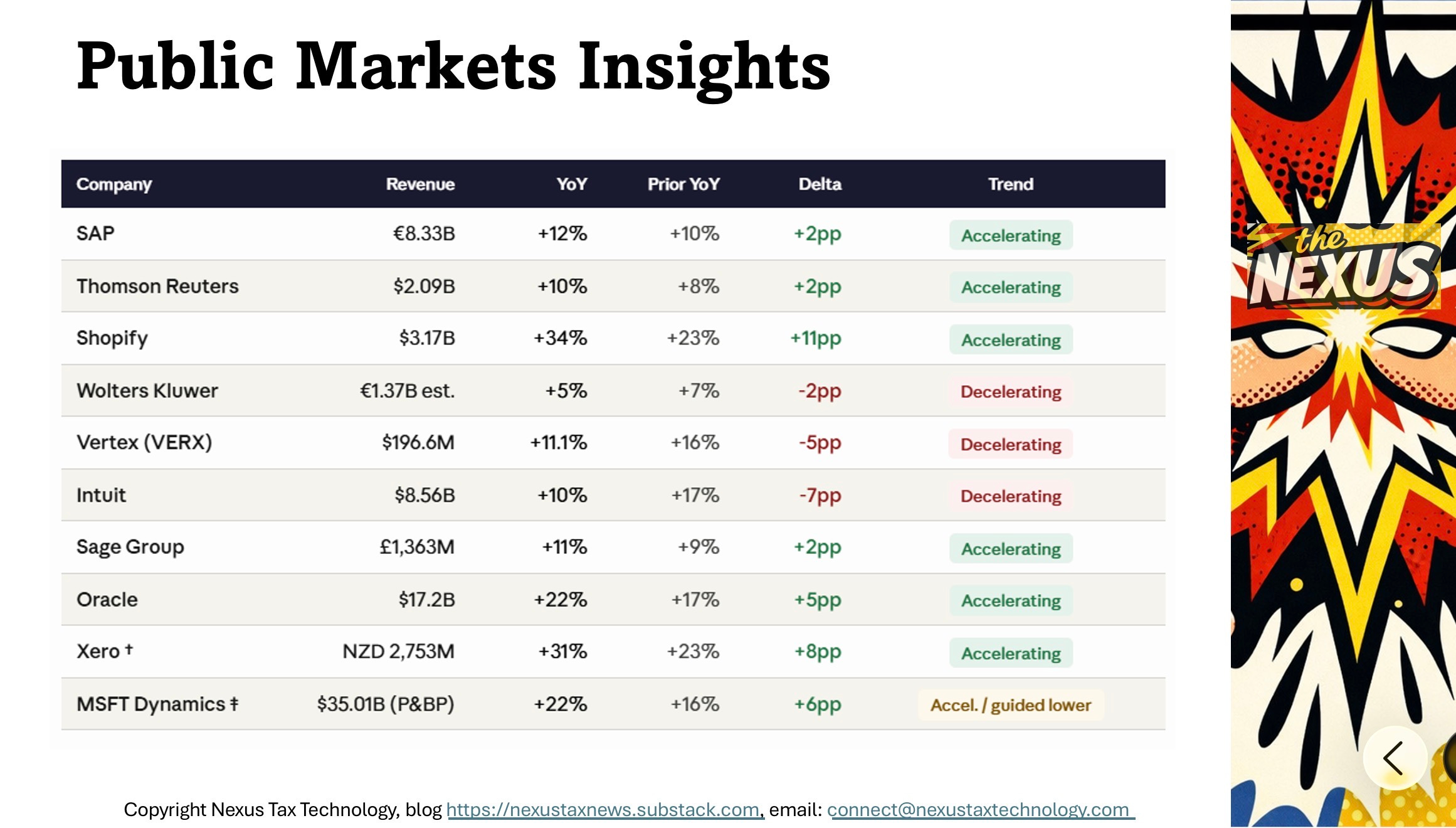
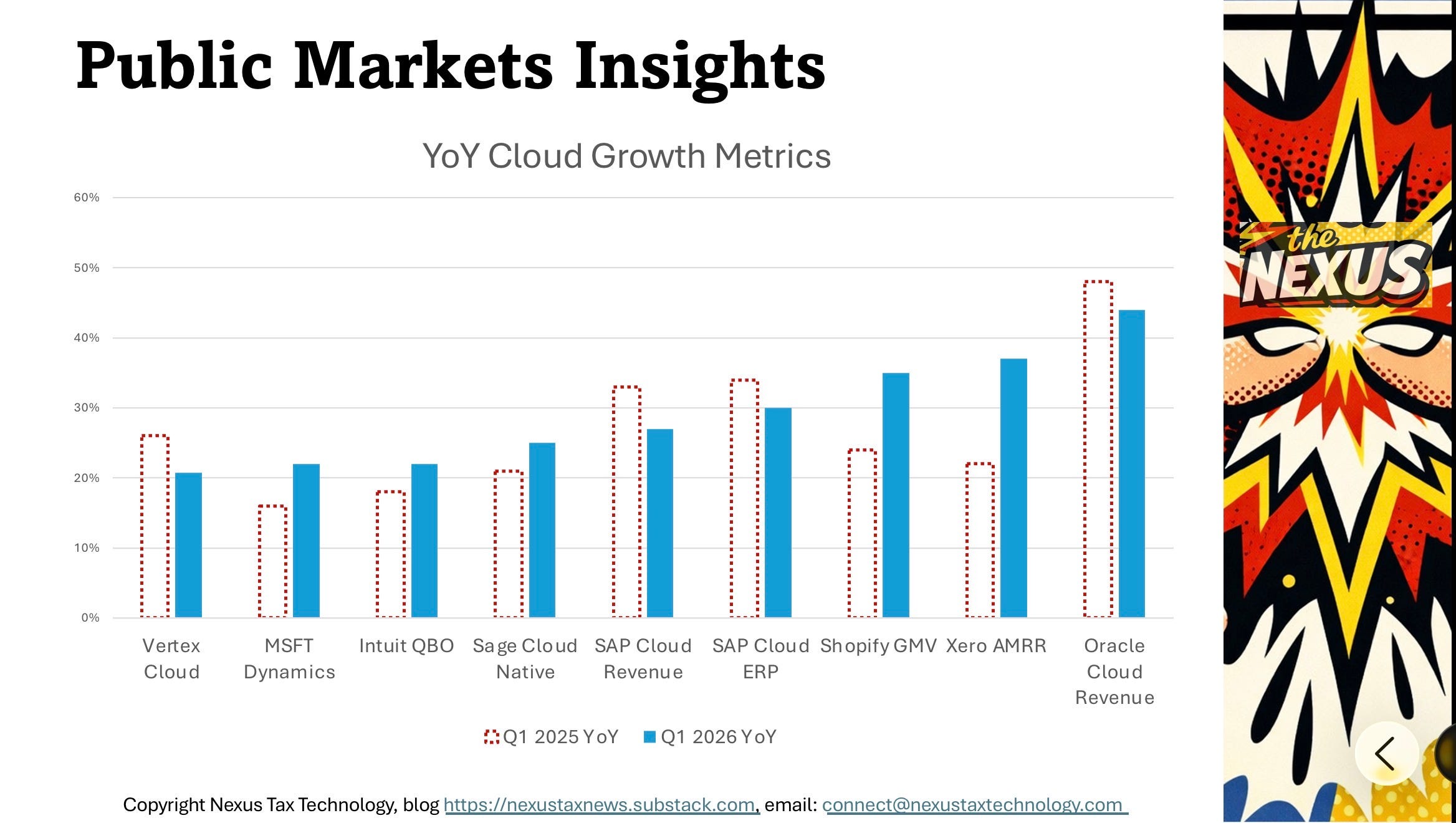
At the platform layer — the ERP and commerce giants that are the structural demand engine for everything downstream — momentum is building. Oracle grew cloud revenue 44%. Shopify crossed $100 billion in a single quarter of merchant GMV. Microsoft Dynamics 365 hit its fastest growth pace in four quarters at +22%. SAP’s cloud backlog sits at €21.9 billion and growing. These are not software companies having a good quarter. They are infrastructure companies confirming that the enterprise cloud migration cycle is in full swing, with years left to run.
At the specialist layer — the tax-focused vendors sitting downstream of those platforms — the picture is more nuanced. Some are accelerating. One is flashing amber. And the most consequential number in the whole report isn’t a growth rate: it’s an NRR compression from 109 to 105 at the only pure-play listed indirect tax vendor. That compression tells you something about where expansion revenue is going.
The ERP Machine
Start with Oracle, because the Oracle story is unlike anything else in enterprise software right now.
Total revenue of $17.2 billion, up 22%. Cloud at $8.9 billion, up 44%. Striking numbers. But the figure that matters for the tax technology market is the Remaining Performance Obligation: $553 billion — up 325% from $130 billion a year ago.
RPO is committed future spend. Signed contracts not yet billed. $553 billion in committed multi-year enterprise cloud spend means Oracle is staring at a decade-long implementation pipeline — and every Fusion ERP and NetSuite go-live inside that pipeline is a procurement trigger for the compliance layer. Tax engine evaluation. E-invoicing certification. Jurisdiction coverage review. Every single one.
SAP tells a similar story. The cloud backlog — €21.9 billion, growing 25% constant currency — is the S/4HANA migration queue made visible. Every organisation in that backlog will, at some point in the next 36 months, need to certify their indirect tax configuration in a new ERP environment.
Microsoft Dynamics completes the picture at the mid-market. Dynamics 365 at +22% in the January–March quarter, with growth across Finance, Supply Chain, and Business Central, confirms the migration cycle is broad-based — not concentrated in the enterprise tier. It is happening across the full market.
For tax technology vendors with certified integrations across SAP, Oracle, and Dynamics, this is structural tailwind that doesn’t require marketing. The pipeline arrives by itself.
Commerce at Scale
Shopify’s quarter deserves its own paragraph.
$101 billion in merchant GMV — the first time a single commerce platform has cleared $100 billion in a calendar quarter outside the hyperscaler marketplace giants. Shop Pay processed $35 billion of that, up 59%. International Shop Pay GMV grew over 70%.
That volume is not abstract. It is hundreds of millions of transactions with indirect tax obligations across hundreds of jurisdictions. Every new Shopify merchant is a new taxable entity navigating economic nexus, VAT registration thresholds, and in many cases real-time reporting requirements.
Shopify’s January 2026 decision to lock tax override capabilities for French and Spanish merchants — enforcing NF525 and Verifactu compliance at the platform layer — is the most underreported signal of the quarter. The platform is beginning to absorb compliance at the point of transaction. That’s not just a product decision. It’s a statement about where the compliance layer is moving.
The Cloud Accounting Quartet
The accounting software segment in Q1 2026 is running four separate storylines simultaneously.
Sage is accelerating cleanly. Cloud-native revenue re-accelerated to 25% growth — reversing modest easing from the prior year — driven by Sage Intacct adoption and Copilot embedding. ARR at £2.7 billion and growing. Management raised full-year guidance. This is the clearest proof in the segment that AI product investment can convert directly into new-logo momentum rather than just cost reduction.
Xero — reporting its full fiscal year to March 2026 — grew revenue 31% overall and 21% organically. Net subscriber additions nearly doubled year-on-year to 750,000. The US is inflecting dramatically via the Melio B2B payments integration, adding 110,000 US customers in a single year. In the UK, where Xero has effectively captured the cloud-native SMB accounting segment, double-digit organic growth continues. For tax technology vendors with Xero integrations, the subscriber trajectory is a direct and accelerating demand signal.
Wolters Kluwer is the most consistent performer in this group — and that consistency is underrated. Organic growth of 5%, cloud software up 14% for the second consecutive comparable quarter. Steady, predictable, self-funding. But the more interesting signal is product: the CCH Axcess Advisor early adopter programme, active throughout Q1 2026 with 40-plus firms, is the most consequential new product in the accounting professional segment this period. Its framing — advisory opportunity identification embedded within compliance workflows — directly addresses the business model transition that accounting firms have been attempting manually for years. If it delivers at general availability, it accelerates the shift from compliance billing to advisory billing across the firm segment, with downstream implications for how much time firms spend on tax automation tooling.
Intuit is the complicated one. Revenue of $8.56 billion, up 10%. QuickBooks Online accounting growing at 22%. Those are solid numbers. But simultaneously: a 17% workforce cut, 3,000-plus employees, significant restructuring charges, and a sharp after-hours share decline. CEO Sasan Goodarzi’s framing — simplify operations to reinvest in AI, including integrations with OpenAI and Anthropic — is coherent. The market’s reaction reflects uncertainty about the gap between the cost of that transition and the revenue it will eventually generate. For accounting firms running on Intuit infrastructure, service continuity during the reset is worth monitoring.
Four vendors. Four growth profiles. Two pulling away, one compounding quietly, one restructuring toward a position it doesn’t yet fully occupy.
The Specialist Vendors
Thomson Reuters and Vertex are the two companies that tell the most about the specialist compliance market — and they tell different stories.
Thomson Reuters accelerated at the group level, growing revenue 10% with organic growth of 8%, up from 6% in the prior year. But the more important number is in the segment mix. Tax & Accounting Professionals grew 10% organic, Corporates grew 9% organic — both holding at the top of the range and both ahead of the prior year. The January 2026 launch of ONESOURCE Sales and Use Tax AI — reporting 65% reduction in routine reporting time and 75% reduction in audit exposure for early adopters — is the most commercially significant product launch in the accounting professional segment this period. It places AI directly into the highest-frequency, highest-friction compliance workflow for US accounting practices. Thomson Reuters is not just growing; it is demonstrating that AI investment translates into measurable workflow outcomes that buyers will pay for.
Vertex is the most important company in this report for understanding where the specialist compliance market is heading under pressure.
Revenue up 11.1%. Cloud up 20.7%. ARR up 11.2%. Positive numbers in isolation. Against the prior year — cloud at 29.6%, ARR at 17.9% — they represent real and visible deceleration. Net Revenue Retention compressed from 109 to 105. A 9% workforce reduction was announced in the same quarter.
This is not a crisis. The Brinta acquisition in LatAm is strategically sharp, the business remains profitable, and management held full-year revenue guidance while raising earnings guidance. But NRR compression is not a vanity metric. It is the most precise signal available about customer expansion behaviour — and the direction of travel is worth watching closely.
The question the Vertex results put on the table is structural: is the deceleration specific to Vertex, or is it a read-through to the broader indirect tax specialist segment across the 4 major SaaS vendors? One data point is not a trend but it raises a question the market should be asking — about where expansion revenue is going? Internal AI tool build out, platform native capability or the slew of new market entrants (my bet!)
What It Means for the Ecosystem
Reading the platform data through the lens of the broader ecosystem produces three clear conclusions.
For enterprise compliance vendors with certified ERP integrations: the demand pipeline is the strongest in at least five years, and it is non-discretionary. SAP’s backlog, Oracle’s RPO, and Dynamics’ growth are not marketing. They are forward orders.
For the specialist compliance vendors — the private players, the e-invoicing specialists, the digital-native API-first vendors serving the SaaS economy — the read-through from Shopify’s GMV, Xero’s subscriber adds, and the ERP migration wave is an expanding addressable market that requires no market share gains to benefit from. It simply requires being embedded in the right platforms.
For the consulting and implementation practices that convert all of this into running systems: this is a generational moment. An S/4HANA or Oracle Fusion implementation runs 18–36 months from contract to go-live. SAP’s current backlog is already generating billable work that will not complete until 2028. The Big 4 tax technology advisory practices and specialist boutiques are looking at a pipeline that is both large and structurally urgent and wondering can they address it?
The Landing Punch
The compliance layer is not a cost centre waiting to be automated away. It is infrastructure that grows in complexity every time a platform crosses a new transaction threshold and every time an ERP migration creates a procurement trigger.
Q1 2026 confirmed that both of those forces are accelerating simultaneously, across every market tier from enterprise ERP to SMB cloud accounting.
The question is not whether the market is growing. The question is who is positioned at the intersections where the demand is concentrating — and who is still competing in the segments that platforms are quietly absorbing.
The machine is running. The operators who understand where it is going next are the ones worth following.
This is not investment advice
Want the full 14 page analyst report?

A selection of of opportunities to connect in person and interact online over the next few weeks
June 2026
Peppol Conference Europe 2026 (Conference)
OpenPeppol | 16–17 June 2026 | Steigenberger Icon Wiltcher’s Hotel, Brussels, Belgium
OpenPeppol’s flagship annual European conference bringing together policymakers, Peppol Authorities, service providers, and global enterprises to discuss the future of interoperable digital trade, e-invoicing, and real-time compliance across the Peppol network.
Compliance Connect Europe 2026 (Conference)
Pagero / Thomson Reuters | 18 June 2026 | Bishopsgate, London, UK
A flagship single-day event where finance, tax, trade, and IT leaders come together to explore what’s next in global regulatory compliance and how to build always-on readiness. Distinguished speakers cover policy, AI & automation, and regulatory roll-out across key markets.
ITR Indirect Tax Forum 2026 (Conference)
International Tax Review | 23–24 June 2026 | Amsterdam, Netherlands
ITR’s flagship indirect tax conference bringing together senior in-house indirect tax professionals and industry experts for two days of curated discussion on VAT, e-invoicing, and digital transformation. Vertex and Fintua among sponsors.
KPMG Tax & Legal Tech Summit — Make It Happen (Conference)
KPMG | 25 June 2026 | SIX ConventionPoint, Zurich, Switzerland
The 2nd KPMG Tax & Legal Tech Summit convenes visionary leaders to shape the future of tax and legal technology. Attendees explore how generative AI, advanced analytics, and intelligent automation are being applied in real-world environments, with practical takeaways from peers and KPMG specialists.
The Future of Tax Is Tech-Savvy (Webinar)
insightsoftware / KPMG | 25 June 2026, 14:00 BST / 09:00 EST | Online
Featuring KPMG’s Global Tax Transformation Leader alongside insightsoftware, this webinar examines how the corporate tax role is being redefined by technology — and how the right platform choices make the difference between keeping up and leading.
AUGUST 2026
US International Tax Course 2026 (Course)
TEI — Tax Executives Institute | 3–7 August 2026 | TBC
TEI’s intensive week-long course for in-house tax professionals covering the full spectrum of US international tax — from Subpart F and GILTI through FDII, BEAT, and transfer pricing — with substantial CPE credit available.
*any organisers or events I’ve missed? please let me know.

A curated selection of blogs, white-papers and on demand content published by multiple organisartions across the landscape, organised into a themed learning path.
MONTH ONE · JUNE 2026
Landscape, AI Strategy & the New Shape of the Tax Tech Market
This month maps the terrain: where the tax technology market is in mid-2026, how AI has moved from experimentation to deployment, what the data tells us about how tax teams are actually investing, and what differentiated strategies look like across the full spectrum from enterprise platforms to AI-native SMB tools.
Week 1 · 1–5 June
The State of the Market: What the Data Actually Says
We open with two benchmark research pieces that together paint the most accurate picture available of where corporate tax technology investment, adoption, and sentiment stands in mid-2026 — the Thomson Reuters Institute’s 2026 Corporate Tax Technology Report (built on 170 US tax decision-makers surveyed Nov–Dec 2025, in partnership with TEI) and Vertex’s Indirect Tax Trends report, which covers the regulatory and policy shifts driving the spending. KPMG’s freshly published connected modelling framework provides the advisory firm’s strategic synthesis.
01 📖 6 Insights from the 2026 Corporate Tax Technology Report Thomson Reuters Institute / TEI 10–12 min
02 📖 2026 Indirect Tax Trends Vertex Inc. 8–10 min
03 📖 The Future of Tax: Connected Modeling and an AI-Enabled Tax Function KPMG 8–10 min
Week total: 3 articles · ~26–32 min
Week 2 · 8–12 June
AI in Practice: From Bolt-On Tools to Agentic Workflows
A deliberately varied week — Wolters Kluwer on the organisational transformation challenges of AI adoption (not just the technology), Thomson Reuters on how indirect tax teams are building agility into their function, and Sphere’s independent overview of the AI tools landscape for tax professionals. Together these avoid the vendor echo chamber and give a rounded view of where AI is genuinely landing versus where it is still aspirational.
04 📖 Survive or Thrive? 2026 Will Test Tax Teams’ Limits Wolters Kluwer / CCH 6–8 min
05 📖 Indirect Tax Transformation: Navigating Change, Embracing Technology Thomson Reuters 10–12 min
07 📖 AI Tools for Tax Professionals: Automate Smarter, Not Harder Sphere 10–12 min
Week total: 3 articles · ~26–32 min
Week 3 · 15–19 June
The New Vendor Landscape: Enterprise to AI-Native, and Everything Between
This is the week where the expanded vendor universe comes into focus. Kintsugi’s 2026 SaaS guide is an unusually candid market map — covering the full spectrum from Avalara and Vertex at the enterprise end through to Anrok, Numeral, and Kintsugi itself for SMBs and SaaS companies, with honest commentary on where each fits and fails. Fonoa’s tech stack strategy piece provides the architectural counterpoint: how do you build a coherent compliance infrastructure rather than accumulating point solutions? The webinar from Wolters Kluwer closes the week with a live practitioner lens on the transformation challenge.
06📖Best Sales Tax Software for SaaS Companies: 2026 Guide Kintsugi 12–15 min
10📖Tax Tech Strategy: Integrate Technology for Compliance Fonoa 10–12 min
09🎥Beyond the Return: How AI and Automation Are Reshaping Tax Preparation Wolters Kluwer / CCH 50–60 min
Week total: 2 articles + 1 webinar · ~72–87 min
Week 4 · 22–26 June
The Strategic Lens: From Compliance Tool to Business Partner
Month One closes with two pieces that zoom out to the strategic and organisational challenge — Wolters Kluwer on the shift from compliance to advisory services, and Fonoa’s SYNAPSE 2026 practitioner takeaways on what the tax function looks like when real-time compliance is the baseline. The Vertex / Kintsugi investment announcement is included as a signal piece: what does it mean when the largest indirect tax enterprise vendor makes a strategic bet on an AI-native SMB platform?
08📖Beyond Compliance: How Tax Professionals Are Becoming Strategic Advisors Wolters Kluwer / CCH 8–10 min
11📖5 Key Indirect Tax Trends from SYNAPSE 2026 Fonoa 10–12 min
36📖Vertex Announces Strategic Investment in Kintsugi: What It Means for the Market Vertex / Kintsugi 6–8 min
Week total: 3 articles · ~24–30 min
June total: 9 articles + 1 webinar · ~148–181 min
*any cool content I’ve missed? please let me know.

A selection of open roles across tax tech vendors and tax advisory/consulting businesses who are involved in tax technology.
Use the column headers to sort, or the (new) search function and don’t forget to navigate all pages!
*I do this using an AI agent and due to the volume, I don’t check every link, so please let me know if any of these don’t work or have disappeared when you follow them.
✌ Last thoughts
Thanks again for reading! If you have any feedback, suggestions, want to contribute, share gossip or would like to work together in any way, email me here or hit the button below!